Support our educational content for free when you purchase through links on our site. Learn more
7 AI Benchmarks to Measure ML ROI (2026) 🚀

Is your machine learning initiative a profit engine or a cost black hole? We’ve seen too many organizations celebrate a 9% model accuracy score, only to watch their cloud bills skyrocket while customer satisfaction plummets. The hard truth is that technical perfection means nothing without business value. In this deep dive, we dissect exactly how organizations can use AI benchmarks to measure the return on investment of their machine learning initiatives, moving beyond vanity metrics to uncover the 7 essential KPIs that actually drive the bottom line. From cost-per-inference to employee augmentation gains, we’ll reveal the hidden data points that separate the winners from the washouts—and show you how to calculate the true financial impact of your AI stack before you spend another dollar.
Key Takeaways
- Align Technical & Business Metrics: True ROI requires bridging the gap between model accuracy and revenue impact; a high F1-score is useless if it increases latency or operational costs.
- Adopt a Multi-Dimensional Framework: Measure success across 7 core pillars, including infrastructure savings, operational velocity, risk mitigation, and customer retention lift.
- Establish a Baseline: You cannot prove value without a control group; compare AI-driven workflows against legacy processes to isolate the true financial impact.
- Prioritize Human Adoption: The most sophisticated algorithm fails if user adoption is low; track employee productivity and skill gap reduction as critical success factors.
- Future-Proof Your Strategy: As Generative AI and Agentic Workflows evolve, shift your benchmarks from simple accuracy to reasoning capability and autonomous execution.
Table of Contents
- ⚡️ Quick Tips and Facts
- 🕰️ The Evolution of ML Metrics: From Hype to Hard ROI
- 🎯 Defining the North Star: Aligning AI Benchmarks with Business KPIs
- 📊 The Core Framework: 7 Essential AI Benchmarks for Measuring ROI
- 1. Cost Efficiency and Infrastructure Savings
- 2. Operational Velocity and Time-to-Value
- 3. Revenue Attribution and Upsell Potential
- 4. Customer Experience and Retention Lift
- 5. Risk Mitigation and Compliance Savings
- 6. Employee Productivity and Augmentation Gains
- 7. Model Accuracy vs. Business Impact Corelation
- 🛠️ Top AI Benchmarking Tools and Platforms for Enterprise Measurement
- 🧩 Deconstructing the Ecosystem: Integrating Benchmarks into Your Data Stack
- 🚀 Strategic Implementation: How to Deploy AI Measurement Without Breaking the Bank
- 🧠 Beyond the Algorithm: The Human Element in AI ROI Assessment
- 📈 Future-Proofing: Adapting Benchmarks for Generative AI and Agentic Workflows
- 💡 Common Pitfalls: Why Your AI ROI Calculations Might Be Wrong
- 🏆 Case Studies: Real-World Success Stories in AI Value Realization
- 🎓 Conclusion
- 🔗 Recommended Links
- ❓ FAQ
- 📚 Reference Links
⚡️ Quick Tips and Facts
Before we dive into the deep neural networks of ROI, let’s get your baseline established. If you are struggling to prove that your Machine Learning (ML) budget isn’t just a “black hole” of GPU costs, these nuggets of wisdom are for you.
- ✅ The Golden Rule: You cannot manage what you do not measure. If you aren’t tracking system latency alongside model accuracy, you’re only seeing half the picture.
- ✅ Tangible vs. Intang/Intangible: ROI isn’t just about dollars saved; it’s about employee morale, customer satisfaction (CSAT), and skill application.
- ✅ The “Control Group” Secret: To truly isolate AI impact, compare a team using AI Agents against a team using legacy workflows. 🧪
- ❌ The Accuracy Trap: Never assume a 9% F1-score equals 9% business value. A highly accurate model that takes 30 seconds to respond might actually destroy your customer experience.
- 📊 The 48% Stat: Did you know that 48% of companies are planning to increase their spending on employee training this year? This makes the integration of AI-powered learning analytics more critical than ever.
🕰️ The Evolution of ML Metrics: From Hype to Hard ROI
We remember the “Wild West” era of AI. Back then, if your model could generate a coherent sentence about a cat, everyone threw a party. 🥳 There was no talk of latency, token throughput, or cost-per-inference. It was all about the “wow” factor.
However, as we transitioned from experimental labs to enterprise-grade AI Business Applications, the conversation shifted. We moved from Model Quality KPIs (Can it do the task?) to Business Value KPIs (Does it make us money?).
The industry has undergone a massive paradigm shift:
- The Era of Accuracy: Focus on Precision, Recall, and F1-score.
- The Era of Efficiency: Focus on GPU/TPU utilization and inference latency.
- The Era of Outcome: Focus on churn reduction, revenue per visit, and operational velocity.
At ChatBench.org™, we’ve seen firsthand that the most successful organizations are those that understand what role AI benchmarks play in measuring the effectiveness of machine learning algorithms by linking technical precision to the bottom line. But here is a question that keeps many CTOs awake at night: If your model’s accuracy goes up, but your cloud computing costs triple, is that actually a “win”? 🌙
🎯 Defining the North Star: Aligning AI Benchmarks with Business KPIs
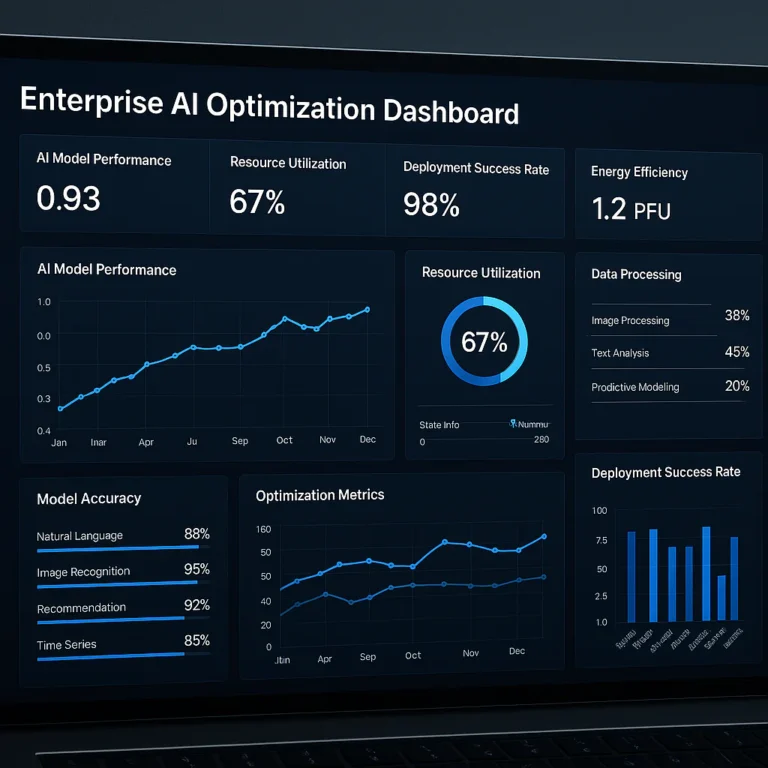
To measure ROI, you need a “North Star.” You cannot simply point to a dashboard of loss curves and tell the CFO, “Look, the error rate is dropping!” They want to see dollars, cents, and cents-per-transaction.
The Alignment Hierarchy
| Level | Focus Area | Key Metrics | Stakeholder |
|---|---|---|---|
| Technical | Model Performance | Accuracy, F1-Score, Perplexity, Groundedness | Data Scientists |
| Operational | System Health | Latency, Uptime, Error Rate, Throughput | DevOps / ML Engineers |
| User/Adoption | Human Interaction | Adoption Rate, Query Length, Thumbs Up/Down | Product Managers |
| Business | Financial Impact | Cost Savings, Revenue Lift, Churn Reduction | CFO / Executives |
The Strategy of Integration:
To achieve true ROI, you must bridge these layers. For example, if you are deploying AI Agents for customer support, a “win” isn’t just a high accuracy score; it’s a high call containment rate (the % of inquiries resolved without a human) coupled with a stable CSAT score.
📊 The Core Framework: 7 Essential AI Benchmarks for Measuring ROI
How do you actually structure your measurement? We recommend a multi-dimensional approach. Don’t just look at one metric; look at the interplay between them.
1. Cost Efficiency and Infrastructure Savings
This is the “low-hanging fruit” of ROI. Are you optimizing your AI Infrastructure?
- Metric: Cost per Inference vs. Legacy Process Cost.
- Goal: Reducing GPU/TPU accelerator utilization waste and optimizing token throughput.
2. Operational Velocity and Time-to-Value
How fast can you move from a trained model to a deployed feature?
- Metric: Model time to deployment.
- Goal: Reducing the bottleneck in your MLOps pipeline.
3. Revenue Attribution and Upsell Potential
Can your recommendation engine drive more sales?
- Metric: Click-Through Rate (CTR) and Revenue per Visit (RPV).
- Goal: Proving that AI-driven personalization directly increases the basket size.
4. Customer Experience and Retention Lift
AI should make life easier, not more frustrating.
- Metric: Customer Churn Rate and Average Handle Time (AHT).
- Goal: Using Natural Language Processing (NLP) to resolve queries instantly, preventing users from leaving.
5. Risk Mitigation and Compliance Savings
In the age of Generative AI, safety is a financial metric.
- Metric: Safety/Harmfulness Score and Hallucination Rate.
- Goal: Avoiding the massive legal and brand-reputation costs associated with “ungrounded” AI outputs.
6. Employee Productivity and Augmentation Gains
This is where AI for L&D shines.
- Metric: Time Saved per Task and Skill Gap Reduction.
- Goal: Quantifying how much “human time” is reclaimed through intelligent document processing.
7. Model Accuracy vs. Business Impact Correlation
The most advanced benchmark.
- Metric: Correlation Coefficient between Model Precision and Business KPI (e.g., Sales).
- Goal: Proving that a 1% increase in model precision leads to a $X increase in revenue.
🛠️ Top AI Benchmarking Tools and Platforms for Enterprise Measurement
Measuring ROI requires a robust “observability stack.” You can’t rely on manual spreadsheets. You need automated, real-time monitoring.
| Tool Category | Real-World Examples | Best For… |
|---|---|---|
| ML Observability | Arize AI, WhyLabs | Detecting data drift and model decay. |
| LLM Evaluation | LangSmith, Weights & Biases | Measuring groundedness, latency, and traceability. |
| Infrastructure Monitoring | Prometheus, Grafana | Tracking GPU utilization and request throughput. |
| Cloud Managed Services | Google Gemini, AWS SageMaker | High-level, managed-service performance tracking. |
Pro-Tip from the Lab: When evaluating tools, always look for “Auto-raters.” Using an LLM as a judge (Model-Based Evaluation) can significantly speed up your pairwise metrics analysis, though we always recommend calibrating them with human feedback to avoid “echo chamber” errors. 🤖
👉 Shop for AI Infrastructure on:
- Compute Power: RunPod | Paperspace | DigitalOcean
- Cloud AI Services: Google Cloud | Amazon Web Services
🧩 Deconstructing the Ecosystem: Integrating Benchmarks into Your Data Stack
Integrating these benchmarks isn’t a “plug-and-play” affair. It requires a deep connection between your Data Warehouse (like Snowflake or BigQuery) and your MLOps pipeline.
The Step-by-Step Integration Flow:
- Data Ingestion: Capture raw logs from your AI Agents (queries, latency, tokens).
- Feature Extraction: Use NLP to extract sentiment or “thumbs up/down” from unstructured user feedback.
- Aggregation: Roll up technical metrics (latency) into business metrics (cost per user).
- Visualization: Push this data into a dashboard (Tableau/Looker) that the CFO can actually understand.
We once worked with a client who had incredible model accuracy but zero visibility into inference costs. They were essentially flying a jet without a fuel gauge. By implementing a unified observability layer, we helped them identify that 40% of their spend was going toward redundant, high-latency queries. 📉
🚀 Strategic Implementation: How to Deploy AI Measurement Without Breaking the Bank
Don’t try to measure everything at once. You’ll drown in data. Instead, follow our Phased Deployment Strategy:
- Phase 1: The Pilot (The “Small Wins” Phase): Pick one high-impact use case, like Intelligent Document Processing. Define your KPIs (e.g., processing time) before you even start.
- Phase 2: The Baseline: Run your legacy process and your AI process in parallel. This is your Control Group.
- Phase 3: The Expansion: Once you prove ROI in one department, use those metrics to secure budget for the next.
Remember the advice from this featured video: To truly calculate ROI, you must define your desired outputs (productivity, time, etc.) in advance. If you wait until after the deployment to decide what “good” looks like, you’ve already lost the battle. 🎥
🧠 Beyond the Algorithm: The Human Element in AI ROI Assessment
Here is the part most engineers forget: The human element is the hardest to measure, but the most important.
As noted in the SweetRush analysis, “Intangible learning metrics are the most difficult to measure, but they are also the most important ones.”
When you implement AI, you aren’t just changing code; you are changing human behavior.
- Are employees using the tool? (Adoption Rate)
- Are they trusting the tool? (Sentiment Analysis)
- Are they learning from the tool? (Skill Gap Prediction)
If your AI-powered personalized learning platform has a 9% accuracy rate but your employees find the interface “annoying,” your ROI will be negative due to low adoption. ❌
But wait… if the human element is so unpredictable, how can we ever truly trust our automated benchmarks? We’ll dive into the “Pitfalls” and “Future Trends” in the next sections to reveal the truth. 🔍
🎓 Conclusion

We started this journey with a burning question: If your model’s accuracy goes up, but your cloud computing costs triple, is that actually a “win”? The answer, as we’ve dissected through the lens of ChatBench.org™‘s engineering experience, is a resounding no.
True AI ROI is not a single number; it is a symphony of technical precision, operational efficiency, and human adoption. You cannot simply point to a high F1-score and claim victory if the inference latency is driving customers away or if the cost-per-inference is eating your entire profit margin.
The Verdict: A Confident Recommendation
For organizations ready to move beyond the hype, our recommendation is clear: Adopt a Holistic Measurement Framework immediately.
- ✅ Do: Integrate Model Quality, System Performance, and Business Value KPIs into a single dashboard.
- ✅ Do: Establish a Control Group to isolate the true impact of your AI Agents and Generative AI initiatives.
- ✅ Do: Prioritize Human-in-the-Loop feedback to calibrate your Auto-raters and ensure your metrics reflect reality, not just algorithmic confidence.
- ❌ Don’t: Rely solely on technical metrics like accuracy or perplexity without translating them into dollars saved or revenue generated.
- ❌ Don’t: Ignore the adoption rate. The most sophisticated model in the world is worthless if your employees refuse to use it.
The future of Strategic Measurement lies in causal inference—proving that because we deployed this AI, therefore our churn rate dropped by 5%. As we look toward Agentic Workflows, the metrics will evolve from “how fast can it answer?” to “how well can it reason and execute?” But the core principle remains: Measure what matters, not just what is easy to count.
🔗 Recommended Links
Ready to build your measurement stack? Here are the essential tools, platforms, and resources we trust to turn AI Insight into Competitive Edge.
🛒 Top AI Infrastructure & Monitoring Platforms
- Arize AI: Search on Amazon | Arize Official Website
- LangSmith: Search on Amazon | LangSmith Official Website
- Google Cloud Vertex AI: Search on Amazon | Google Cloud Official Website
- RunPod: Search on Amazon | RunPod Official Website
- Paperspace: Search on Amazon | Paperspace Official Website
📚 Essential Reading for AI Leaders
- “Competing in the Age of AI” by Marco Iansiti and Karim R. Lakhani: Buy on Amazon
- “The AI-Powered Enterprise” by Thomas H. Davenport: Buy on Amazon
- “Human Compatible: Artificial Intelligence and the Problem of Control” by Stuart Russell: Buy on Amazon
❓ FAQ

What role do performance benchmarks play in justifying AI budget allocations?
Performance benchmarks serve as the objective evidence required to secure funding. They transform subjective “hunches” about AI potential into quantifiable data regarding cost efficiency, speed, and accuracy. By demonstrating that a specific model outperforms legacy systems in token throughput or latency, leaders can justify the significant infrastructure costs associated with GPU/TPU deployment.
Which KPIs best demonstrate the competitive advantage of AI investments?
The most compelling KPIs are those that directly link to revenue and customer retention.
- Revenue per Visit (RPV): Shows direct monetization of AI recommendations.
- Customer Churn Rate: Demonstrates AI’s ability to retain users through superior service.
- Time-to-Value: Measures how quickly AI can solve a problem compared to human teams.
- Adoption Rate: Indicates market fit and user trust.
Read more about “12 Essential Key Performance Indicators for AI Success in 2026 🚀”
How do organizations track the financial impact of machine learning projects?
Organizations track financial impact by establishing a baseline (pre-AI performance) and comparing it against post-deployment metrics. This involves calculating:
- Cost Savings: (Legacy Cost – AI Cost) × Volume.
- Revenue Uplift: (AI-Driven Revenue – Baseline Revenue).
- Productivity Gains: (Hours Saved × Hourly Wage Rate).
Tools like Arize AI and Google Cloud Vertex AI help automate this tracking by correlating model logs with business transaction data.
Read more about “🚀 AI Evaluation Metrics: The 2026 Blueprint for Winning Solutions”
What are the most effective AI benchmarks for measuring ML ROI?
The most effective benchmarks are multi-dimensional:
- Technical: F1-Score, Groundedness, Hallucination Rate.
- Operational: Inference Latency, Error Rate, GPU Utilization.
- Business: Call Containment Rate, Conversion Rate, Employee Productivity.
Relying on just one category leads to a skewed view of ROI.
Read more about “🏆 7 AI Benchmarks to Crush the Competition (2026)”
Can AI benchmarks help predict the long-term profitability of machine learning projects?
Yes, but with caveats. Benchmarks like Model Drift detection and Adoption Trends can predict sustainability. If a model’s accuracy degrades rapidly or user engagement drops, it signals a future loss of profitability. However, long-term prediction also requires scenario planning for market changes that benchmarks alone cannot foresee.
Which metrics should organizations track to validate AI investment returns?
To validate returns, track:
- ROI Ratio: (Net Profit / Cost of Investment).
- Payback Period: Time to recoup infrastructure costs.
- Customer Satisfaction (CSAT): Qualitative validation of AI performance.
- Operational Efficiency: Reduction in manual hours or processing time.
How do you calculate the financial impact of AI models using performance benchmarks?
The formula generally follows:
Financial Impact = (Baseline Performance - AI Performance) × Volume × Unit Value
For example, if AI reduces Average Handle Time (AHT) by 2 minutes per call, and you handle 10,0 calls a month, the savings are:
2 mins × 10,0 calls × ($/min cost of agent) = Total Savings.
This must be offset by API costs and maintenance fees.
What are the best AI benchmarks for measuring ROI in enterprise machine learning?
For enterprise, the best benchmarks are Business Value KPIs aligned with Strategic Goals.
- Risk Mitigation: Reduction in compliance violations or fraud losses.
- Inovation: Number of new products/services launched using AI.
- Scalability: Ability to handle 10x traffic without linear cost increases.
Read more about “Measuring ROI in Machine Learning Initiatives: 10 Proven Metrics for 2025 🚀”
How can benchmarking AI performance improve competitive advantage?
Benchmarking reveals inefficiencies in your current stack, allowing you to optimize cost-per-inference and latency faster than competitors. It also ensures your AI Agents are more reliable and accurate, leading to better customer experiences and higher brand loyalty.
Read more about “🚀 7 AI Benchmarking Strategies for Business Dominance (2026)”
What metrics define successful machine learning initiatives in business?
Success is defined by sustainable adoption and measurable business outcomes.
- High Adoption Rate: >80% of target users actively using the tool.
- Positive ROI: Net financial gain within 6-12 months.
- Stable Performance: No significant data drift or model decay over time.
- User Trust: High thumbs-up ratios and low complaint rates.
Read more about “15 Must-Know AI Performance Metrics to Master in 2026 🚀”
How do AI benchmarks help in optimizing machine learning project outcomes?
Benchmarks act as a feedback loop. By continuously monitoring latency, error rates, and user feedback, teams can identify bottlenecks (e.g., a slow retrieval step in RAG) and optimize them. This iterative process ensures the model evolves with changing data and business needs.
Read more about “Mastering LLM-as-a-Judge Evaluation Methodology in 2026 🚀”
What are the key AI benchmarks organizations should track for ROI measurement?
- Cost Efficiency: Cost per Inference.
- Speed: Time to First Token, Total Latency.
- Quality: Groundedness, Instruction Following.
- Impact: Revenue Lift, Churn Reduction, Productivity Gains.
Read more about “Measuring AI Model Accuracy and Efficiency: 12 Essential Metrics for 2026 🚀”
📚 Reference Links
- SweetRush: Measuring Learning ROI with AI: Key Insights and Benchmarks – Insights on outcome-oriented measurement and behavioral change.
- Google Cloud: Measuring Gen AI ROI: Key Benchmarks and KPIs – Deep dive into model quality, system quality, and business operational KPIs.
- MIT Sloan Management Review: The Future of Strategic Measurement: Enhancing KPIs With AI – Strategic perspectives on evolving KPIs in the AI era.
- Arize AI: ML Observability Best Practices – Resources on detecting data drift and model decay.
- LangChain: LangSmith Evaluation Guide – Documentation on LM evaluation and tracing.
- NIST: AI Risk Management Framework (AI RMF) – Guidelines for trustworthy AI measurement and safety.