Support our educational content for free when you purchase through links on our site. Learn more
12 AI Model Testing and Validation Techniques 🧪


The strongest AI model testing and validation techniques combine representative test data, task-appropriate metrics, fairness and security checks, and ongoing production monitoring. A high accuracy score alone can’t tell you whether a model is reliable, safe, or ready for the real users who will depend on it.
We’ve seen promising models stumble over surprisingly ordinary details: a new camera, a changed data field, or a test set that accidentally leaked into training. The lesson? Test the whole system, not just the algorithm—and make sure your checks reflect what can go wrong in practice.
That discipline matters as AI systems spread into consequential workflows. Stanford HAI recorded 233 reported AI-related incidents in 2024, up 56.4% from 2023; incident counts don’t measure every failure, but they make a good case for testing before and after launch. (Stanford HAI AI Index Report 2025)
Key Takeaways
- Use multiple validation techniques. Combine holdout testing, cross-validation, error analysis, robustness checks, and expert review.
- Choose metrics for the task and its risks. Accuracy can conceal missed cases, especially when classes are imbalanced.
- Test data, fairness, privacy, and security—not just model performance. A model can score well and still fail users or expose sensitive information.
- Validate the complete AI system. Include APIs, prompts, data pipelines, retrieval tools, and human workflows.
- Keep testing after deployment. Monitor drift and outcomes, define alert owners, and revalidate meaningful changes.
- Treat documentation as evidence. Record the model version, evaluation data, thresholds, limitations, approvals, and rollback plan.
Table of Contents
- ⚡ Quick Tips and Facts: AI Model Testing at a Glance
- 🧭 How AI Model Testing and Validation Have Evolved
- 🔍 What AI Model Validation Means—and Why It Matters
- Model testing vs. validation vs. verification
- Why validation matters to business leaders
- The AI model lifecycle: where testing fits
- 🧪 A Practical Framework for Testing AI Models
- Define intended use, users, and risk level
- Set acceptance criteria and measurable thresholds
- Build representative test datasets
- Choose manual, automated, and human-in-the-loop testing
- 📊 12 Essential AI Model Testing and Validation Techniques
- 1. Holdout testing and train-test splits
- 2. K-fold cross-validation and stratified sampling
- 3. Performance metrics and threshold testing
- 4. Baseline and benchmark comparisons
- 5. Error analysis and confusion-matrix review
- 6. Robustness and stress testing
- 7. Bias, fairness, and subgroup testing
- 8. Explainability and interpretability checks
- 9. Data leakage and overfitting detection
- 10. Adversarial, privacy, and security testing
- 11. Calibration and uncertainty estimation
- 12. Human evaluation and domain-expert review
- ✅ AI Validation Checklist: Accuracy, Reliability, and Safety
- Check data quality, lineage, and representativeness
- Test for bias across groups and use cases
- Review predictions, decisions, and failure cases
- Assess security, privacy, and access controls
- Verify governance, documentation, and auditability
- Test integrations with APIs and third-party tools
- 📈 Metrics for AI Model Performance and Reliability
- Classification, regression, ranking, and clustering metrics
- Generative AI and large language model evaluation
- Selecting metrics that match business outcomes
- 🗂️ Data Quality Management for AI and Machine Learning
- Data quality dimensions and validation rules
- Label quality, data drift, and dataset shift
- Synthetic data: benefits, risks, and testing
- 🛡️ Bias, Fairness, Explainability, and Responsible AI
- Fairness metrics and subgroup analysis
- Explainable AI methods and their limitations
- Responsible AI standards and risk management
- 🔐 Security, Privacy, and Adversarial Testing
- Threat modeling and attack-surface review
- Prompt injection and jailbreak testing for LMs
- Privacy leakage, access control, and data protection
- 🚀 Validating AI Models Before Deployment
- Pre-production gates and release criteria
- Shadow, canary, and A/B testing
- Integration, load, latency, and scalability testing
- 🔄 Continuous AI Testing, Monitoring, and Model Drift
- Production monitoring and alert thresholds
- Detecting data drift, concept drift, and performance decay
- Retraining, rollback, and incident response
- 🧰 AI Testing Tools, Platforms, and Frameworks
- Open-source model evaluation tools
- Cloud and enterprise ML testing platforms
- Choosing a testing partner or specialist
- ⚠️ Common AI Model Testing Challenges—and How to Solve Them
- 🧑 💻 Building an AI Model Validation Team and Workflow
- 📝 AI Testing Documentation, Governance, and Audit Trails
- 🧭 Before You Leave: Pinpoint the Biggest Gaps in Your AI Testing
- 🏁 Conclusion
- 🔗 Recommended Links
- ❓ FAQ
- What is AI model validation, and why is it important?
- What are the most common AI model testing challenges?
- How does testing improve AI model accuracy?
- Why is data quality essential for AI validation?
- How does data quality management improve model performance and reliability?
- How often should an AI model be tested and revalidated?
- Can AI models be fully tested before deployment?
- Which metrics should teams use to validate an AI model?
- 📚 Reference Links
⚡ Quick Tips and Facts: AI Model Testing at a Glance
AI model testing and validation is not one final exam before launch. It is a repeatable process for checking whether a model is accurate enough, robust to change, fair across relevant groups, secure against misuse, and dependable in its real operating environment.
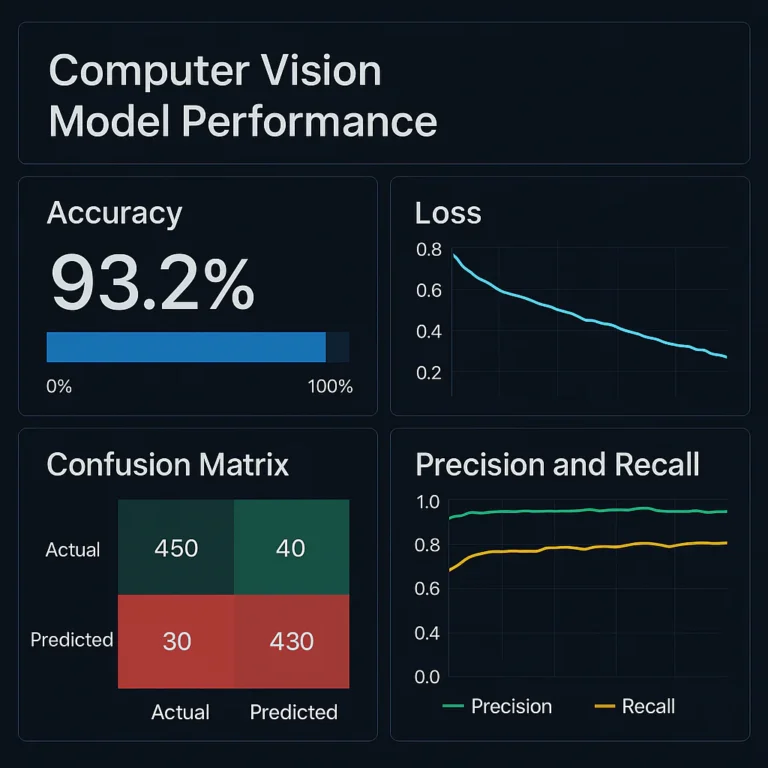
For a practical example of how evaluation differs across AI tasks, see our guide to computer vision benchmarks. A vision model’s score on a benchmark is useful—but it does not automatically prove that the system will work with your camera, users, lighting, and workflow. 🧪
| Quick fact | What it means for your team |
|---|---|
| A high training score is not proof of real-world performance | Test on data the model did not train on, then check performance after deployment. |
| Accuracy can hide serious failures | For imbalanced data, inspect precision, recall, F1, and subgroup results—not accuracy alone. |
| Cross-validation strengthens estimates | Use stratified folds for imbalanced classification and time-aware splits for time-dependent data. |
| Fairness is measurable, but context matters | Compare appropriate metrics across relevant groups, then investigate differences with domain experts. |
| Production data changes | Monitor for data drift, concept drift, and changes in business outcomes. |
| Generative AI needs task-specific evaluation | Test factuality, safety, prompt injection, consistency, and human usefulness—not just fluency. |
| Every model update can change risk | Rerun evaluations when data, code, prompts, retrieval sources, or downstream integrations change. |
| Keep evidence, not just dashboards | Record datasets, model versions, metrics, thresholds, approvals, and known limitations. |
Five quick wins before you ship
- ✅ Write down the model’s intended use. Name the users, decisions, context, and cases where it should not be used.
- ✅ Choose metrics based on the cost of errors. Missing a serious fraud case and falsely flaging a legitimate customer are different failures.
- ✅ Keep a genuinely untouched test set. Reusing it for repeated tuning turns it into another training signal.
- ✅ Test slices and edge cases. Overall performance can look fine while a small but important user group gets worse outcomes.
- ✅ Define what happens when checks fail. Specify who can pause a release, roll back a model, or route cases to a person.
One recurring trap: teams often ask, “How accurate is the model?” before asking, “Accurate at what, for whom, and at what cost?” That second question determines which tests are actually useful.
🧭 How AI Model Testing and Validation Have Evolved
Traditional software testing often checks whether a program returns the expected result for a defined input. Machine-learning systems add a wrinkle: their behavior depends on learned patterns in data, and their predictions may be probabilistic rather than fixed.
A model can pass a software integration test while still being wrong, biased, brittle, or out of date. Conversely, an occasional incorrect prediction does not automatically mean the model is unusable. The team needs to define acceptable behavior and test it against the intended use.
The NIST AI Risk Management Framework treats AI risk management as an ongoing activity, not a one-time sign-off. That fits what we see in engineering: the model is only one component. Data pipelines, prompts, APIs, user behavior, and business rules can all alter system outcomes.
From static test sets to lifecycle validation
| Earlier emphasis | Broader modern practice |
|---|---|
| Check a model against a fixed test set | Evaluate across datasets, groups, edge cases, and production conditions |
| Focus on offline accuracy | Include fairness, robustness, privacy, security, latency, and operational outcomes |
| Validate before launch | Revalidate after meaningful changes and monitor during use |
| Treat the model as the whole system | Test data pipelines, APIs, retrieval components, interfaces, and human workflows |
| Record a score | Preserve evidence, assumptions, limitations, versions, and approvals |
The stakes are visible incident reporting. The 2025 AI Index Report from Stanford HAI documents a rise in reported AI-related incidents to 233 in 2024, a 56.4% increase from 2023. Incident counts depend on reporting and definitions, so they are not a complete measure of risk. They are still a useful reminder that deployment failures are not merely theoretical.
TestingXperts puts the accountability point plainly: “You not just own the code, you also own the outcomes.” That is a vendor’s framing, but the engineering implication is sound: a model owner needs evidence about what the system does, not only proof that it runs.
Why model evaluation is harder than building a prototype
A prototype can look impressive on a handful of examples. Production asks tougher questions:
- Does it generalize to new data rather than memorize training examples?
- Does it perform adequately for different populations and operating conditions?
- Does it handle missing, malformed, or adversarial inputs?
- Are the results useful within the real workflow, including human review and system latency?
- Can the team detect failure and act before it causes lasting harm?
As the creator of the featured explainer puts it, “It’s very easy to build an AI model. It’s very difficult to validate that the model performs according to the specifications.” That is especially true when the specifications are vague. “Works well” is not a test criterion; a documented threshold tied to a use case is.
For more coverage of the systems around model deployment, explore ChatBench.org’s AI Infrastructure and AI News sections.
🔍 What AI Model Validation Means—and Why It Matters
AI model validation asks whether a trained model—and the system using it—is suitable for its intended purpose under realistic conditions. Validation goes beyond a leaderboard score. It considers generalization, reliability, fairness, security, interpretability, and operational fit.
In plain language: testing asks whether the implementation behaves as designed; validation asks whether the design and model are fit for the real problem. Teams need both.
Model testing vs. validation vs. verification
The terms overlap in everyday conversation, but distinguishing them helps teams define responsibilities.
| Activity | Main question | Example |
|---|---|---|
| Verification | Did we build the system according to its specifications? | Does the API return the expected schema and error codes? |
| Testing | How does the implementation behave under defined conditions? | Does a model meet its recall threshold on a held-out dataset? |
| Validation | Is this the right system for the intended use and context? | Does a triage model support safe decisions in the actual clinical workflow? |
| Monitoring | Is the deployed system continuing to behave acceptably? | Have input distributions, error rates, or business outcomes shifted? |
These are not competing definitions so much as different lenses. A correct implementation can still be a poor solution to the problem. And a well-validated model can later deteriorate when its environment changes.
Why validation matters to business leaders
For business leaders, model quality is not just a technical metric. It affects customer experience, operational costs, compliance obligations, reputation, and the ability to explain decisions.
A useful leadership review asks:
- What decision or task does the model influence?
- Who could be harmed by an error, and how severe could it be?
- What is the acceptable tradeoff between false positives and false negatives?
- Who owns monitoring and incident response after launch?
- Can the team explain which evidence supports release approval?
NIST’s AI RMF Playbook organizes practical risk-management actions around Govern, Map, Measure, and Manage. It is voluntary guidance, not a replacement for laws or sector-specific rules, but it offers a useful structure for connecting testing evidence to organizational decisions.
The AI model lifecycle: where testing fits
Testing should follow the model from idea to retirement. It is not a gate placed at the end of a pipeline.
| Lifecycle stage | Useful validation questions |
|---|---|
| Problem definition | Is machine learning appropriate? What does success mean, and what is out of scope? |
| Data collection | Are the data lawful, relevant, representative, and documented? |
| Training and experimentation | Is evaluation leakage-free? Are baselines and alternative models compared? |
| Pre-release | Does the complete system meet performance, safety, privacy, and operational criteria? |
| Deployment | Can the model be rolled back? Are logs, access controls, and alerts working? |
| Production | Has the data, target relationship, or business context changed? |
| Retirement or replacement | Are records retained, dependencies removed, and users informed where needed? |
A practical rule from our engineering reviews: every transition that can change model behavior should trigger an evaluation decision. That includes a new model version, but also a changed prompt, feature pipeline, retrieval index, data source, or third-party API.
🧪 A Practical Framework for Testing AI Models
The most reliable framework is risk-based. A model ranking songs does not need the same approval process as a model supporting medical diagnosis or credit decisions. But “low risk” is not “no testing”; it means proportionate testing with clear limits.
Define intended use, users, and risk level
Start with a short use-case specification:
- Purpose: What task does the model perform?
- Users: Who interacts with the output?
- Decision role: Does it recommend, rank, generate, approve, reject, or automate?
- Impact: What can happen if it is wrong?
- Operating conditions: What inputs, devices, languages, or regions are in scope?
- Limits: When should the model abstain or hand the case to a person?
Risk classification should be grounded in the application and applicable rules. The EU AI Act uses a risk-based regulatory approach, with specific duties for systems classed as high risk. Applicability depends on the system, provider or deployer role, and relevant provisions; teams should seek qualified legal guidance rather than infer obligations from a generic checklist.
Set acceptance criteria and measurable thresholds
Avoid acceptance criteria like “the model should be accurate.” Make them specific and reviewable.
Examples:
- Minimum recall for a high-priority event class
- Maximum tolerated error rate for a defined subgroup
- A confidence or abstention policy for uncertain cases
- Maximum response latency under expected load
- No release if critical safety tests fail
- Human review for specified high-impact decisions
Thresholds should reflect business costs, user impact, and uncertainty. A model that misses rare but serious cases may need a higher recall target. A system that creates burdensome false alarms may require a precision guardrail. There is no universally best threshold; choosing one is a product and risk decision informed by technical evidence.
Build representative test datasets
A test dataset should resemble the inputs the model will actually receive, while remaining separate from training and tuning data.
Check for:
- Coverage: Relevant populations, devices, geography, language, time periods, and operating environments
- Label quality: Clear annotation instructions, agreement checks, and expert adjudication for ambiguous cases
- Independence: No accidental reuse of training examples or near-duplicates
- Privacy: Appropriate collection, access, retention, and de-identification safeguards
- Versioning: A record of data sources, transformations, dates, and exclusions
If the deployed environment differs from the test set, the score may be technically correct and practically misleading. That gap is one reason teams should pair offline validation with carefully monitored real-world evaluation.
Choose manual, automated, and human-in-the-loop testing
Automation makes repeatable checks faster. People provide context, challenge assumptions, and identify failures no metric captures.
| Method | Strong for | Watch out for |
|---|---|---|
| Automated metric tests | Regression checks, repeatable benchmarks, CI/CD gates | Metrics can encode the wrong objective |
| Adversarial or fuzz testing | Edge cases, malformed inputs, robustness | Test coverage can never enumerate every attack |
| Domain-expert review | High-impact edge cases and domain correctness | Reviews can be costly and subject to inconsistent judgment |
| User studies | Usability, workflow fit, human reliance | Results may not generalize to every context |
| Production monitoring | Real-world shifts and operational issues | Labels may arrive late or be unavailable |
A useful principle: automate the repeatable; escalate the consequential. For example, a pipeline can block a release if a fairness slice drops below a threshold, while a domain expert reviews borderline clinical examples.
📊 12 Essential AI Model Testing and Validation Techniques
No single technique can establish that a model is “good.” A dependable validation plan combines methods suited to the data, task, risks, and deployment environment.
1. Holdout testing and train-test splits
Divide data into training, validation, and test sets:
- Training set: Used to fit model parameters.
- Validation set: Used to compare models and tune settings.
- Test set: Reserved for final, unbiased evaluation.
A common failure is repeatedly checking the test set and then changing the model based on the results. Once that happens, it is no longer an independent final test. Scikit-learn documents common cross-validation and model-evaluation approaches, including the need to avoid leakage between training and evaluation.
Use a simple holdout split when: the dataset is large enough, data points are independent, and the test data can represent the intended use.
2. K-fold cross-validation and stratified sampling
In K-fold cross-validation, the data is divided into k parts. The model is trained k times, each time validating on a different part, and the results are summarized.
- Stratified K-fold helps preserve class proportions across folds.
- Group-based splits keep related records together, such as multiple records from one person.
- Time-series splits train on earlier observations and evaluate on later ones.
- Leave-one-out uses a different single example for each validation round; it can be expensive and unstable for some problems.
Cross-validation gives a more dependable estimate than one arbitrary split when its assumptions fit the data. It does not prove performance under distribution shifts or guarantee that the test folds resemble future production inputs.
3. Performance metrics and threshold testing
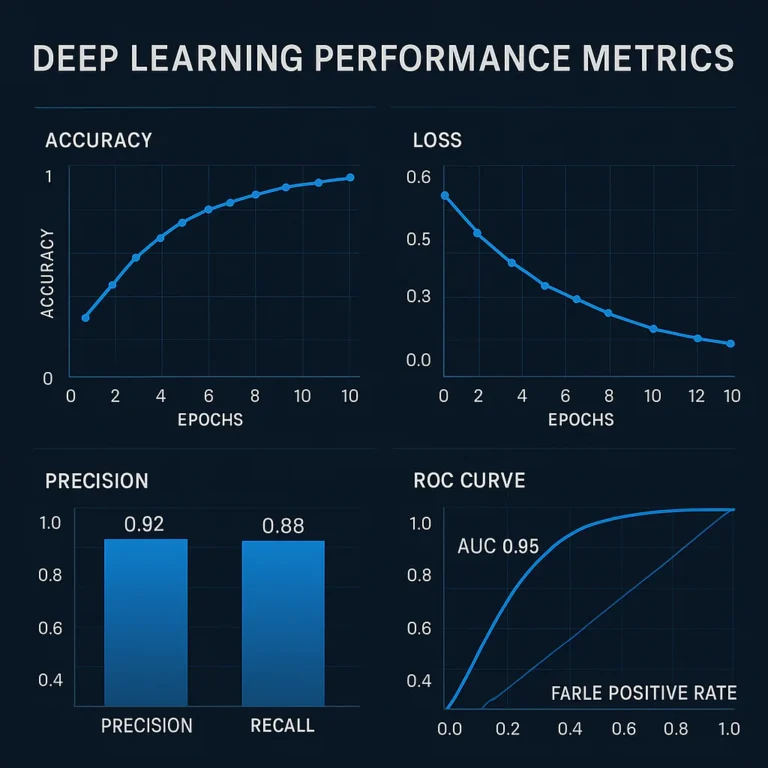
Evaluate more than a headline score. For classification, review the confusion matrix alongside precision, recall, F1, and threshold behavior. For regression, review error magnitude and error patterns. For ranking or retrieval, use metrics that reflect ordering and relevance.
The scikit-learn metrics guide describes common metrics and their tradeoffs.
A fraud example makes the problem vivid: if 98% of transactions are legitimate, a model that labels every transaction “legitimate” can reach 98% accuracy while detecting zero fraud. This is why metric selection must follow the task’s error costs, not convenience.
4. Baseline and benchmark comparisons
A complex model should beat a sensible baseline—or provide another justified benefit such as lower latency, better calibration, or improved subgroup performance.
Useful baselines include:
- Majority-class prediction
- Simple linear or tree-based models
- Existing production model
- Business-rule system
- Human performance or expert reference, where appropriate
Benchmarks make comparisons easier, but benchmark performance does not equal production readiness. Our computer vision benchmarks guide explains why dataset and evaluation setup matter: a model can rank well on a public benchmark and still fail on images from a different camera, environment, or population.
5. Error analysis and confusion-matrix review
A confusion matrix counts true positives, false positives, true negatives, and false negatives. It helps teams see the model’s error profile rather than burying all outcomes in a single number.
Review errors by:
- Class, subgroup, geography, language, or device
- Confidence level and decision threshold
- Time period or workflow stage
- Data quality, missingness, and unusual input conditions
- Impact and reversibility of the resulting decision
Then ask: What pattern produced this error? Is it a label problem, missing feature, weak representation, threshold issue, or mismatch between the model and the intended use? Error analysis often suggests the next experiment better than immediately swapping algorithms.
6. Robustness and stress testing
Robustness testing asks whether small, realistic changes cause unreasonable output changes.
Try:
- Controlled image noise, blur, or lighting changes
- Typos, punctuation, paraphrases, or formatting changes in text
- Missing, delayed, out-of-range, or corrupted features
- Unusual but valid input extremes
- High-volume, high-latency, or partial-service conditions
As the Testriq article summarizes, “A model that produces wildly different outputs from inputs that differ only in minor ways has a robustness problem.” The exact tolerance depends on the task: a translation system may reasonably vary its wording, while a medical risk score may not swing sharply after an irrelevant formatting change.
7. Bias, fairness, and subgroup testing
Evaluate performance across groups that are relevant to the application and legally or ethically appropriate to assess. Compare metrics such as recall, false-positive rates, calibration, and selection rates where suitable.
Keep three cautions in mind:
- A single fairness metric cannot define fairness for every context.
- Group-level averages can conceal intersections or small subgroups.
- A difference in metrics is a signal to investigate, not automatic proof of cause or a complete legal analysis.
The NIST AI RMF emphasizes identifying and managing risks in context. For tools, TensorFlow Model Analysis supports evaluation across slices, while Fairlearn provides resources for assessing and improving fairness in machine learning.
8. Explainability and interpretability checks
Explainability tests help investigate how model outputs relate to inputs. Techniques include feature-importance analysis, local explanations, counterfactuals, and example-based review.
Common tools include SHAP and LIME. They can help surface unexpected dependencies, but an explanation is not automatically a faithful account of a model’s reasoning or proof that a decision is fair.
Use explanations to ask better questions:
- Does the model rely on plausible information?
- Do irrelevant features appear influential?
- Does a local explanation match domain expectations?
- Can users understand the output well enough to act appropriately?
9. Data leakage and overfitting detection
Data leakage occurs when training or evaluation uses information that would not legitimately be available at prediction time. It can make a weak model look remarkably clever.
Examples include:
- A feature recorded after the event the model is supposed to predict
- Duplicate or near-duplicate records across train and test
- Preprocessing fitted on the full dataset before splitting
- Target labels accidentally embedded input fields
Compare training, validation, and test results. A large gap—such as 99% training accuracy and 71% on new data—may signal overfitting, leakage, distribution differences, or inconsistent evaluation. The numbers alone do not diagnose the cause; investigate data splits, feature timing, and pipeline behavior.
10. Adversarial, privacy, and security testing
Security testing should consider how attackers might manipulate inputs, extract sensitive information, or exploit the surrounding application. For generative systems, include prompt injection, jailbreak attempts, data exfiltration paths, and unsafe tool use.
Relevant references include the OWASP Top 10 for LM Applications and NIST’s adversarial machine-learning resources. A model can be statistically accurate and still create a serious security exposure if an attacker can steer it into revealing data or taking unauthorized actions.
Test the whole system—not just the model weights—including:
- Authentication and authorization
- Secret and personal-data handling
- API rate limits and logging
- Tool permissions and retrieval boundaries
- Human approval for consequential actions
11. Calibration and uncertainty estimation
A model is calibrated when its confidence estimates correspond reasonably well to observed outcome frequencies. Among cases assigned confidence near 0.8, for example, about 80% should be correct over an appropriate evaluation set.
Calibration is useful when a system needs to abstain, request more information, or route uncertain cases to a human. Test calibration across relevant slices and operating conditions. Confidence should not be treated as a guarantee, especially for generative systems whose fluent wording can make unsupported output sound certain.
12. Human evaluation and domain-expert review
Human review is essential when “correct” depends on context, usefulness, safety, or expert judgment. Reviewers need clear rubrics, representative examples, and a way to record disagreement.
For large language models, human evaluation can assess:
- Factuality and completeness
- Relevance to the user’s request
- Tone, clarity, and accessibility
- Safety and policy compliance
- Whether the answer cites suitable evidence
Human judgments are not magically objective. Reduce noise with reviewer training, multiple raters for sensitive evaluations, adjudication rules, and documented scoring criteria.
✅ AI Validation Checklist: Accuracy, Reliability, and Safety
Use this checklist as a starting point, then adapt it to the model’s purpose and risk level. A checked box is useful only if you can point to evidence.
Check data quality, lineage, and representativeness
- ✅ Record data sources, dates, permissions, transformations, and exclusions.
- ✅ Inspect missing values, duplicates, outliers, class balance, and label consistency.
- ✅ Compare test data with expected production populations and input conditions.
- ✅ Check that preprocessing and feature creation do not leak future information.
- ✅ Define controls for sensitive data, retention, and access.
Test for bias across groups and use cases
- ✅ Identify relevant groups and intersections before inspecting results.
- ✅ Compare appropriate error rates, precision, recall, calibration, or selection outcomes.
- ✅ Investigate small sample sizes and uncertainty; do not overinterpret noisy differences.
- ✅ Review whether the use case creates disparate impact or demands additional oversight.
- ✅ Document limitations, mitigation plans, and residual risk.
Review predictions, decisions, and failure cases
- ✅ Inspect confusion matrices, threshold tradeoffs, and error examples.
- ✅ Test edge cases, missing features, and distribution shifts.
- ✅ Confirm that users can recognize uncertainty and know when to escalate.
- ✅ For generative AI, check unsupported claims, harmful responses, and instruction-following boundaries.
- ✅ Test the complete decision workflow, not just model outputs.
Assess security, privacy, and access controls
- ✅ Review authentication, permissions, logging, encryption, and data minimization.
- ✅ Test prompt injection and unauthorized tool or data access where relevant.
- ✅ Check whether outputs expose personal, confidential, or training data.
- ✅ Review third-party APIs, data processing terms, and incident procedures.
- ✅ Document threat assumptions and test them again after major system changes.
Verify governance, documentation, and auditability
Maintain a practical evidence set, not a paperwork mountain:
- Model or system card describing purpose, scope, limits, and known risks
- Dataset records and labeling guidance
- Training configuration and model-version history
- Evaluation results, metrics, slices, and acceptance thresholds
- Change logs, approvals, and known issues
- Monitoring plan, escalation path, and rollback procedure
The NIST AI RMF offers a governance-oriented structure. Requirements vary by sector and jurisdiction, so documentation should also reflect applicable laws, standards, contracts, and internal controls.
Test integrations with APIs and third-party tools
An external model, data service, retrieval source, or automation API can change independently of your own code. Test:
- Schema validation and error handling
- Authentication and access boundaries
- Timeout, retry, and rate-limit behavior
- Provider or model-version changes
- Data storage, training-use, and retention terms
- Service-level commitments and incident notification procedures
When a tool participates in a consequential workflow, include it in the system’s risk review. A third-party component does not make the outcome somebody else’s problem.
📈 Metrics for AI Model Performance and Reliability
Metrics are a compressed view of behavior. Useful, yes; complete, no. Select them based on the problem and inspect examples to understand what the numbers conceal.
Classification, regression, ranking, and clustering metrics
| Task | Common metrics | What they help reveal |
|---|---|---|
| Classification | Precision, recall, F1, ROC-AUC, PR-AUC, confusion matrix | Error tradeoffs, ranking quality, and performance under class imbalance |
| Regression | MAE, MSE, RMSE, R² | Typical error size, sensitivity to large errors, and explained variation |
| Ranking or retrieval | Precision@k, Recall@k, NDCG, MRR | Whether useful results appear near the top |
| Clustering | Silhouette score, stability, expert review | Separation and consistency, though not necessarily meaningful categories |
| Forecasting | MAE, RMSE, MAPE where appropriate, backtesting | Forecast errors over time and across horizons |
Metric reminders:
- Accuracy is the share of correct predictions; it can mislead with imbalanced classes.
- Precision asks how often positive predictions are correct.
- Recall asks how many actual positive cases the model finds.
- F1 balances precision and recall, but may not reflect the costs of each error.
- MAE reports average absolute error; MSE penalizes larger errors more heavily.
- AUC summarizes ranking or separation across thresholds; it does not identify the best operational threshold by itself.
Generative AI and large language model evaluation
Language-model evaluation needs task-specific tests because a plausible answer can still be false, incomplete, unsafe, or unsupported by sources.
For retrieval-augmented generation (RAG), test:
- Whether retrieval finds relevant, authoritative material
- Whether the response is supported by retrieved evidence
- Whether citations point to the claims they are meant to support
- Whether the system admits when evidence is insufficient
- Whether prompt injection in documents can alter instructions
For assistants that call tools, test permissions, argument validation, side effects, and human confirmation. For broader coverage of these systems, see ChatBench.org’s AI Agents and AI Automation Workflows sections.
An LM’s output may vary between runs. That does not make evaluation impossible; it means teams should use fixed test prompts, multiple runs where appropriate, explicit scoring rubrics, and human review for high-impact judgments.
Selecting metrics that match business outcomes
Work backward from the decision:
- List plausible errors.
- Estimate who is affected and how serious each error is.
- Choose metrics that expose those error types.
- Set thresholds and abstention or escalation policies.
- Test thresholds against a held-out dataset and representative workflow.
- Review the cost of monitoring, manual review, and false alarms.
A metric target without an error-cost discussion is a number looking for a purpose.
🗂️ Data Quality Management for AI and Machine Learning
Data quality is not a cleanup task you finish once. It is part of the model’s operating environment. Poor labels, missing records, skewed samples, and stale features can degrade model behavior even when the algorithm has not changed.
Data quality dimensions and validation rules
| Data dimension | Example check |
|---|---|
| Completeness | Are required features present at expected rates? |
| Validity | Do values match documented types and allowed ranges? |
| Consistency | Do fields agree across sources and time? |
| Uniqueness | Are duplicate or near-duplicate records inflating evaluation? |
| Timeliness | Are features available when the model must make its decision? |
| Representativeness | Do examples cover the intended users and settings? |
| Lineage | Can the team trace inputs to sources and transformations? |
| Label quality | Are labels defined consistently and reviewed when ambiguous? |
Tools such as TensorFlow Data Validation can help detect schema changes, distribution anomalies, and data-quality problems in pipelines. Automated checks catch known patterns; humans still need to decide whether an unusual change is harmful or an expected business shift.
Label quality, data drift, and dataset shift
These terms describe related but distinct problems:
- Data drift: The distribution of incoming features changes.
- Concept drift: The relationship between features and the target changes.
- Label shift: The prevalence of outcome classes changes.
- Label noise: Recorded outcomes are incorrect, inconsistent, or ambiguous.
A model may appear stable on input statistics while becoming less useful because the relationship between input and outcome has changed. For example, shifts in lending behavior or broader economic conditions can weaken assumptions in a credit-risk model trained on earlier periods.
Synthetic data: benefits, risks, and testing
Synthetic data can help teams explore rare cases, protect sensitive records, or expand a limited dataset. It can also preserve or amplify biases, fail to represent real-world variation, or accidentally reveal information from source data.
Before relying on synthetic examples:
- Compare relevant distributions and edge cases with real data.
- Evaluate models on independent, real-world data where feasible.
- Check privacy and memorization risks.
- Document which records are synthetic and how they were generated.
- Do not treat volume as a substitute for representativeness.
🛡️ Bias, Fairness, Explainability, and Responsible AI
Responsible AI testing combines measurement with context. A numerical fairness result is evidence, not the final ethical or legal judgment.
Fairness metrics and subgroup analysis
Depending on the task, teams may examine:
- Selection or approval rates
- False-positive and false-negative rates
- Precision and recall by group
- Calibration by group
- Performance on intersections, not only broad categories
Some fairness criteria can conflict when base rates differ, so teams may not be able to satisfy every measure simultaneously. Document which criteria were selected, why they suit the use case, and what tradeoffs remain. For guidance, see Fairlearn’s assessment resources.
Explainable AI methods and their limitations
Feature importance, SHAP values, LIME explanations, counterfactuals, and interpretable surrogate models can help teams audit outputs. But each method has assumptions and potential failure modes.
A good explanation workflow:
- Check whether explanations are stable under small input changes.
- Compare explanations with domain knowledge and known causal limitations.
- Review unexpected feature dependence.
- Explain uncertainty and limitations to the intended audience.
- Avoid presenting an explanation as proof of fairness or causality.
Responsible AI standards and risk management
Use standards and guidance as scaffolding, not a substitute for application-specific analysis. The NIST AI RMF supports voluntary risk management. The EU AI Act, meanwhile, establishes legal obligations for covered systems and actors; requirements depend on classification, role, timing, and context. Teams should have legal and compliance specialists determine applicability.
🔐 Security, Privacy, and Adversarial Testing
Security testing should follow data through the full system: user input, prompt construction, retrieval, model calls, tool execution, logging, and output.
Threat modeling and attack-surface review
Ask what an attacker could do, what they could access, and how the system would fail. Consider:
- Data poisoning or manipulation
- Evasion and adversarial inputs
- Model or training-data extraction
- Unauthorized access tools, APIs, or records
- Supply-chain and dependency risks
- Abuse through excessive requests or resource consumption
The OWASP Machine Learning Security Top Ten and OWASP’s LLM application guidance provide threat categories teams can adapt.
Prompt injection and jailbreak testing for LMs
Test direct and indirect prompt injection, including hostile instructions embedded in retrieved documents, uploaded files, or web content. Check whether the model:
- Reveals system or confidential information
- Ignores safety rules
- Calls tools outside its permitted scope
- Treats untrusted content as trusted instructions
- Produces harmful or policy-violating material
A refusal in one test is not proof of robust protection. Use varied phrasing and contexts, test the tool layer independently, and apply least-privilege permissions so the model cannot perform actions it should not be able to authorize.
Privacy leakage, access control, and data protection
Assess what personal or confidential information enters the system, where it is processed, how long it is stored, and who can access it. Test output behavior for sensitive data exposure, but also inspect logging, telemetry, backups, and vendor integrations.
Privacy reviews should be coordinated with security, legal, and data-protection specialists. Model tests cannot substitute for lawful data processing, appropriate notices, or access-control design.
🚀 Validating AI Models Before Deployment
Pre-release evaluation should cover both offline model quality and the end-to-end system. A good model can still fail when its API, database, user interface, or fallback path behaves badly.
Pre-production gates and release criteria
A release gate should be explicit, versioned, and difficult to bypass accidentally. It may require:
- Minimum performance on the agreed evaluation suite
- No critical regressions in fairness, safety, or security checks
- Review of known limitations and high-severity errors
- Tested rollback and incident procedures
- Human approval for high-impact deployment
- Complete records for data, code, configuration, and evaluation results
Do not make a single aggregate score the only gate. A strong average should not cancel a severe failure in a critical slice.
Shadow, canary, and A/B testing
These methods help test a candidate model with real traffic, under controlled conditions.
| Method | How it works | Best for |
|---|---|---|
| Shadow testing | Candidate model receives copied inputs but does not control user-facing decisions | Comparing outputs safely before release |
| Canary deployment | Candidate is exposed to a small portion of traffic, then expanded if checks pass | Gradual rollout and early fault detection |
| A/B testing | Different users or traffic groups receive different versions | Comparing user or business outcomes |
Start with low exposure where appropriate, but choose sample sizes and duration based on statistical power, risk, and the time needed for outcomes to emerge. The Testriq article gives 1–5% as a typical canary starting range; this is a rule of thumb, not a universal standard. For a high-impact model, a smaller or non-decision-making shadow test may be more appropriate.
Integration, load, latency, and scalability testing
Evaluate practical system behavior:
- Response latency at expected and peak load
- Throughput and resource consumption
- Timeout, retry, and service-degradation behavior
- Compatibility with data schemas and downstream tools
- Fallback behavior when the model or vendor is unavailable
- Accessibility and user comprehension of outputs
The model’s benchmark score means little if the system misses its service objective or silently drops inputs during a traffic spike. For surrounding infrastructure topics, see ChatBench.org’s AI Infrastructure.
🔄 Continuous AI Testing, Monitoring, and Model Drift
Offline validation is a snapshot. Production monitoring tells you whether the snapshot still represents reality.
Production monitoring and alert thresholds
Monitor signals that match the system’s risks:
- Input schema and feature distributions
- Prediction distributions and confidence
- Delayed labels and observed performance
- Fairness metrics where lawful and meaningful
- Latency, error rates, and system availability
- Business outcomes and human override rates
Alerts need an owner and response plan. A dashboard without an escalation path is a smoke alarm taped to the wall.
Detecting data drift, concept drift, and performance decay
Use distribution tests and drift dashboards as early-warning signals, not as automatic proof that a model has failed. A shift inputs may be harmless, while stable inputs can still conceal changes in labels or business relationships.
Evidently AI offers monitoring and evaluation tooling, and the Google Cloud MLOps documentation describes continuous delivery and monitoring practices for machine-learning systems. Tool choice does not replace good alert design or reliable labels.
Retraining, rollback, and incident response
Retraining is not the automatic answer to every alert. First determine whether the cause is data quality, infrastructure, a changed target relationship, a policy change, or model weakness.
A prepared response plan should define:
- Who triages the alert and how quickly.
- What evidence is needed to confirm the issue.
- Whether to pause, roll back, restrict, or route cases to humans.
- What must be documented and communicated.
- What tests are required before re-release.
Revalidation should follow risk and change velocity. Stable applications may need periodic formal reviews; dynamic systems may need more frequent evaluation. Any meaningful change to data pipelines, features, prompts, retrieval sources, model versions, or downstream decisions should trigger a risk-based review.
🧰 AI Testing Tools, Platforms, and Frameworks
Tools help automate checks and preserve evidence. They do not decide what “good enough” means for your application.
Open-source model evaluation tools
| Tool | Useful for | Considerations |
|---|---|---|
| scikit-learn | Metrics, cross-validation, pipelines, model comparison | Strong general-purpose toolkit; teams still design the evaluation correctly |
| TensorFlow Model Analysis | Slice-based model evaluation | Fits TensorFlow-oriented workflows |
| TensorFlow Data Validation | Data schemas and anomaly detection | Best integrated into a maintained pipeline |
| Fairlearn | Fairness assessment and mitigation workflows | Metrics require contextual interpretation |
| SHAP | Feature-atribution analysis | Explanations have assumptions and should not be overstated |
| LIME | Local explanations for individual predictions | Local approximation may be unstable |
| MLflow | Experiment tracking and model lifecycle management | Governance still depends on team practices |
| Evidently AI | Evaluation and drift monitoring | Monitoring needs appropriate reference data and alert ownership |
| Deepchecks | Data and model validation checks | Review which checks suit the project and current package capabilities |
Cloud and enterprise ML testing platforms
Managed cloud services can support pipelines, model registries, monitoring, access controls, and deployment. Examples include Amazon SageMaker, Google Vertex AI, and Microsoft Azure Machine Learning.
Compare platforms based on:
- Existing cloud and data architecture
- Access controls and audit requirements
- Support for custom metrics and slice-based evaluation
- Monitoring and rollback capabilities
- Portability, vendor dependencies, and data-handling terms
- Team expertise and operational cost
A platform with more features is not automatically a better fit. Pick the one that supports the tests and governance your use case actually requires.
Choosing a testing partner or specialist
External specialists can help with model evaluation, security testing, fairness review, test automation, and governance. Ask for:
- A clear methodology and sample deliverables
- Evidence behind any claimed accuracy, speed, or savings improvements
- Experience with your sector and model type
- How they handle confidential data and independence
- How their findings integrate with your internal release process
TestingXperts describes its QE for AI services as supporting repeatable AI quality engineering. Its article reports provider-stated results—including 80% improved response consistency, 80% faster response times, 50% reduced manual effort, and 90% easy CI/CD integration—but does not provide a measurement methodology in the summary provided here. Treat those numbers as vendor claims, not independently verified benchmarks. Ask what was measured, against which baseline, and on what kinds of projects.
Likewise, Testriq’s article reports company claims of 150+ validated models and a 99.5% bias detection rate. Without independent methodology and definitions, those figures should be treated as marketing claims rather than general evidence of tool or service performance.
⚠️ Common AI Model Testing Challenges—and How to Solve Them
| Challenge | Why it causes trouble | Practical response |
|---|---|---|
| Limited labeled data | Metrics may be noisy or unrepresentative | Use expert-reviewed samples, confidence intervals, and carefully chosen external or temporal tests |
| Imbalanced classes | Accuracy can conceal missed minority cases | Report precision, recall, PR-AUC, and error counts by class |
| Changing production data | Offline results become stale | Monitor drift and outcome metrics; define revalidation triggers |
| Non-deterministic outputs | Exact-match tests can fail for acceptable variations—or miss harmful ones | Use task rubrics, repeated runs, invariants, and human review |
| Black-box complexity | Teams may struggle to explain behavior | Combine local explanations, error analysis, documentation, and domain review |
| Bias assessment is difficult | Group data may be limited or metrics may conflict | Choose context-relevant measures, disclose limitations, and consult specialists |
| Weak test criteria | Teams argue about scores after results arrive | Agree on use case, costs, thresholds, and release rules before evaluation |
| Tool and API dependencies | Updates can change system behavior without model retraining | Version dependencies, contract-test integrations, and rerun release checks |
Testomat.io calls AI “not a magic bullet, but a powerful co-pilot.” That perspective is useful for AI-assisted software testing as well as model deployment: automation can accelerate test generation and anomaly review, but people still need to inspect whether suggested tests are relevant, complete, and safe.
The “pesticide effect” is worth watching: a model tested repeatedly on the same known cases may become excellent at those cases while failing to reveal new weaknesses. Refresh test scenarios carefully, preserve a stable benchmark for comparison, and add newly discovered failures to regression suites without letting the test set leak into training.
🧑 💻 Building an AI Model Validation Team and Workflow
AI validation works best when accountability is shared. Data scientists understand model behavior; software engineers understand system integration; security and privacy specialists understand threats and data handling; domain experts understand the consequences of wrong answers.
A practical workflow
- Scope the use case. Agree on users, decisions, limits, and risk.
- Create a test plan. Select datasets, metrics, thresholds, slices, and edge cases.
- Build repeatable checks. Automate schema, regression, performance, and safety tests.
- Review failures. Combine quantitative patterns with human inspection.
- Approve the release. Record evidence, risks, owners, and rollback conditions.
- Monitor and learn. Track outcomes, investigate alerts, and update the test suite.
- Revalidate changes. Re-run the checks affected by new data, code, prompts, models, or integrations.
Who should own what?
| Role | Typical contribution |
|---|---|
| Product or business owner | Intended use, impact, acceptance criteria |
| Data scientist or ML engineer | Model design, metrics, experiments, validation |
| Software or platform engineer | APIs, pipelines, reliability, release automation |
| Domain expert | Context, edge cases, interpretation of errors |
| Security and privacy teams | Threats, access controls, data protection |
| Legal or compliance specialists | Applicable obligations and documentation review |
| Operations or support | Monitoring, incident response, user feedback |
For teams applying AI to software quality workflows, the right balance is similar: models can prioritize tests or generate candidate cases, while humans confirm coverage and business relevance. Explore related work in AI Business Applications and AI Automation Workflows.
📝 AI Testing Documentation, Governance, and Audit Trails
Documentation is useful when it lets someone reconstruct what was evaluated and why a release was approved.
For each model or AI system, record:
- Intended use and out-of-scope uses
- Training and evaluation data descriptions
- Model, prompt, code, and dependency versions
- Evaluation methodology and acceptance thresholds
- Results by task, slice, and relevant operating condition
- Known limitations and unresolved failures
- Human-oversight and escalation procedures
- Monitoring thresholds, incident owners, and rollback steps
- Third-party components and data-handling terms
Keep documentation current. A model card written before a major feature change may no longer describe the deployed system. Tie records to version control and deployment events where possible, and make release evidence easy for reviewers to find.
This is not paperwork for its own sake. Traceability helps teams investigate incidents, compare versions, reproduce results, and make informed decisions when conditions change.