Support our educational content for free when you purchase through links on our site. Learn more
Image Recognition Dataset Comparison: 15 Top Picks 🔍


The best image recognition dataset is the one that matches your task and real-world images—not simply the one with the most files. For classification, ImageNet is a strong general-purpose benchmark; for object detection and segmentation, CO and Open Images are better starting points; and for specialized applications, a domain-specific dataset may be the smarter choice.
We compare 15 popular datasets by task, scale, annotations, strengths, and limitations, including CIFAR-10, Food-101, iNaturalist, EuroSAT, and MedMNIST. We also cover data quality, licensing, bias, evaluation, and how to avoid a benchmark score that looks terrific on paper but falls flat outside the lab.
That mismatch is easier to make than you’d think. CIFAR-10’s 60,000 images are only 32×32 pixels—great for learning a computer-vision workflow, but a very different test from recognizing objects in full-resolution, cluttered camera footage.
Key Takeaways
- Match the dataset to the task: classification needs class labels; detection needs bounding boxes; segmentation needs pixel-level masks.
- Choose for relevance, not raw size: image quality, class balance, label accuracy, diversity, and real-world fit matter just as much as image count.
- Start with the right benchmark: use ImageNet for broad classification, CO or Open Images for object detection, and domain-specific datasets for specialized tasks.
- Treat benchmark results as a starting point: use clean splits, check for duplicates and data leakage, and validate on independent data that resembles deployment.
- Review licensing, privacy, and bias before use: public availability does not automatically mean unrestricted commercial use.
- Report meaningful metrics: accuracy alone can hide poor results on rare or important classes; include class-level metrics and task-specific measures.
Table of Contents
- ⚡️ Quick Tips and Facts
- 🧭 What an Image Recognition Dataset Comparison Can Tell You
- Image classification, object detection, and image segmentation
- Image recognition benchmarks versus real-world datasets
- 📚 Image Dataset History and Benchmarking Background
- 🔎 How We Compare Image Recognition Datasets
- Dataset size, image resolution, and class balance
- Labels, annotations, and data quality
- Licensing, privacy, and commercial-use restrictions
- Bias, diversity, and geographic representation
- Download size, format, and tooling
- 🏆 Best Image Recognition Datasets Compared
- 1. ImageNet: Large-scale object recognition
- 2. CIFAR-10 and CIFAR-100: Compact image classification benchmarks
- 3. MNIST and Fashion-MNIST: Handwritten digits and clothing
- 4. CO: Common objects, detection, and segmentation
- 5. Open Images: Broad labels and bounding-box annotations
- 6. Pascal VOC: Classic object detection and segmentation
- 7. Caltech-101 and Caltech-256: Object category recognition
- 8. Stanford Dogs and Stanford Cars: Fine-grained recognition
- 9. Food-101: Food image classification
- 10. Places365: Scene and environment recognition
- 11. iNaturalist: Wildlife and species classification
- 12. EuroSAT: Satellite and land-use image recognition
- 13. MedMNIST: Lightweight medical image benchmarks
- 14. ImageNet-A, ImageNet-C, and ImageNet-R: Robustness testing
- 15. Domain-specific and synthetic image datasets
- 📊 Image Recognition Dataset Comparison Table
- Dataset size, classes, tasks, and annotation comparison
- Best datasets by project type
- 🎯 Choosing the Right Dataset for Your Use Case
- For learning computer vision and teaching
- For training image classifiers
- For object detection and instance segmentation
- For medical, retail, food, and industrial applications
- For edge devices and low-resource projects
- 🧪 Preparing and Evaluating Image Datasets
- Train, validation, and test splits
- Preventing data leakage and duplicate images
- Metrics for image classification and recognition
- Handling class imbalance and noisy labels
- Data augmentation and preprocessing
- ⚖️ Dataset Licensing, Ethics, and Responsible Use
- Checking dataset terms before training or redistribution
- Privacy, consent, and sensitive images
- Fairness, bias, and dataset documentation
- 🛠️ Tools and Resources for Finding Image Datasets
- Dataset repositories and benchmark portals
- Python libraries for loading image datasets
- Creating a custom image recognition dataset
- ✅ Quick Tips for Comparing Image Datasets
- Conclusion
- Recommended Links
- FAQ
- What is the best dataset for image recognition?
- Which image dataset is best for beginners?
- What is the difference between ImageNet and CO?
- Are image recognition datasets free to use commercially?
- How many images do you need to train an image classifier?
- How can you tell whether an image dataset is biased?
- Reference Links
Table of Contents
- ⚡️ Quick Tips and Facts
- 🧭 What an Image Recognition Dataset Comparison Can Tell You
- Image classification, object detection, and image segmentation
- Image recognition benchmarks versus real-world datasets
- 📚 Image Dataset History and Benchmarking Background
- 🔎 How We Compare Image Recognition Datasets
- Dataset size, image resolution, and class balance
- Labels, annotations, and data quality
- Licensing, privacy, and commercial-use restrictions
- Bias, diversity, and geographic representation
- Download size, format, and tooling
- 🏆 Best Image Recognition Datasets Compared
- 1. ImageNet: Large-scale object recognition
- 2. CIFAR-10 and CIFAR-100: Compact image classification benchmarks
- 3. MNIST and Fashion-MNIST: Handwritten digits and clothing
- 4. CO: Common objects, detection, and segmentation
- 5. Open Images: Broad labels and bounding-box annotations
- 6. Pascal VOC: Classic object detection and segmentation
- 7. Caltech-101 and Caltech-256: Object category recognition
- 8. Stanford Dogs and Stanford Cars: Fine-grained recognition
- 9. Food-101: Food image classification
- 10. Places365: Scene and environment recognition
- 11. iNaturalist: Wildlife and species classification
- 12. EuroSAT: Satellite and land-use image recognition
- 13. MedMNIST: Lightweight medical image benchmarks
- 14. ImageNet-A, ImageNet-C, and ImageNet-R: Robustness testing
- 15. Domain-specific and synthetic image datasets
- 📊 Image Recognition Dataset Comparison Table
- Dataset size, classes, tasks, and annotation comparison
- Best datasets by project type
- 🎯 Choosing the Right Dataset for Your Use Case
- For learning computer vision and teaching
- For training image classifiers
- For object detection and instance segmentation
- For medical, retail, food, and industrial applications
- For edge devices and low-resource projects
- 🧪 Preparing and Evaluating Image Datasets
- Train, validation, and test splits
- Preventing data leakage and duplicate images
- Metrics for image classification and recognition
- Handling class imbalance and noisy labels
- Data augmentation and preprocessing
- ⚖️ Dataset Licensing, Ethics, and Responsible Use
- Checking dataset terms before training or redistribution
- Privacy, consent, and sensitive images
- Fairness, bias, and dataset documentation
- 🛠️ Tools and Resources for Finding Image Datasets
- Dataset repositories and benchmark portals
- Python libraries for loading image datasets
- Creating a custom image recognition dataset
- ✅ Quick Tips for Comparing Image Datasets
- Conclusion
- Recommended Links
- FAQ
- What is the best dataset for image recognition?
- Which image dataset is best for beginners?
- What is the difference between ImageNet and CO?
- Are image recognition datasets free to use commercially?
- How many images do you need to train an image classifier?
- How can you tell whether an image dataset is biased?
- Reference Links
⚡️ Quick Tips and Facts
The best image recognition dataset is the one that matches your task, target images, and deployment conditions—not necessarily the one with the biggest download button. We compare datasets by task fit, label quality, diversity, licensing, and whether their images resemble the ones your model will actually encounter.
Our first rule in benchmark work is to match the comparison to the problem. For a broader explanation of benchmark design and model evaluation, see our guide to computer vision benchmarks.
| Quick fact | Why it matters |
|---|---|
| Image classification assigns a label to an image; object detection locates objects; segmentation labels pixels. | A dataset built for one task may be unsuitable for another. |
| ImageNet-1K is widely used for large-scale classification and model pretraining. | It is a strong general-purpose benchmark, not a substitute for domain-specific evaluation. |
| CO supports object detection, segmentation, and captioning. | Its annotations are richer than simple image-level class labels. |
| CIFAR-10 has 60,000 small, 32×32 color images in 10 classes. | It is convenient for learning and quick experiments, but tiny images do not represent many production camera feeds. |
| Dataset size alone does not establish quality. | Duplicate images, noisy labels, narrow coverage, or test leakage can inflate results. |
| Licensing must be checked dataset by dataset. | A public download does not automatically grant commercial reuse, redistribution, or rights to every image. |
| External testing is crucial. | A high score on the training benchmark may not survive a new hospital, camera, region, or customer environment. |
✅ Fast recommendation: start with CIFAR-10 or Fashion-MNIST to learn the pipeline; choose ImageNet for broad classification pretraining; use CO or Open Images for detection and localization; and find a domain-specific dataset for the final reality check.
❌ Easy trap: choosing a dataset because a paper reports a striking accuracy score. Results across different splits, labels, image sources, and evaluation metrics are not directly comparable. In a medical-imaging review of 36 studies, only a small number of studies used independent external tests, illustrating how often benchmark performance can be mistaken for real-world validation (systematic review).
🧭 What an Image Recognition Dataset Comparison Can Tell You
An image recognition dataset comparison helps you answer a practical question: which collection of images and labels gives us credible evidence that a model can perform the job we care about? That means comparing more than image counts. We look at the task, class definitions, image sources, annotation detail, split design, legal terms, and how well the benchmark resembles deployment.
Dataset comparisons are useful for:
- Choosing a benchmark for a research paper or class project.
- Selecting pretraining data for a computer vision model.
- Estimating whether a dataset can support fine-grained recognition, detection, or segmentation.
- Identifying gaps before investing in annotation.
- Assessing whether public benchmark results are relevant to a business application.
- Checking whether a dataset’s license and data provenance fit your intended use.
One caution from our own review process: the dataset with the best headline score can lose its shine once you inspect the test images. We have seen projects discover that the benchmark’s clean, centered objects looked nothing like cluttered store shelves or dim factory footage. That mismatch—not a lack of model sophistication—was the real problem.
Image classification, object detection, and image segmentation
The phrase image recognition gets used loosely. Before comparing datasets, identify what your model must output.
| Task | Model output | Example dataset fit | Example use |
|---|---|---|---|
| Image classification | One or more labels for the whole image | ImageNet, CIFAR-10, Food-101 | “This image contains a bicycle.” |
| Object detection | Class labels plus bounding boxes | CO, Open Images, Pascal VOC | “There are two bicycles, at these locations.” |
| Instance segmentation | A separate pixel mask for each object | CO, Open Images | “These pixels belong to bicycle A; those belong to bicycle B.” |
| Semantic segmentation | A class label for each pixel | Cityscapes, Pascal VOC segmentation | “These pixels are road, these are sidewalk.” |
| Fine-grained recognition | A specific subtype or identity label | Stanford Dogs, Stanford Cars, iNaturalist | “This is a specific dog breed or car model.” |
| Image retrieval / visual search | Ranked images or identities similar to a query | Task-specific retrieval or face datasets | “Find visually similar products.” |
A classification dataset can still be useful for a detection project as pretraining data, but it does not replace box or mask annotations. If your end product must point to an object, a class-only label is like asking a map to tell you a city exists without showing you where it is.
Image recognition benchmarks versus real-world datasets
A benchmark is a standardized test; a deployment dataset is a sample of the messy conditions your model will face. They overlap, but they are not interchangeable.
A benchmark usually offers consistent splits and a familiar metric, making comparisons easier. Real-world data often contains different cameras, lighting, image compression, backgrounds, class proportions, and edge cases. Dataset shift occurs when the distribution at deployment differs from the distribution used for training; the Google Machine Learning glossary explains this general concept.
| Benchmark strength | Real-world limitation |
|---|---|
| Reproducible evaluation | May not reflect your operating environment |
| Commonly used labels and metrics | Labels may not match business definitions |
| Easy to compare published results | Different papers may use different splits or preprocessing |
| Useful for model development | Strong benchmark performance does not prove production readiness |
The practical answer is to use both: a recognized benchmark for comparability and a representative, held-out evaluation set for relevance. That distinction becomes especially important when a public leaderboard looks impressive.
📚 Image Dataset History and Benchmarking Background

Image datasets have expanded alongside computer vision itself. Small, tightly defined collections made early research manageable; larger datasets later enabled models to learn from broader visual variation. More recent benchmarks have added object locations, segmentation masks, captions, rare categories, and robustness challenges.
A few milestones help explain why today’s dataset landscape can feel like a pantry with 40 kinds of flour:
- MNIST helped popularize quick experiments in handwritten-digit recognition.
- CIFAR-10 and CIFAR-100 offered small natural-image benchmarks that remain useful for teaching and rapid protyping.
- ImageNet helped establish large-scale visual classification and pretraining as major components of modern computer vision; the original dataset and project history are documented by the ImageNet team.
- Pascal VOC became a well-known benchmark for object detection and segmentation.
- CO expanded evaluation to common objects, localization, segmentation, and captions.
- Newer robustness datasets ask whether models still work when images are corrupted, unusual, or presented in less familiar forms.
The history matters because benchmark scores are shaped by their era. A classic dataset can be valuable for reproducibility and teaching while being too small, too narrow, or too clean for a current application. We recommend treating benchmark popularity as context, not proof of suitability.
🔎 How We Compare Image Recognition Datasets
Our comparison uses seven core checks: task fit, size and resolution, class coverage, annotation quality, diversity, evaluation design, and legal usability. A dataset can excel in one category and still be a poor fit overall.
| Comparison factor | What we check | Red flag |
|---|---|---|
| Task fit | Does it provide the labels or annotations your model needs? | Classification labels for a localization task |
| Scale and resolution | Are there enough images at useful dimensions? | Heavy upscaling of tiny images |
| Class coverage | Are target categories present and sufficiently represented? | Rare but critical classes missing |
| Annotation quality | Are labels consistent, detailed, and documented? | Ambiguous categories or weak quality control |
| Diversity | Do sources, backgrounds, devices, and populations vary? | Images from one narrow setting |
| Evaluation design | Are train, validation, and test splits meaningful and leakage-resistant? | Near-duplicates across splits |
| Governance | Are license, consent, and provenance clear? | Unclear rights or sensitive data without safeguards |
We also consider the model family only after dataset conditions are understood. A systematic review comparing CNNs and vision transformers across medical-image studies found no universal rule for choosing one architecture across modalities and tasks. Its authors reported that dataset quality can affect the model choice and emphasized the scarcity of independent external tests (review). That’s a useful reminder: the dataset is not just fuel for the model; it can change which engine works best.
Dataset size, image resolution, and class balance
A larger dataset can offer more visual variation, but raw count is only a starting point. Ask how many usable, distinct, correctly labeled examples exist per class—not just how many files appear in the download.
Check:
- Total images and examples per class: A dataset with many images but only a handful for an important class may still be imbalanced.
- Image dimensions: Resolution should support the smallest details the task depends on.
- Image uniqueness: Near-duplicates can make a dataset look larger than it is.
- Class distribution: Decide whether naturally occurring imbalance reflects deployment or simply weak sampling.
- Capture variation: Include relevant differences in device, distance, angle, lighting, and background.
- Label granularity: “Bird” and a specific species label require different levels of evidence.
Resolution is not a simple higher-is-better contest. The medical-imaging systematic review reported that low-resolution datasets could favor CNNs in some comparisons, while other tasks favored vision transformers; results varied by task and study. The lesson is not “always use CNNs for small images.” It is test your model and preprocessing on the resolution your application actually supplies.
Labels, annotations, and data quality
Labels are the ground truth—or, more honestly, the best available approximation to it. If they are inconsistent, the model may learn a noisy target with great enthusiasm.
For each dataset, inspect:
- Label definitions: Are categories mutually exclusive? Is “other” defined?
- Annotator guidance: Were annotators given clear criteria?
- Quality assurance: Were labels reviewed, adjudicated, or sampled for audits?
- Annotation format: Image-level class, bounding box, polygon, mask, keypoint, or text?
- Uncertainty handling: Can an image be ambiguous, multi-label, or ungradable?
- Known errors: Are corrections or dataset errata published?
For dense annotations, such as segmentation masks, check whether boundaries are consistent enough for your intended metric. A mask suitable for a broad scene-segmentation task may not be precise enough for measuring a tiny medical structure.
We recommend sampling images before building a training pipeline. Open a random set from every class, inspect difficult examples, and compare labels against the dataset documentation. It’s a low-effort check that can save a very expensive training run.
Licensing, privacy, and commercial-use restrictions
“Available online” does not mean “free to use however you like.” Dataset terms may restrict commercial use, redistribution, or derivative use; image-level rights can also differ from the license for dataset code or annotations.
Before use, verify:
- The dataset’s official license and terms.
- Whether the images have separate copyright or usage restrictions.
- Whether commercial training is permitted.
- Whether redistribution of images, trained weights, or derived material is allowed.
- Whether privacy, consent, or sensitive-data rules apply.
- Whether your organization’s counsel needs to review the intended use.
For research governance, Datasheets for Datasets proposes documenting a dataset’s motivation, composition, collection process, and recommended uses. That kind of documentation helps teams ask better questions than “Can we download it?”
Bias, diversity, and geographic representation
A dataset may cover many categories while still representing the world unevenly. Bias can arise through who or what was collected, how images were sourced, which categories were selected, and how labels were assigned.
Ask:
- Are image sources and capture locations documented?
- Do demographic or geographic groups appear in the data where relevant?
- Are the backgrounds strongly correlated with labels?
- Are rare classes represented across varied conditions?
- Do labels carry subjective judgments?
- Does performance vary across relevant subgroups?
A model that recognizes a product only against a white background may look brilliant in a controlled benchmark and rather less brilliant on a crowded shelf. The NIST AI Risk Management Framework offers broader guidance for identifying and managing AI risks, including risks linked to data and system use.
Download size, format, and tooling
The most suitable dataset is one your team can actually process. Practical friction matters.
| Operational check | Why it matters |
|---|---|
| Download method | Registration, scripts, or access approvals may affect reproducibility |
| File format | JPEG/PNG, TFRecord, WebDataset, or archive structures affect loading workflows |
| Metadata availability | Class maps, splits, and annotations should be easy to interpret |
| Storage and bandwidth | Large-resolution data can require substantial storage and transfer |
| Library support | Established loaders reduce custom parsing and labeling mistakes |
| Versioning | Stable versions and checksums improve repeatability |
When a dataset has multiple versions, record the version, download date, preprocessing, and split definition in your experiment notes. Future-you will appreciate the favor.
🏆 Best Image Recognition Datasets Compared
There is no universal winner, so we group datasets by what they are good at. The counts below refer to commonly cited benchmark versions; dataset releases and annotation subsets can differ, so consult each official source before designing an experiment.
1. ImageNet: Large-scale object recognition
ImageNet is a broad visual dataset organized through the WordNet hierarchy. The commonly referenced ImageNet-1K classification benchmark contains roughly 1.2 million training images across 1,000 classes, with validation and test data defined by benchmark conventions.
Best for: Large-scale image classification, transfer learning, and comparing general-purpose visual models.
Strengths
- Broad object-category coverage.
- A long history of research use and pretrained-model support.
- Useful as a pretraining source for downstream tasks.
Limitations
- Its class labels and images may not match your application.
- The full dataset is not simply a blanket commercial-use license; verify current terms and image rights.
- A benchmark score does not establish robustness in a new domain.
Our take: ImageNet is a strong reference point for broad visual recognition, not a shortcut around collecting or validating target-domain data. See the official ImageNet site for dataset access and usage information.
2. CIFAR-10 and CIFAR-100: Compact image classification benchmarks
CIFAR-10 contains 60,000 32×32 color images split into 10 classes. CIFAR-100 has the same total number of images distributed across 100 classes, making its classification problem more fine-grained.
Best for: Introductory computer vision, classroom exercises, quick baseline comparisons, and testing training code.
Strengths
- Small, convenient, and supported by common frameworks.
- Useful for learning the end-to-end workflow.
- Easy to run on modest compute.
Limitations
- Tiny image size limits fine detail.
- The categories and visual conditions are simplified compared with many production applications.
- Strong CIFAR results do not guarantee strong performance on full-resolution photographs.
A hands-on perspective: The linked tutorial in the featured video uses PyTorch and CIFAR-10 to build a CNN with two convolutional layers and three fully connected layers. The tutorial reports 69% test accuracy after 10 epochs. That is a helpful learning milestone, not a current state-of-the-art result—and that distinction is exactly why we separate “the pipeline works” from “the model is ready.”
3. MNIST and Fashion-MNIST: Handwritten digits and clothing
MNIST contains 70,000 grayscale handwritten-digit images. Fashion-MNIST was designed as a more challenging drop-in alternative, with 70,000 grayscale images across 10 clothing categories.
Best for: Learning classification basics and testing small models.
Strengths
- Compact and widely supported.
- Clear, simple class labels.
- Good for teaching preprocessing, training loops, and evaluation.
Limitations
- Grayscale 28×28 images are far simpler than many real visual tasks.
- Models can achieve strong scores without learning skills that transfer to complex photography.
- Not a meaningful stand-in for fine-grained product or scene recognition.
Our take: Use MNIST as a first stepping stone, not the finish line. If you can already train a classifier, Fashion-MNIST or CIFAR-10 makes a more informative next exercise.
4. CO: Common objects, detection, and segmentation
CO—the Common Objects in Context dataset—supports several vision tasks, including object detection, instance segmentation, keypoints, and captions. Its core object-detection benchmark covers 80 object categories and provides richly annotated everyday scenes.
Best for: Object detection, instance segmentation, and evaluating models in scenes with multiple objects.
Strengths
- More than image-level labels: objects can be localized and segmented.
- Includes diverse, context-rich scenes.
- Broad ecosystem support across detection frameworks.
Limitations
- Annotation subsets and task versions can be confusing.
- Images and categories may not cover specialized business or scientific use cases.
- Licensing and image rights should be checked before reuse.
Our take: CO is a practical choice when the model must find objects, not merely name the dominant one. Read the CO dataset documentation carefully to select the correct task and split.
5. Open Images: Broad labels and bounding-box annotations
Open Images is a large-scale dataset with image-level labels and annotations that include bounding boxes and visual relationships in selected releases. The official project reports millions of images across thousands of image-level categories, though annotation coverage varies by task and release.
Best for: Large-scale object recognition and detection across a broad range of everyday concepts.
Strengths
- Large category vocabulary.
- Multiple annotation types.
- Useful for training or evaluating models that need broader object coverage.
Limitations
- Annotation density is not uniform across all images and categories.
- Its scale can increase storage and data-enginering demands.
- Confirm label availability and release-specific terms before use.
Our take: Open Images can offer broader category coverage than smaller benchmarks, but “more classes” does not automatically mean “better coverage for your classes.” Inspect the category map first.
6. Pascal VOC: Classic object detection and segmentation
The PASCAL VOC Challenge is a classic benchmark for classification, object detection, and segmentation, with familiar categories such as people, vehicles, and animals.
Best for: Comparing traditional detection and segmentation baselines and reproducing established research.
Strengths
- Well-known categories and benchmark history.
- Supports several common vision tasks.
- Useful for teaching and compatibility with older research.
Limitations
- Smaller and less broad than newer large-scale benchmarks.
- Its images and label scope may not reflect current deployment conditions.
- Results should be interpreted in the context of the benchmark’s age and task design.
Our take: Pascal VOC remains useful for reproducibility and education. For broader modern detection coverage, compare it with CO and Open Images rather than treating it as a universal default.
7. Caltech-101 and Caltech-256: Object category recognition
Caltech-101 and Caltech-256 are object-category datasets used in visual recognition research. Caltech-101 has 101 object categories; Caltech-256 expands the category set.
Best for: Studying category recognition and reproducing older classification experiments.
Strengths
- Manageable size.
- Useful for exploring category-level recognition.
- Established presence in computer vision research.
Limitations
- Smaller collections can make results sensitive to split choices.
- Dataset age and image composition may limit real-world relevance.
- Not designed to replace large-scale pretraining benchmarks.
Our take: These datasets are handy for focused experiments, but use transparent splits and avoid implying that their scores predict production accuracy.
8. Stanford Dogs and Stanford Cars: Fine-grained recognition
Stanford Dogs and Stanford Cars target fine-grained visual categories: dog breeds and car models.
Best for: Testing whether a model can distinguish visually similar subcategories.
Strengths
- More specific labels than broad “animal” or “vehicle” classes.
- Useful for exploring subtle visual differences.
- Supports transfer-learning experiments.
Limitations
- Fine-grained labels can be difficult to distinguish even for human annotators.
- Images may not represent every angle, age, condition, or region.
- Dataset-specific class coverage should be checked against the target product catalog or taxonomy.
Our take: Good choices for fine-grained recognition research. If your business depends on a different product taxonomy, build or obtain data for that taxonomy rather than forcing a near-match.
9. Food-101: Food image classification
Food-101 contains 101 food categories and 101,000 images, with 1,000 images per category. It was designed as a challenging dataset for food recognition, including noisy training examples.
Best for: Food-category classification, menu and recipe research, and visual food-recognition experiments.
Strengths
- Balanced class counts in the benchmark.
- Many recognizable food categories.
- Useful starting point for food image classification.
Limitations
- A fixed taxonomy may not match a restaurant’s menu or local cuisine.
- Dish appearance changes with plating, lighting, and regional variation.
- It does not automatically provide nutritional values, ingredients, portion sizes, or allergen labels.
Our take: Food-101 is a benchmark, not a dietitian. Pair visual predictions with validated data if the application makes claims about nutrition or allergens. The IEEE Xplore page for a food image recognition study is access-restricted in the available view, so we cannot independently verify its claims or quote its findings.
10. Places365: Scene and environment recognition
Places365 is a scene-recognition dataset covering a broad set of indoor and outdoor environments.
Best for: Scene classification, environment recognition, and visual context research.
Strengths
- Focuses on places and scenes rather than only individual objects.
- Offers many scene categories.
- Useful when environment context is part of the task.
Limitations
- Scene labels may be ambiguous or overlapping.
- It is not an object-detection benchmark.
- Target applications may require new classes or more specialized labels.
Our take: Choose Places365 when the question is “What kind of place is shown?” rather than “Which objects are in this image?”
11. iNaturalist: Wildlife and species classification
The iNaturalist research datasets support fine-grained species recognition, with many categories and substantial variation in image quality and frequency.
Best for: Plant, animal, and species classification, especially when rare categories matter.
Strengths
- Fine-grained taxonomies.
- Natural variation in backgrounds, viewpoints, and image quality.
- A useful challenge for long-tailed classification.
Limitations
- Many species may have few labeled examples.
- Taxonomy and label quality require careful attention.
- Training and evaluation can be complicated by class imbalance.
Our take: iNaturalist is a better fit than generic object benchmarks when the task is species-level recognition. Still, confirm taxonomy versions and split definitions for your chosen release.
12. EuroSAT: Satellite and land-use image recognition
EuroSAT contains satellite images for land-use and land-cover classification, with optical and multispectral data in its published versions.
Best for: Remote sensing and land-cover classification experiments.
Strengths
- Built for a domain that differs substantially from everyday photographs.
- Offers multiple land-cover classes.
- Multispectral data can support research beyond standard RGB images.
Limitations
- Geographic and sensor coverage may constrain generalization.
- Remote-sensing imagery needs domain-specific preprocessing and evaluation.
- It is not a general-purpose natural-image benchmark.
Our take: EuroSAT is useful for learning and benchmarking satellite-image classification; operational systems should test across relevant regions, seasons, and sensors.
13. MedMNIST: Lightweight medical image benchmarks
MedMNIST provides standardized, lightweight biomedical image datasets across multiple modalities and tasks. The project includes classification datasets such as DermaMNIST, BloodMNIST, PneumoniaMNIST, and OrganCMNIST.
Best for: Teaching and lightweight experiments in medical-image classification.
Strengths
- Convenient standardized formats.
- Multiple medical domains in one benchmark family.
- Useful for quick model comparisons and education.
Limitations
- Small, standardized images are not a substitute for clinical-grade validation.
- A benchmark score does not establish diagnostic safety.
- Medical labels and populations require careful interpretation.
Our take: MedMNIST is a teaching and research resource, not a clinical approval stamp. Any real medical application requires appropriate validation, domain expertise, and regulatory review.
A systematic review of CNNs and vision transformers in medical imaging examined 36 studies across classification, segmentation, and registration. It reported that evidence varied by task and dataset, and that independent external validation was uncommon. That makes the evaluation design at least as important as the architecture headline (review).
14. ImageNet-A, ImageNet-C, and ImageNet-R: Robustness testing
These ImageNet-derived benchmarks test different forms of distribution shift:
- ImageNet-A focuses on naturally occurring images that are difficult for classifiers trained on standard ImageNet.
- ImageNet-C evaluates corruptions such as blur, noise, and weather effects.
- ImageNet-R includes renditions such as paintings and other artistic depictions.
See the benchmark papers and project materials for ImageNet-A, ImageNet-C, and ImageNet-R.
Best for: Measuring robustness beyond standard in-distribution test accuracy.
Strengths
- Adds stress tests that conventional classification splits may miss.
- Helps reveal sensitivity to corruption and unusual visual styles.
- Encourages more informative evaluation than a single accuracy number.
Limitations
- Each benchmark captures only selected kinds of shift.
- Passing one robustness test does not guarantee resilience to your deployment conditions.
- Results still depend on model training and evaluation protocol.
Our take: These are useful stress tests, but your own data should supply the final exam.
15. Domain-specific and synthetic image datasets
Some tasks need a dataset that broad benchmarks simply do not contain: factory defects, crop disease, retinal scans, product packaging, traffic signs, or a company-specific catalog. Domain-specific data can be more relevant, while synthetic data can help fill controlled gaps.
| Data type | Potential benefit | Main caution |
|---|---|---|
| Domain-specific public dataset | Better match to a specialized task | May be narrow or use a different capture setup |
| Custom-colected dataset | Closely aligned to deployment | Cost, consent, annotation quality, and coverage burden |
| Synthetic images | Controlled variation and rare scenarios | Simulated images may not match real image statistics |
| Augmented images | Can improve training variation | Transformations may create unrealistic or label-changing examples |
| Foundation-model generated data | Scalable supplemental examples | Requires validation for artifacts, bias, and label correctness |
Synthetic data can be useful when carefully validated, but it should not be assumed to replace real-world evaluation. Compare synthetic and real examples, test on held-out real data, and document how the generated images were produced.
📊 Image Recognition Dataset Comparison Table
The table below is a quick selection guide, not a universal league table. Dataset counts and tasks can vary by version and annotation subset, so follow the linked official documentation before citing exact specifications.
Dataset size, classes, tasks, and annotation comparison
| Dataset | Common scale / classes | Main tasks | Typical image type | Strongest use | Main caveat |
|---|---|---|---|---|---|
| ImageNet-1K | About 1.2M training images; 1,000 classes | Classification | Natural images | Broad classification and pretraining | Not a domain-specific deployment test |
| CIFAR-10 | 60,000 images; 10 classes | Classification | 32×32 color images | Learning and quick experiments | Very low resolution |
| CIFAR-100 | 60,000 images; 100 classes | Fine-grained classification | 32×32 color images | Compact multi-class tests | Fine details are limited |
| MNIST | 70,000 images; 10 classes | Classification | 28×28 grayscale digits | Introductory ML | Far simpler than natural images |
| Fashion-MNIST | 70,000 images; 10 classes | Classification | 28×28 grayscale clothing | Introductory image classification | Low-resolution, narrow domain |
| CO | Hundreds of thousands of images; 80 core object categories | Detection, instance segmentation, keypoints, captions | Everyday scenes | Localization and multi-object scenes | Annotation subsets differ |
| Open Images | Millions of images; thousands of labels in project releases | Classification, detection, relationships | Broad natural imagery | Large-vocabulary recognition | Uneven annotation coverage |
| Pascal VOC | A few thousand images; 20 object categories | Classification, detection, segmentation | Natural images | Classic benchmark comparison | Smaller and older |
| Caltech-101/256 | Thousands of images across 101/256 categories | Classification | Object-centered images | Category-recognition research | Limited scale and context |
| Stanford Dogs | About 20,000 images; 120 breeds | Fine-grained classification | Dog photographs | Breed recognition research | Category-level coverage limits |
| Stanford Cars | About 16,000 images; 196 classes | Fine-grained classification | Vehicle photographs | Car-model recognition | May not match current catalog |
| Food-101 | 101,000 images; 101 classes | Classification | Food photographs | Food-category recognition | Taxonomy may not match use |
| Places365 | Millions of images; 365 scene categories | Scene classification | Indoor/outdoor scenes | Environment recognition | Not object localization |
| iNaturalist | Release-dependent; many fine-grained taxa | Species classification | Field photographs | Biodiversity and species recognition | Long-tailed class distribution |
| EuroSAT | 27,000 images; 10 land-cover classes | Classification | Satellite imagery | Remote sensing | Sensor and region shift |
| MedMNIST | Multiple datasets and modalities | Medical-image classification | Standardized biomedical images | Teaching and lightweight research | Not clinical validation |
| ImageNet-A/C/R | Benchmark-specific challenge sets | Robustness evaluation | Natural, corrupted, or rendered images | Stress testing classifiers | Tests selected shifts only |
Best datasets by project type
| Project goal | Good starting point | Add this before claiming readiness |
|---|---|---|
| Learn image classification | MNIST, Fashion-MNIST, or CIFAR-10 | A higher-resolution, target-domain dataset |
| Compare general-purpose classifiers | ImageNet-1K | Independent validation from your target domain |
| Train an object detector | CO or Open Images | Representative images with your own target classes |
| Build fine-grained recognition | Stanford Dogs, Stanford Cars, or iNaturalist | A taxonomy-matched test set |
| Recognize food categories | Food-101 | Local menu images and verified class definitions |
| Classify scenes | Places365 | Scene images from the intended camera and location |
| Explore medical imaging | MedMNIST plus relevant public clinical datasets | External clinical validation and expert review |
| Assess robustness | ImageNet-A, ImageNet-C, or ImageNet-R | Application-specific shift and corruption tests |
| Work with satellite images | EuroSAT | Additional regions, seasons, and sensor data |
🎯 Choosing the Right Dataset for Your Use Case
Start with the expected model output, then work backwards to the data. This five-step process keeps teams from collecting impressive but unusable image piles.
- Write down the task. Is the output a category, bounding box, mask, ranking, or similarity score?
- Define the label taxonomy. Use categories that match the real decision, not just the nearest available benchmark labels.
- Inspect candidate data. Review sample images, metadata, label instructions, splits, and license.
- Compare coverage to deployment. Check cameras, image quality, demographics or geography where relevant, lighting, and class frequency.
- Plan an independent test. Reserve representative data that is not used for training or tuning.
The Google ML data preparation guidance provides practical principles for preparing training and evaluation data. For broader discussions of how AI is used in organizations, browse ChatBench.org’s AI Business Applications and AI Infrastructure coverage.
For learning computer vision and teaching
Choose datasets that are easy to download, well documented, and small enough to iterate quickly:
- MNIST for the first classification pipeline.
- Fashion-MNIST for a modest jump in visual variety.
- CIFAR-10 for color-image preprocessing and CNN training.
- CO subsets once you are ready to learn detection and segmentation.
Keep the goal clear: learning how a pipeline works is different from proving a model generalizes. A tutorial score on CIFAR-10 is evidence that a particular setup learned that benchmark—not that the same model is ready to inspect products, road scenes, or scans.
For training image classifiers
For broad visual features, ImageNet pretraining is a common starting point. For a specific task, combine that starting point with target-domain images, a suitable label taxonomy, and a test set that reflects deployment.
- Use ImageNet-1K for broad classification experiments.
- Use Food-101, iNaturalist, Stanford Dogs, or Stanford Cars for relevant fine-grained tasks.
- Use a custom or domain-specific dataset when labels or image conditions differ materially.
- Evaluate class-by-class performance, not only overall accuracy.
A benchmark can be a good starting line. It is rarely the finish tape.
For object detection and instance segmentation
Choose datasets with the annotation type your model needs:
- CO: strong general-purpose baseline for common object detection and instance segmentation.
- Open Images: broad categories and annotations in supported releases.
- Pascal VOC: useful for classic, smaller-scale experiments.
- Custom annotations: often needed for specialized objects, product categories, or industrial defects.
Before training, confirm whether your annotation format stores boxes in the expected coordinate convention, whether masks are instance-level or semantic, and how ignored or difficult objects are handled. Small format mistakes can quietly turn a good dataset into a bad experiment.
For medical, retail, food, and industrial applications
Medical imaging: Match modality, institution, patient population, and label process. Public benchmarks help with research, but should not stand in for external clinical validation. The systematic review of CNNs and vision transformers found heterogeneous results across studies and noted limited use of independent external datasets (review).
Retail: Product images should reflect packaging variation, shelf clutter, oclusion, lighting, and changing catalogs. Generic object benchmarks may not distinguish close product variants.
Food: Food-101 can support category-recognition experiments, but restaurant-specific menus, regional dishes, and plating styles may require custom data. Never infer sensitive nutritional or allergen information from a visual label alone without validated supporting data.
Industrial inspection: Capture images using the intended camera, lens, lighting, line speed, and defect definitions. Rare defects need deliberate representation; a model cannot reliably learn a defect it hardly ever sees.
Agriculture and remote sensing: Validate across crop stages, geographic regions, seasons, and sensors. EuroSAT is a useful starting benchmark, but deployment conditions may differ substantially.
For edge devices and low-resource projects
For edge inference or limited training resources, prioritize input size, model architecture, data-loading overhead, and class complexity alongside dataset size.
- Start with CIFAR-10 or a carefully sampled domain dataset for pipeline checks.
- Avoid using tiny benchmark images to make unsupported claims about high-resolution deployments.
- Measure model size, inference latency, and memory on the actual target hardware.
- Keep enough representative examples in every evaluation class.
- Consider transfer learning, but validate the pretrained model against target data.
The PyTorch tutorials offer practical examples for image classification and data loading. For infrastructure and workflow discussions, see ChatBench.org’s AI Infrastructure and AI Automation Workflows categories.
🧪 Preparing and Evaluating Image Datasets
A careful evaluation can reveal more than a bigger model. Use a documented, repeatable process:
- Freeze the dataset version. Record source, version, download date, and license.
- Inspect images and labels. Sample examples from every class and annotation type.
- Check duplicates and leakage. Group related images before splitting.
- Create fixed splits. Separate training, validation, and test data according to the real-world unit of independence.
- Define metrics before training. Choose measures that match the cost of mistakes.
- Run a baseline. Start with a simple, reproducible model.
- Evaluate slices. Report results by class, capture conditions, and relevant subgroups.
- Test externally. Use an independent source whenever possible.
- Document limitations. Record known gaps, uncertainty, and intended-use boundaries.
Train, validation, and test splits
A typical split has three roles:
- Training set: used to fit model parameters.
- Validation set: used to select models and tune hyperparameters.
- Test set: held back for final evaluation.
The exact proportions depend on dataset size and project design; a fixed “80/10/10” recipe is not automatically correct. Small datasets may need cross-validation or carefully designed grouped splits.
A key detail: split by the real-world unit that must be independent. For medical images, that may mean patient; for manufacturing, production batch or device; for videos, recording session; for products, SKU or catalog family. Randomly splitting nearly identical examples can make test performance look artificially strong.
Preventing data leakage and duplicate images
Data leakage occurs when information from evaluation data influences training or model selection. Common causes include:
- The same image appearing in multiple splits.
- Cropped or resized variants of one image crossing split boundaries.
- Multiple frames from the same video split randomly.
- A patient or product appearing in both train and test when the goal requires generalization to new patients or products.
- Normalization or feature selection calculated using the full dataset.
- Repeated tuning against the test set.
Use perceptual hashes, metadata, file hashes, and source identifiers to detect duplicates. Then split grouped examples together. The scikit-learn guidance on data leakage explains why preprocessing and evaluation boundaries need careful separation.
Metrics for image classification and recognition
Accuracy is simple, but it can hide serious failures when classes are imbalanced. Choose metrics that reflect what errors cost.
| Metric | What it tells you | Useful when |
|---|---|---|
| Accuracy | Fraction of predictions that are correct | Classes are reasonably balanced and error costs are similar |
| Precision | How often positive predictions are correct | False positives are costly |
| Recall / sensitivity | How many true positives are found | Missing positive cases is costly |
| Specificity | How many true negatives are identified | Avoiding false alarms matters |
| F1 score | Balance of precision and recall | You need a single summary for imbalanced classes |
| ROC-AUC | Ranking quality across thresholds | You need to compare classification thresholds |
| PR-AUC | Precision-recall trade-off | Positive examples are rare |
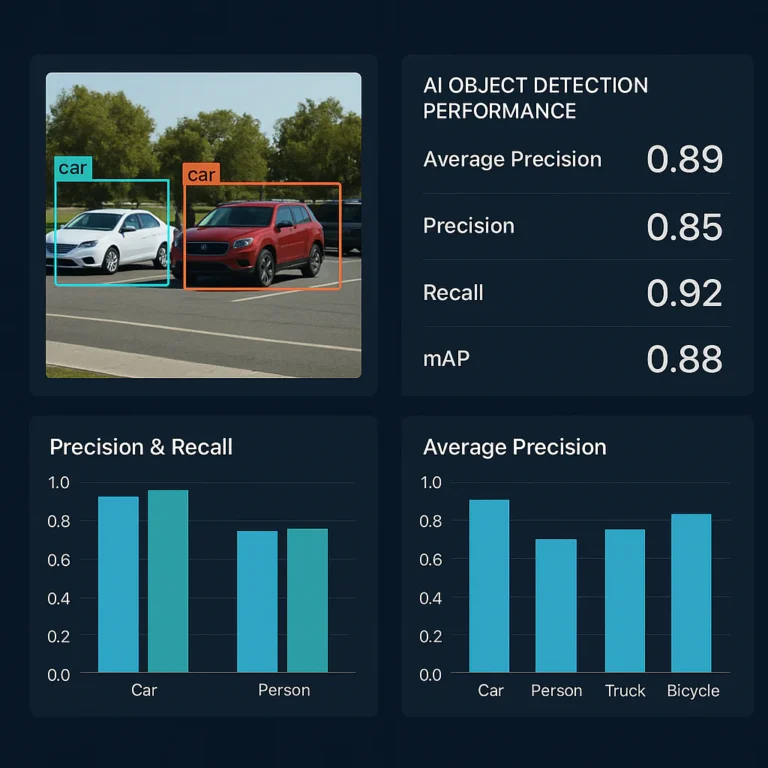
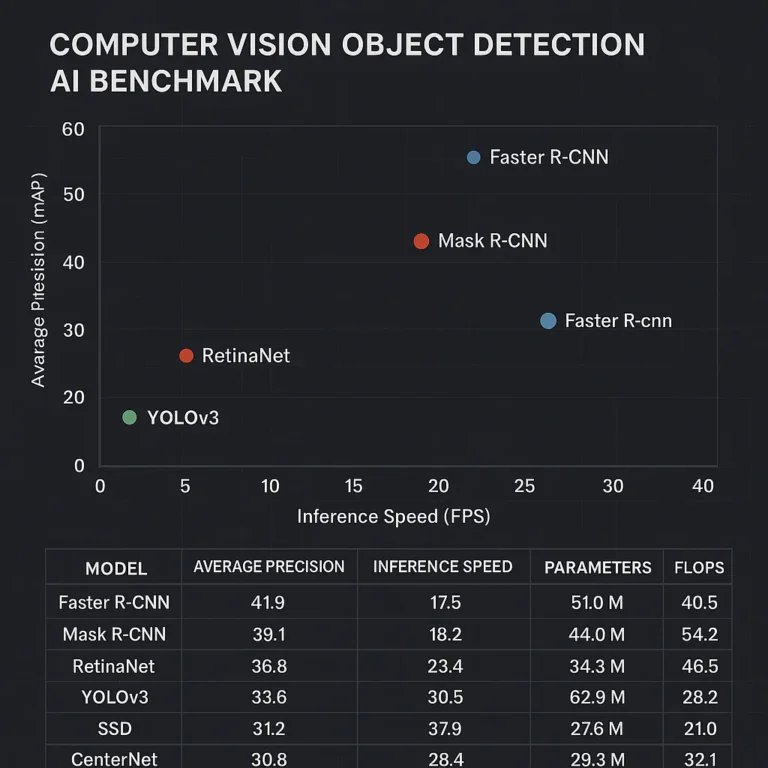
| Mean average precision (mAP) | Detection performance across classes and thresholds | Object detection |
| Intersection over Union (IoU) / Dice | Overlap between predicted and reference regions | Segmentation |
Metrics can disagree because they answer different questions. A medical model with high accuracy but poor recall on a critical condition may be unacceptable. A detection model’s mAP should be reported with the relevant evaluation protocol, not as a context-free trophy.
Handling class imbalance and noisy labels
Class imbalance may reflect reality, but it can make overall accuracy misleading. Consider:
- Reporting per-class precision, recall, and support.
- Using class-weighted losses or balanced sampling when appropriate.
- Collecting more examples for underepresented but important categories.
- Separating rare-class performance from aggregate metrics.
- Reviewing confusing categories for label ambiguity.
- Auditing a sample of annotations and documenting corrections.
Do not blindly balance the training set if the production class frequencies are important to your decision threshold. Training balance and deployment prevalence serve different purposes. And before reaching for a fancy loss function, inspect the labels—sometimes the “model problem” is actually a taxonomy problem.
Data augmentation and preprocessing
Common image transformations include resizing, cropping, horizontal flipping, color jitter, and normalization. They can improve robustness when they preserve the label and reflect plausible image variation.
A safe augmentation workflow:
- Inspect the original training images and task.
- Choose transformations that could occur in deployment.
- Apply augmentation only to the training data.
- Keep validation and test preprocessing fixed and documented.
- Check examples visually after transformation.
- Confirm that transformations do not change the label.
For example, rotating a product image may be reasonable; flipping a medical image may or may not be appropriate depending on anatomy and the clinical label. Augmentation is not a magic “more data” button. It is a way to teach selected invariances, and teaching the wrong invariance can hurt.
⚖️ Dataset Licensing, Ethics, and Responsible Use
Dataset comparison is incomplete without governance. Image data can include faces, homes, medical information, children, license plates, or copyrighted works. The team using the data is responsible for understanding its source and appropriate use.
Checking dataset terms before training or redistribution
Use this checklist before downloading or deploying:
- Read the official dataset terms, not only a third-party mirror.
- Confirm whether use is permitted for research, commercial training, or both.
- Check whether images may be redistributed.
- Confirm whether trained weights or derived data have separate requirements.
- Record attribution and citation requirements.
- Review image-level copyright or rights statements where available.
- Keep a copy or reference to the license version used in the project.
- Ask legal or privacy specialists when the use is consequential.
Do not assume that permissive code licensing covers the image files. Dataset images, annotations, and software can have different terms.
Privacy, consent, and sensitive images
Images can be personal data, and some image tasks are especially sensitive. Facial imagery, medical scans, and images of identifiable individuals call for additional scrutiny.
Consider:
- Whether people can be identified directly or indirectly.
- Whether informed consent or another lawful basis is needed.
- Whether data minimization, retention limits, and access controls are appropriate.
- Whether face blurring or metadata removal is necessary.
- Whether the intended model use creates risks beyond the original collection purpose.
- Whether applicable privacy rules organizational policies impose additional requirements.
The NIST Privacy Framework provides a structured resource for privacy risk management. Specific obligations depend on the jurisdiction, data, and application, so general benchmark documentation is not a substitute for legal advice.
Fairness, bias, and dataset documentation
Responsible use begins with documentation and continues through evaluation. Report what the dataset contains, what it omits, and what the model should not be used for.
Useful resources include:
- Datasheets for Datasets, a framework for documenting dataset motivation, composition, collection, and recommended use.
- Model Cards for Model Reporting, which proposes documenting model performance and limitations.
- The NIST AI Risk Management Framework, for broader AI risk management.
Where relevant, evaluate performance across meaningful subgroups and capture conditions. An average score can hide a weak slice; a polished benchmark table will not make that weakness disappear.
🛠️ Tools and Resources for Finding Image Datasets
A sensible search process starts with official dataset sites, then checks repositories and library loaders for versions and metadata. ChatBench.org also tracks developments in AI News and AI Agents where computer vision connects to broader AI systems.
Dataset repositories and benchmark portals
| Resource | Best for | Practical note |
|---|---|---|
| Papers with Code datasets | Finding datasets by task and related papers | Verify details against the official dataset source |
| Huging Face Datasets | Browsing and loading community datasets | Inspect dataset cards, license, and version history |
| Google Dataset Search | Discovering datasets across repositories | Search results are not a license review |
| Kagle Datasets | Community datasets and competitions | Check provenance, terms, and annotation quality |
| ImageNet | Large-scale classification research | Review access rules and official terms |
| CO | Detection, segmentation, captions, and keypoints | Select the right annotation release |
| Open Images | Broad object categories and annotations | Coverage varies by label and annotation type |
| MedMNIST | Lightweight biomedical benchmarks | Educational or research benchmark, not clinical validation |
Python libraries for loading image datasets
Popular options include:
- PyTorch torchvision: provides dataset interfaces and image transforms for many common computer vision workflows.
- TensorFlow Datasets: offers prepared datasets with standardized access patterns.
- Huging Face Datasets: supports dataset loading, processing, and sharing.
- OpenCV: provides image-processing and computer-vision utilities.
- scikit-learn: useful for evaluation, preprocessing, and conventional machine-learning workflows.
Before training, confirm that the loader uses the intended dataset version and official splits. Convenience is excellent; silently changing the data is less excellent.
Creating a custom image recognition dataset
When no public benchmark matches the task, a custom dataset may be the better investment. A disciplined workflow:
- Define the real decision: what should the model recognize, and what will someone do with the output?
- Set label rules: write clear class definitions and examples of edge cases.
- Plan representative collection: cover devices, environments, viewpoints, lighting, and expected class frequency.
- Review rights and privacy: establish consent, access, retention, and permitted use.
- Annotate with quality controls: train annotators, adjudicate disagreements, and audit samples.
- Group related samples: keep related images together when designing splits.
- Reserve an untouched test set: avoid repeated tuning on final evaluation data.
- Document limitations: explain what the dataset does and does not represent.
- Monitor after deployment: check for drift, new classes, and changing image conditions.
A custom dataset is not automatically better than a public one. It is better when it closes a real gap and is collected, labeled, and governed carefully.
✅ Quick Tips for Comparing Image Datasets
- Match the dataset to the output: labels for classification, boxes for detection, masks for segmentation.
- Inspect examples before training: a few minutes with the images can reveal a serious mismatch.
- Compare per-class counts, not only total size.
- Check resolution and capture conditions against deployment.
- Verify licenses, provenance, and privacy terms at the official source.
- Use robust splits: group by patient, video, product, site, or source when necessary.
- Report more than accuracy: add class-level metrics and the relevant task-specific measures.
- Use an independent external test when possible.
- Treat public leaderboard scores as evidence about a benchmark, not a guarantee about your application.
- Record dataset version, preprocessing, splits, and evaluation protocol.
- If comparing CNNs and vision transformers, hold the data and evaluation conditions steady. The medical-imaging review found task-dependent results and emphasized that independent testing remains limited (systematic review).
- Use small datasets to learn and larger, representative data to validate. CIFAR-10 makes a friendly training ground; it cannot tell you whether your model will recognize objects in every real-world setting.