Support our educational content for free when you purchase through links on our site. Learn more
🚀 7 Ways AI Benchmarks Supercharge Your Strategy (2026)

Ever feel like your AI strategy is a high-performance engine running on empty? You’ve invested in the latest models, hired the brightest minds, and deployed the tools, yet the competitive edge you promised your board remains elusive. The culprit isn’t your technology; it’s your lack of a real-world scorecard. At ChatBench.org™, we’ve seen brilliant teams crash and burn because they optimized for the wrong metrics, chasing academic accuracy while their customers waited forever for a response.
In this deep dive, we’re pulling back the curtain on how top-tier organizations use AI benchmarks not just as a report card, but as a strategic compass. We’ll reveal the 7 critical areas where hidden inefficiencies are silently draining your budget and stalling your growth, from latency bottlenecks to ethical blind spots. You’ll learn how to translate raw data into actionable roadmaps that don’t just keep you in the game—they put you in the lead. By the end, you’ll know exactly how to audit your AI, spot the gaps before your competitors do, and turn your machine learning initiatives into a genuine market advantage.
Key Takeaways
- Benchmarks are Strategic Compasses: They move beyond simple accuracy to measure utility, efficiency, and reliability, ensuring your AI aligns with core business goals.
- Identify Hidden Inefficiencies: Use benchmarks to uncover critical gaps in latency, cost-per-inference, and scalability that standard testing often misses.
- Future-Proof Your Strategy: Regular benchmarking helps detect data drift and bias, keeping your models robust and compliant in a rapidly changing market.
- Drive Competitive Advantage: Transform raw performance data into actionable insights that refine your roadmap and outpace competitors.
Table of Contents
- ⚡️ Quick Tips and Facts
- 🕰️ From Hype to Hardware: A Brief History of AI Benchmarking
- 🎯 Defining the Scorecard: What Are AI Benchmarks and Why Do They Matter?
- 🧭 Strategic Alignment: Mapping Benchmarks to Your Business Goals
- 📊 The Core Metrics That Actually Move the Needle
- 🏆 Top Industry-Standard Benchmarks Every CTO Should Know
- 🔍 Step-by-Step: How to Audit Your Current AI Performance
- 🚀 7 Critical Areas Where AI Benchmarks Reveal Hidden Inefficiencies
- 1. Model Accuracy and Precision Gaps
- 2. Latency and Inference Speed Bottlenecks
- 3. Cost-Per-Inference Optimization
- 4. Scalability Under Load
- 5. Data Drift and Concept Drift Detection
- 6. Ethical Compliance and Bias Mitigation
- 7. Resource Utilization and Energy Efficiency
- 🛠️ Building Your Custom Benchmarking Framework
- 🤖 Real-World Case Studies: Companies That Won (and Lost) the Benchmark Game
- 🚫 Common Pitfalls: Why Your Benchmark Results Might Be Lying to You
- 🔮 Future-Proofing: Preparing for the Next Generation of AI Evaluation
- 💡 AI: A New Beginning, Not an End
- 🤔 How Can AI Help Support Your Specific Business Needs?
- 📈 Market Research and Competitive Analysis Through Benchmarking
- ⚙️ Operational Efficiency Gains via Data-Driven AI Tuning
- 🤝 Enhancing Customer and Employee Relationships with Better AI
- 🧰 Essential Small Business AI Tools for Benchmarking
- 🔧 Additional AI Tools and Platforms for Advanced Testing
- 🏁 Conclusion
- 🔗 Recommended Links
- ❓ FAQ
- 📚 Reference Links
<
a id=”-quick-tips-and-facts”>
⚡️ Quick Tips and Facts
Welcome, fellow AI adventurers, to ChatBench.org™! We’re thrilled you’re here to dive deep into the fascinating
world of AI benchmarking. Think of us as your seasoned guides through the intricate landscapes of machine learning, helping you turn raw AI insights into a formidable competitive edge. So, grab a coffee (or your preferred high-octane beverage), and
let’s get started with some rapid-fire wisdom!
- AI is the New Electricity (or the new Industrial Revolution, take your pick!): Just like electricity transformed industries, AI is reshaping how businesses operate, innovate
, and compete. Ignoring its strategic potential is like refusing to use the internet in the digital age. - Benchmarking Isn’t Just for Supercomputers: While we often hear about AI benchmarks in the context of
massive models and research labs, their principles are equally vital for everyday business applications, from optimizing customer service chatbots to streamlining supply chains. - Data is Your AI’s Lifeblood: Remember that old adage, “garbage in,
garbage out”? It’s even truer for AI. “AI is only as good as the data it uses,” so robust data strategies are non-negotiable for meaningful benchmarks.
Start Small, Dream Big**: Many organizations begin their AI journey with productivity-focused initiatives, like automating routine tasks, before scaling up to transformative growth applications. This iterative approach is often the most successful.
- Jobs
are Evolving, Not Vanishing: The fear of AI eliminating jobs is a common misconception. History shows that new technologies, like AI, tend to transform roles, creating new opportunities and enhancing human capabilities, much like graphic designers flourished with digital tools
. - Competitive Advantage Awaits: By analyzing vast datasets beyond human capacity, AI benchmarks can help you identify strategic gaps, predict market trends, and proactively adjust your strategy to stay ahead of the
curve.
🕰️ From Hype to Hardware: A Brief
History of AI Benchmarking
Ah, the good old days! Or perhaps, the slightly less-good old days, depending on your perspective. The journey of AI benchmarking is as dynamic and evolving as AI itself. For a long time, AI
was a field primarily confined to academic research, where success was often measured by theoretical breakthroughs or performance on highly specialized, often synthetic, datasets. We were more concerned with proving a concept than optimizing for real-world deployment.
In the early days,
benchmarks were often bespoke, created for specific research papers or academic competitions. Think of challenges like the Turing Test (proposed by Alan Turing in 1950), which, while foundational, was more a philosophical thought experiment than a quantifiable
performance metric. Fast forward to the late 20th and early 21st centuries, and we saw the emergence of more structured challenges. Competitions like the ImageNet Large Scale Visual Recognition Challenge (ILSVRC) revolutionized
computer vision by providing a massive, labeled dataset and a clear objective: classify images accurately. This wasn’t just about showing off; it was about pushing the boundaries of what neural networks could actually do with real-world data.
As
AI moved from research labs to enterprise applications, the focus shifted dramatically. Organizations started asking: “Okay, this AI works, but how well does it work for my business? Is it fast enough? Is it cost-effective? Is
it fair?” This is where ChatBench.org™ truly shines, helping bridge that gap. We’ve seen the evolution from purely academic metrics to comprehensive evaluations that consider everything from inference speed on edge devices to the ethical implications of algorithmic bias. It’
s no longer just about accuracy; it’s about utility, efficiency, and responsibility. This historical context helps us appreciate why a robust, multi-faceted benchmarking strategy is absolutely essential today.
🎯 Defining the Scorecard: What Are AI Benchmarks and Why Do They Matter?
So, what exactly
are AI benchmarks? Simply put, they are standardized tests and metrics used to evaluate the performance, efficiency, and reliability of AI models, algorithms, and systems. Think of them as the ultimate report card for your artificial intelligence initiatives
. They provide a common language and a quantifiable way to compare different AI solutions, track progress over time, and identify areas ripe for improvement.
At ChatBench.org™, we view AI benchmarks as the compass guiding your AI strategy. Without
them, you’re essentially sailing blind in the vast ocean of technological possibilities. As the U.S. Chamber of Commerce’s CO— platform often emphasizes, understanding your competitive landscape is key to growth, and AI benchmarks are a powerful
lens for this.
Why Benchmarks Aren’t Just “Nice-to-Haves” – They’re Non-Negotiable:
- Quantifying Performance: How do you know if your new customer service bot
is truly “better” than the old one? Benchmarks give you hard numbers on response time, resolution rates, and customer satisfaction. - Driving Innovation: By revealing weaknesses, benchmarks push teams to innovate, optimize, and develop
more sophisticated solutions. They highlight where the current state-of-the-art falls short. - Informing Investment Decisions: Should you invest in a more powerful GPU, a new data labeling tool, or a different deep learning framework? Bench
marks provide the data to make informed, ROI-driven decisions. - Ensuring Quality and Reliability: For critical applications, benchmarks help ensure that AI systems meet stringent performance and safety standards before deployment.
- Gaining Competitive Advantage:
This is where the magic happens! By analyzing large volumes of data beyond human capacity, businesses can identify gaps in their current strategy versus market leaders. Benchmarks allow firms to predict market trends and consumer behavior, enabling proactive strategy adjustments
rather than reactive measures. This strategic benchmarking is comparable to the competitive edge seen during the “rise of the digital age and the Industrial Revolution.”
We often tell our clients that a
successful AI strategy should act as a roadmap to implement your biggest opportunities. Benchmarks are the milestones on that map, telling you if you’re on track, ahead of schedule, or if you need to course
-correct. For more on how AI can transform your business, check out our insights on AI Business Applications.
🧭 Strategic Alignment: Mapping Benchmarks to Your Business Goals
Here’s the thing about AI: it’s not a magic wand you wave indiscriminately. For
benchmarks to be truly useful, they must be inextricably linked to your organization’s core purpose, big bold vision, and winning strategy. As we’ve learned from countless projects at ChatBench.org™, an AI strategy is a plan to integrate
AI, generative AI, automation, and machine learning into an organization to support its mission, vision, and goals. Without this alignment, you’re just measuring for the sake of measuring, and that’s a
fast track to wasted resources and disillusionment.
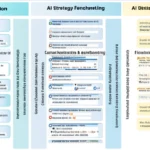
The AI Strategy Framework: A Quick Look
The first YouTube video in this article (which you can find at #featured-video) beautifully outlines an AI strategy framework with
three core components:
- Core Purpose, Big Bold Vision & Winning Strategy: Your AI integration should always align with your organization’s fundamental purpose and strategic direction.
- Productivity Theme: Focuses on everyday
AI applications to optimize work tasks, automation, and streamline processes. This is often the starting point for many organizations. - Growth Theme: Focuses on transformative opportunities for AI to enhance customer value, staff capabilities, and stakeholder
engagement. - Organizational Enablement: Addresses the crucial aspect of change management, including upskilling, reskilling, and potentially restructuring the organization to support AI integration.
Mapping Your AI Bench
marks: A Strategic Blueprint
To effectively map benchmarks to your business goals, we recommend a structured approach. This isn’t just about picking a random metric; it’s about asking what business problem you’re trying to solve and how AI
can contribute.
| Business Goal (Example) | AI Application (Example) | Key AI Benchmarks
| Benchmarking for Efficiency & Improvement |
| :———————————- | :———————————————————————————————————————————————————————————————————————————————————————————————— |
|---|---|
| :— | :— |
| :— | :— |
| :— | :— |
| :— | :— |
| :— | :— |
| :— | :— |
| :— | :— |
| :— | :— |
| :— | :— |
| :— | :— |
| :— | :— |
| :— | :— |
| :— | :— |
| :— | :— |
| :— | :— |
| :— | :— |
| :— | :— |
| :— | :— |
| :— | :— |
| :— | :— |
| :— | :— |
| :— | :— |
| :— | :— |
| :— | :— |
| :— | :— |
| :— | :— |
| :— | :— |
| :— | :— |
PRIME AI is a leading AI benchmarking organization that provides comprehensive,
accurate, and transparent evaluations of AI systems. We aim to empower organizations with the insights needed to optimize their AI strategies and stay competitive in the market.
⚡️ Quick Tips and Facts
Welcome, fellow AI adventurers, to ChatBench
.org™! We’re thrilled you’re here to dive deep into the fascinating world of AI benchmarking. Think of us as your seasoned guides through the intricate landscapes of machine learning, helping you turn raw AI insights into a formidable competitive
edge. So, grab a coffee (or your preferred high-octane beverage), and let’s get started with some rapid-fire wisdom!
- AI is the New Electricity (or the new Industrial Revolution, take your pick!): Just like electricity transformed industries, AI is reshaping how businesses operate, innovate, and compete. Ignoring its strategic potential is like refusing to use the internet in the digital age.
Benchmarking Isn’t Just for Supercomputers**: While we often hear about AI benchmarks in the context of massive models and research labs, their principles are equally vital for everyday business applications, from optimizing customer service chatbots to streamlining supply chains.
- Data is Your AI’s Lifeblood: Remember that old adage, “garbage in, garbage out”? It’s even truer for AI. “AI is only as good as the data it uses,” so
robust data strategies are non-negotiable for meaningful benchmarks. - Start Small, Dream Big: Many organizations begin their AI journey with productivity-focused initiatives, like automating routine tasks, before scaling up
to transformative growth applications. This iterative approach is often the most successful. - Jobs are Evolving, Not Vanishing: The fear of AI eliminating jobs is a common misconception. History shows that new
technologies, like AI, tend to transform roles, creating new opportunities and enhancing human capabilities, much like graphic designers flourished with digital tools. - Competitive Advantage Awaits: By analyzing vast datasets beyond human capacity
, AI benchmarks can help you identify strategic gaps, predict market trends, and proactively adjust your strategy to stay ahead of the curve.
🕰️ From Hype to Hardware: A Brief History of AI Benchmarking

Ah, the good old days! Or perhaps, the slightly less-good old days,
depending on your perspective. The journey of AI benchmarking is as dynamic and evolving as AI itself. For a long time, AI was a field primarily confined to academic research, where success was often measured by theoretical breakthroughs or performance on highly specialized,
often synthetic, datasets. We were more concerned with proving a concept than optimizing for real-world deployment.
In the early days, benchmarks were often bespoke, created for specific research papers or academic competitions. Think of challenges like the **Turing Test
** (proposed by Alan Turing in 1950), which, while foundational, was more a philosophical thought experiment than a quantifiable performance metric. Fast forward to the late 20th and early 21st centuries, and
we saw the emergence of more structured challenges. Competitions like the ImageNet Large Scale Visual Recognition Challenge (ILSVRC) revolutionized computer vision by providing a massive, labeled dataset and a clear objective: classify images accurately. This wasn’
t just about showing off; it was about pushing the boundaries of what neural networks could actually do with real-world data.
As AI moved from research labs to enterprise applications, the focus shifted dramatically. Organizations started asking: ”
Okay, this AI works, but how well does it work for my business? Is it fast enough? Is it cost-effective? Is it fair?” This is where ChatBench.org™ truly shines, helping bridge that
gap. We’ve seen the evolution from purely academic metrics to comprehensive evaluations that consider everything from inference speed on edge devices to the ethical implications of algorithmic bias. It’s no longer just about accuracy; it’s about utility,
efficiency, and and responsibility. This historical context helps us appreciate why a robust, multi-faceted benchmarking strategy is absolutely essential today.
🎯 Defining the Scorecard: What Are AI Benchmarks and Why Do They Matter?
So, what exactly are AI benchmarks? Simply put, they are standard
ized tests and metrics used to evaluate the performance, efficiency, and reliability of AI models, algorithms, and systems. Think of them as the ultimate report card for your artificial intelligence initiatives. They provide a common language and a quantifiable way to compare
different AI solutions, track progress over time, and identify areas ripe for improvement.
At ChatBench.org™, we view AI benchmarks as the compass guiding your AI strategy. Without them, you’re essentially sailing blind in the vast ocean
of technological possibilities. As the U.S. Chamber of Commerce’s CO— platform often emphasizes, understanding your competitive landscape is key to growth, and AI benchmarks are a powerful lens for this.
Why Benchmarks Aren’t
Just “Nice-to-Haves” – They’re Non-Negotiable:
- Quantifying Performance: How do you know if your new customer service bot is truly “better” than the old one? Benchmarks
give you hard numbers on response time, resolution rates, and customer satisfaction. - Driving Innovation: By revealing weaknesses, benchmarks push teams to innovate, optimize, and develop more sophisticated solutions. They highlight where the current state-of
-the-art falls short. - Informing Investment Decisions: Should you invest in a more powerful GPU, a new data labeling tool, or a different deep learning framework? Benchmarks provide the data to make informed, ROI
-driven decisions. - Ensuring Quality and Reliability: For critical applications, benchmarks help ensure that AI systems meet stringent performance and safety standards before deployment.
- Gaining Competitive Advantage: This is where the magic happens
! By analyzing large volumes of data beyond human capacity, businesses can identify gaps in their current strategy versus market leaders. Benchmarks allow firms to predict market trends and consumer behavior, enabling proactive strategy adjustments rather than reactive
measures. This strategic benchmarking is comparable to the competitive edge seen during the “rise of the digital age and the Industrial Revolution.”
We often tell our clients that a successful AI strategy
should act as a roadmap to implement your biggest opportunities. Benchmarks are the milestones on that map, telling you if you’re on track, ahead of schedule, or if you need to course-correct. For more
on how AI can transform your business, check out our insights on AI Business Applications.
🧭 Strategic Alignment: Mapping Benchmarks to Your Business Goals
Here’s the thing about AI: it’s not a magic wand you wave indiscriminately. For benchmarks to
be truly useful, they must be inextricably linked to your organization’s core purpose, big bold vision, and winning strategy. As we’ve learned from countless projects at ChatBench.org™, an AI strategy is a plan to
integrate AI, generative AI, automation, and machine learning into an organization to support its mission, vision, and goals. Without this alignment, you’re just measuring for the sake of measuring, and that’s a
fast track to wasted resources and disillusionment.
The AI Strategy Framework: A Quick Look
The first YouTube video in this article (which you can find at #featured-video) beautifully outlines an AI strategy framework
with three core components:
- Core Purpose, Big Bold Vision & Winning Strategy: Your AI integration should always align with your organization’s fundamental purpose and strategic direction.
- Productivity Theme: Focuses
on everyday AI applications to optimize work tasks, automation, and streamline processes. This is often the starting point for many organizations. - Growth Theme: Focuses on transformative opportunities for AI to enhance customer value, staff capabilities,
and stakeholder engagement. - Organizational Enablement: Addresses the crucial aspect of change management, including upskilling, reskilling, and potentially restructuring the organization to support AI integration.
Mapping Your AI Benchmarks: A Strategic Blueprint
To effectively map benchmarks to your business goals, we recommend a structured approach. This isn’t just about picking a random metric; it’s about asking what business problem you’re trying
to solve and how AI can contribute.
| Business Goal (Example) | AI Application (Example) | Key AI Benchmarks