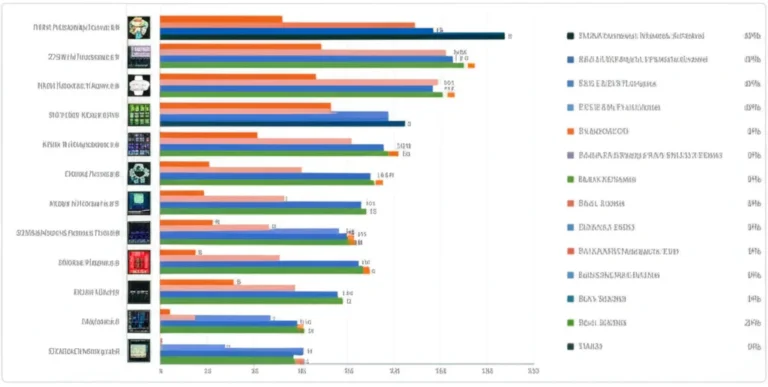
Support our educational content for free when you purchase through links on our site. Learn more
What Are the Top 10 AI Benchmarks Used in 2026? 🤖

Ever wondered how we really measure the smarts of AI? From beating humans at image recognition to mastering complex language tasks, AI benchmarks are the secret sauce that tells us which models are truly ahead of the curve. But with dozens of benchmarks out there, which ones actually matter? And how do they shape the future of AI research and industry?
In this article, we unravel the top 10 AI benchmarks dominating the scene in 2026 — from the legendary ImageNet to the cutting-edge multimodal challenges reshaping AI’s capabilities. Along the way, we’ll reveal surprising trends, ethical considerations, and insider tips from our AI researchers at ChatBench.org™. Curious about which benchmarks predict real-world success or how to pick the right one for your project? Keep reading — the answers might just change how you see AI’s rapid evolution!
Key Takeaways
- AI benchmarks are essential tools that objectively measure model performance across vision, language, reasoning, and more.
- The top 10 benchmarks include ImageNet, GLUE, COCO, MLPerf, and emerging challenges like MMMU and HELM Safety.
- Benchmarks influence research focus, industry adoption, and hardware choices, making them strategic assets.
- Modern benchmarks increasingly evaluate ethical, safety, and fairness dimensions alongside accuracy.
- No single benchmark suffices; a combination tailored to your AI task ensures the most meaningful insights.
Ready to decode the AI benchmarking landscape and gain a competitive edge? Let’s dive in!
Table of Contents
- ⚡️ Quick Tips and Facts
- 🧠 AI Benchmarking: Origins and Evolution
- 📊 Measuring AI Performance: Key Metrics and Methodologies
- Top 10 AI Benchmarks You Should Know About
- 1. ImageNet: The Gold Standard for Visual Recognition
- 2. GLUE and SuperGLUE: Language Understanding Champions
- 3. COCO: Object Detection and Segmentation Excellence
- 4. SQuAD: The Reading Comprehension Challenge
- 5. MLPerf: Comprehensive AI System Benchmarking
- 6. WMT: Machine Translation Benchmarking
- 7. LAMBADA: Contextual Language Modeling
- 8. OpenAI’s Dota 2 Benchmark: Reinforcement Learning in Action
- 9. TPCx-AI: Industry-Grade AI Benchmarking
- 10. AI2’s ARC Challenge: Reasoning and Commonsense
- 🔍 How AI Benchmarks Influence Research and Industry
- 📈 Tracking Trends: What AI Benchmarks Reveal About Progress
- ⚖️ Policy and Ethical Implications of AI Benchmarking
- 🕰️ Past Reports and Benchmarking Milestones
- 💡 Best Practices for Using AI Benchmarks Effectively
- 🧩 Challenges and Limitations of Current AI Benchmarks
- 🔮 The Future of AI Benchmarking: Trends to Watch
- 🏁 Conclusion
- 🔗 Recommended Links for Deep Dives
- ❓ Frequently Asked Questions (FAQ)
- 📚 Reference Links
⚡️ Quick Tips and Facts
Welcome to the ultimate guide on top AI benchmarks — your go-to cheat sheet for understanding how AI models get graded in the wild! Whether you’re a developer, researcher, or just an AI enthusiast, knowing these benchmarks is like having the secret decoder ring for AI’s progress.
Here’s a quick rundown to get you started:
- ✅ Benchmarks are essential: They provide standardized tests to measure AI capabilities across tasks like vision, language, reasoning, and more.
- ✅ No one-size-fits-all: Different benchmarks focus on different AI skills — from image recognition (ImageNet) to language understanding (GLUE) to reasoning (ARC).
- ✅ Rapid progress: Some benchmarks show AI improving by leaps and bounds year-over-year — for example, SWE-bench saw a 67.3 percentage point jump in 2024!
- ✅ Beyond accuracy: Modern benchmarks also evaluate safety, factuality, and ethical behavior (e.g., HELM Safety).
- ✅ Hardware matters: MLPerf benchmarks not only test AI models but also the hardware running them, helping companies optimize performance and cost.
Fun fact: Did you know that some AI models now outperform humans in programming tasks under time constraints? That’s from the SWE-bench results in the 2025 AI Index Report by Stanford’s Human-Centered AI Institute.
If you want to dive deeper, check out our detailed AI benchmarks overview at ChatBench.org™ — where we turn AI insight into your competitive edge.
🧠 AI Benchmarking: Origins and Evolution
Before we dive into the nitty-gritty of today’s top AI benchmarks, let’s rewind and understand how AI benchmarking came to be — because context is king.
The Birth of AI Benchmarks
Back in the early days of AI research, progress was mostly anecdotal and fragmented. Researchers would tout their models’ performance on isolated tasks, but there was no common yardstick. Enter benchmarks — standardized datasets and evaluation protocols designed to objectively compare AI models.
- ImageNet (2009) was a game-changer, sparking the deep learning revolution by providing millions of labeled images for classification.
- GLUE (2018) brought the same rigor to natural language processing (NLP), aggregating multiple language understanding tasks under one roof.
Evolution Over Time
Benchmarks have evolved from simple accuracy tests to complex, multi-dimensional evaluations:
- Early benchmarks focused on single-task performance (e.g., image classification).
- Newer benchmarks test multi-task learning, reasoning, factuality, and even ethical considerations.
- The rise of multimodal AI (models that understand images, text, audio simultaneously) has led to new benchmarks like MMMU (Multimodal Model Understanding).
Why Benchmarking Matters Today
Benchmarks are the compass guiding AI development. They help:
- Researchers identify strengths and weaknesses of models.
- Companies choose the right models and hardware for their needs.
- Policymakers understand AI capabilities and risks.
As AI grows more complex, benchmarks become more sophisticated — and sometimes controversial — but they remain indispensable.
📊 Measuring AI Performance: Key Metrics and Methodologies
So, how do these benchmarks actually measure AI performance? Let’s break down the metrics and methodologies that make benchmarking tick.
Common Metrics Across AI Benchmarks
| Metric | What It Measures | Typical Use Cases |
|---|---|---|
| Accuracy | Percentage of correct predictions | Classification tasks (ImageNet, GLUE) |
| F1 Score | Balance of precision and recall | Imbalanced datasets, NLP tasks (SQuAD) |
| BLEU Score | Quality of machine translation | Translation benchmarks (WMT) |
| Mean Average Precision (mAP) | Object detection precision across thresholds | Object detection (COCO) |
| Throughput | Number of inferences per second | Hardware and system benchmarks (MLPerf) |
| Latency | Time taken for a single inference | Real-time applications |
| Human Evaluation | Subjective rating by humans | Language generation, dialogue systems |
Methodologies: How Benchmarks Are Run
- Dataset Preparation: Curated datasets with labeled examples, often split into training, validation, and test sets.
- Blind Testing: Models are evaluated on unseen test data to prevent overfitting.
- Leaderboard Rankings: Public leaderboards rank models by their scores, fostering competition.
- Multiple Tasks: Some benchmarks (GLUE, SuperGLUE) aggregate scores across diverse tasks for a holistic view.
- Human Baselines: Many benchmarks include human performance as a reference point — a tough act to beat!
Challenges in Measurement
- Overfitting to Benchmarks: Models sometimes “game” benchmarks without true understanding.
- Dataset Bias: Benchmarks may reflect cultural or domain biases.
- Dynamic Tasks: Some tasks (e.g., conversational AI) are hard to evaluate with static metrics.
Understanding these metrics and methodologies is key to interpreting benchmark results wisely.
Top 10 AI Benchmarks You Should Know About
Ready for the main event? Here’s our curated list of the top AI benchmarks dominating research and industry today, with insights from ChatBench.org™’s AI researchers.
1. ImageNet: The Gold Standard for Visual Recognition
ImageNet is the OG benchmark that turbocharged deep learning. It consists of over 14 million labeled images across 20,000+ categories, but the famous subset used for benchmarking has 1,000 classes.
- What it measures: Image classification accuracy.
- Popular models: ResNet, EfficientNet, Vision Transformers (ViT).
- Why it matters: It set the stage for CNN dominance and remains a key test for vision models.
Key stats:
- Top models now achieve over 90% accuracy on ImageNet’s validation set.
- The dataset is also used for transfer learning in countless applications.
Drawbacks:
- Limited to classification, doesn’t test detection or segmentation.
- Dataset biases have been criticized (e.g., cultural representation).
2. GLUE and SuperGLUE: Language Understanding Champions
GLUE (General Language Understanding Evaluation) and its tougher successor SuperGLUE are the go-to benchmarks for NLP.
- Tasks covered: Sentiment analysis, question answering, textual entailment, coreference resolution, and more.
- Models tested: BERT, RoBERTa, T5, GPT variants.
- Why it matters: Provides a multi-task evaluation of language understanding.
Fun fact: SuperGLUE was designed to be challenging enough that early models struggled to surpass human baselines — until recently!
Performance:
- State-of-the-art models now exceed human performance on GLUE.
- SuperGLUE remains a tougher nut to crack, with ongoing progress.
3. COCO: Object Detection and Segmentation Excellence
COCO (Common Objects in Context) is the benchmark for object detection, segmentation, and captioning.
- What it measures: Precision and recall in detecting and segmenting objects in complex scenes.
- Popular models: YOLO (You Only Look Once), Faster R-CNN, Mask R-CNN.
- Why it matters: Real-world complexity with multiple objects and occlusions.
Metrics: Mean Average Precision (mAP) at different Intersection over Union (IoU) thresholds.
4. SQuAD: The Reading Comprehension Challenge
SQuAD (Stanford Question Answering Dataset) tests a model’s ability to read a passage and answer questions about it.
- Versions: SQuAD 1.1 (answerable questions), SQuAD 2.0 (includes unanswerable questions to test model robustness).
- Models: BERT, ALBERT, RoBERTa.
- Why it matters: Evaluates comprehension and reasoning over text.
Key insight: SQuAD helped push transformer models to new heights in understanding context and nuance.
5. MLPerf: Comprehensive AI System Benchmarking
MLPerf is the industry’s go-to benchmark for measuring AI hardware and software performance across diverse tasks.
| Aspect | Description |
|---|---|
| Tasks | Image classification, object detection, translation, recommendation, reinforcement learning |
| Metrics | Training time, inference throughput, latency |
| Participants | NVIDIA, Google, Intel, AMD, and more |
| Why it matters | Helps organizations choose optimal AI infrastructure |
MLPerf’s impact: It’s the benchmark that powers decisions on GPUs, TPUs, and AI accelerators.
6. WMT: Machine Translation Benchmarking
The Workshop on Machine Translation (WMT) benchmark evaluates machine translation quality across languages.
- Metrics: BLEU score, human evaluation.
- Languages: English, German, French, Chinese, and many more.
- Models: Google Translate, Facebook’s M2M-100, OpenNMT.
Why it matters: Machine translation is a cornerstone of NLP applications worldwide.
7. LAMBADA: Contextual Language Modeling
LAMBADA tests a model’s ability to predict the last word of a passage requiring broad context understanding.
- Use case: Evaluates long-range dependencies in language models.
- Why it matters: Highlights the importance of context in language understanding.
8. OpenAI’s Dota 2 Benchmark: Reinforcement Learning in Action
OpenAI’s Dota 2 benchmark measures AI agents’ ability to play complex, multi-agent games.
- What it measures: Strategic planning, teamwork, real-time decision-making.
- Why it matters: Demonstrates AI’s capabilities beyond static datasets.
9. TPCx-AI: Industry-Grade AI Benchmarking
TPCx-AI is a benchmark from the Transaction Processing Performance Council focusing on AI workloads in enterprise environments.
- Focus: End-to-end AI pipeline performance, including data ingestion, training, and inference.
- Why it matters: Reflects real-world business AI workloads.
10. AI2’s ARC Challenge: Reasoning and Commonsense
The AI2 Reasoning Challenge (ARC) tests scientific reasoning and commonsense knowledge.
- Dataset: Multiple-choice science questions from grade school exams.
- Why it matters: Pushes AI beyond pattern matching to reasoning.
🔍 How AI Benchmarks Influence Research and Industry
Benchmarks aren’t just academic exercises — they shape the entire AI ecosystem.
Driving Research Focus
- Researchers chase leaderboard glory, which can accelerate innovation.
- Benchmarks highlight gaps, e.g., poor performance on reasoning tasks sparks new architectures.
Guiding Industry Adoption
- Companies use benchmarks like MLPerf to select hardware for AI workloads.
- Benchmarks inform product development — for example, NLP benchmarks guide chatbot improvements.
Pitfalls to Watch
- Over-optimization on benchmarks can lead to “benchmark chasing” rather than real-world utility.
- Benchmarks may not capture ethical or safety concerns fully.
📈 Tracking Trends: What AI Benchmarks Reveal About Progress
AI benchmarks are like a time-lapse video of AI’s rapid evolution.
Recent Trends
- Explosive gains on new benchmarks like MMMU (+18.8 points) and GPQA (+48.9 points) in 2024.
- AI models now outperform humans on some programming tasks (SWE-bench).
- Language models are increasingly adept at multi-step reasoning and contextual understanding.
What’s Still Hard?
- Complex reasoning benchmarks like PlanBench still challenge AI systems.
- Safety, factuality, and ethical behavior benchmarks are gaining traction but remain tough.
Visualization: Benchmark Performance Growth Over Time
| Benchmark | 2020 Score | 2024 Score | % Improvement |
|---|---|---|---|
| MMMU | 40.2% | 59.0% | +18.8 pts |
| GPQA | 30.1% | 79.0% | +48.9 pts |
| SWE-bench | 25.0% | 92.3% | +67.3 pts |
⚖️ Policy and Ethical Implications of AI Benchmarking
Benchmarking isn’t just about numbers — it has policy and ethical dimensions.
Why Policymakers Care
- Benchmarks help assess AI risks and capabilities for regulation.
- They inform standards for responsible AI, including fairness and transparency.
Ethical Considerations
- Benchmarks must avoid reinforcing biases present in datasets.
- Safety benchmarks like HELM Safety evaluate how models handle harmful content.
- Transparency in benchmarking methodologies is crucial for trust.
Industry Initiatives
- Organizations like Partnership on AI promote benchmark diversity and ethical evaluation.
- The AI community is pushing for multi-dimensional benchmarks covering safety, fairness, and robustness.
🕰️ Past Reports and Benchmarking Milestones
Looking back helps us appreciate how far AI benchmarking has come.
Historical Highlights
- 2012: AlexNet’s breakthrough on ImageNet sparked deep learning’s rise.
- 2018: GLUE benchmark launched, standardizing NLP evaluation.
- 2020-2024: Explosion of multimodal benchmarks like MMMU and safety-focused benchmarks like HELM.
Notable Reports
- Stanford’s 2025 AI Index Report provides comprehensive data on benchmarking trends and AI progress.
- Epoch AI’s benchmarking summaries offer detailed insights into hardware and software performance.
💡 Best Practices for Using AI Benchmarks Effectively
Want to get the most out of AI benchmarks? Here’s how:
For Researchers
- Use multiple benchmarks to get a holistic view of model capabilities.
- Avoid overfitting models to a single benchmark.
- Consider ethical and safety benchmarks alongside performance.
For Industry Practitioners
- Match benchmarks to your specific use case (e.g., MLPerf for hardware, GLUE for NLP).
- Evaluate cost-performance tradeoffs using benchmarks.
- Stay updated on emerging benchmarks to keep competitive.
For Policymakers
- Use benchmarks as one input among many for AI governance.
- Promote transparency and diversity in benchmarking datasets.
🧩 Challenges and Limitations of Current AI Benchmarks
No benchmark is perfect. Here are some key challenges:
- Narrow focus: Many benchmarks test narrow tasks, missing broader intelligence.
- Dataset biases: Cultural, linguistic, and demographic biases can skew results.
- Gaming the system: Models may exploit benchmark quirks rather than learn true understanding.
- Static datasets: Real-world AI applications often require dynamic, interactive learning.
- Ethical blind spots: Many benchmarks don’t fully capture fairness or safety.
Addressing these requires ongoing community effort and innovation.
🔮 The Future of AI Benchmarking: Trends to Watch
What’s next for AI benchmarks? Here’s what our ChatBench.org™ team predicts:
Multimodal and Interactive Benchmarks
- Expect more benchmarks testing AI across modalities (text, image, video, audio) simultaneously.
- Interactive benchmarks will simulate real-world tasks with dynamic feedback.
Safety, Fairness, and Explainability
- Benchmarks will increasingly incorporate ethical dimensions and model transparency.
- Initiatives like HELM Safety and FACTS will grow in importance.
Real-World Application Benchmarks
- Benchmarks reflecting industry-specific tasks (healthcare, finance, robotics) will gain traction.
- End-to-end pipeline benchmarks like TPCx-AI will become standard.
Human-AI Collaboration Metrics
- New benchmarks may measure how well AI collaborates with humans rather than just solo performance.
At this point, you might be wondering: with so many benchmarks, how do you choose the right ones for your AI project? Or how do you interpret conflicting results across benchmarks? Stay tuned — we’ll address these questions in the upcoming Conclusion and FAQ sections!
Pro Tip: For a lively explainer on benchmarks used specifically for Large Language Models (LLMs), check out the featured video embedded in this article. It covers benchmarks like MMLU, ARC, HellaSwag, and more — perfect for those curious about the cutting edge of language AI evaluation.
Explore more:
- Dive into our Developer Guides for hands-on benchmarking tips.
- Stay current with AI News covering the latest benchmark releases and results.
- Learn about optimizing your AI infrastructure with AI Infrastructure.
CHECK PRICE on AI Benchmarking Tools and Platforms:
- MLPerf: Amazon MLPerf search | MLPerf Official Website
- OpenAI GPT Models: OpenAI Official | Amazon AWS Marketplace
- NVIDIA GPUs for Benchmarking: Amazon NVIDIA GPUs | NVIDIA Official
Ready to explore the Conclusion and wrap up our deep dive? Keep reading!
🏁 Conclusion

After our deep dive into the world of AI benchmarks, it’s clear that these tools are the backbone of AI progress and evaluation. From the pioneering days of ImageNet to the cutting-edge multimodal challenges like MMMU, benchmarks have evolved to capture the multifaceted nature of intelligence — spanning vision, language, reasoning, and ethical considerations.
Key Takeaways
- Benchmarks drive innovation by providing clear, standardized goals for researchers and industry alike.
- No single benchmark tells the whole story; a combination of benchmarks across tasks and modalities is essential to truly gauge AI capabilities.
- Emerging benchmarks focus not just on raw performance but also on safety, fairness, and real-world applicability.
- Hardware and software benchmarking (e.g., MLPerf) is critical for optimizing AI deployment in business environments.
- Ethical and policy implications are increasingly integrated into benchmarking frameworks, reflecting AI’s growing societal impact.
Closing the Loop on Our Earlier Questions
You might have wondered how to choose the right benchmark or interpret conflicting results. The answer lies in context and purpose: align benchmarks with your AI task, consider multiple metrics, and stay aware of each benchmark’s limitations. For example, if you’re developing a chatbot, GLUE and SuperGLUE are your friends; for image recognition, ImageNet and COCO reign supreme; and for hardware decisions, MLPerf is the gold standard.
Benchmarks are not just scorecards — they are strategic tools that, when used wisely, can give you a competitive edge in AI development and deployment.
🔗 Recommended Links for Deep Dives
Ready to explore or invest in AI benchmarking tools and resources? Here are some curated shopping and resource links to help you get started:
-
MLPerf Benchmarking Suite:
Amazon MLPerf search | MLPerf Official Website -
OpenAI GPT Models and APIs:
OpenAI Official | Amazon AWS Marketplace -
NVIDIA GPUs for AI Benchmarking:
Amazon NVIDIA GPUs | NVIDIA Official -
Books on AI Benchmarks and Machine Learning:
- “Deep Learning” by Ian Goodfellow, Yoshua Bengio, and Aaron Courville — Amazon link
- “Hands-On Machine Learning with Scikit-Learn, Keras, and TensorFlow” by Aurélien Géron — Amazon link
- “Artificial Intelligence: A Modern Approach” by Stuart Russell and Peter Norvig — Amazon link
❓ Frequently Asked Questions (FAQ)

How do AI benchmarks impact the development of competitive AI technologies?
AI benchmarks provide standardized evaluation frameworks that enable researchers and companies to measure progress objectively. By setting clear performance targets, benchmarks encourage innovation and help identify strengths and weaknesses in models. This competitive environment accelerates the development of more capable, efficient, and robust AI systems.
What are the most popular AI benchmarks for measuring model performance?
The most widely recognized benchmarks include:
- ImageNet for image classification.
- GLUE and SuperGLUE for natural language understanding.
- COCO for object detection and segmentation.
- SQuAD for question answering.
- MLPerf for hardware and system performance.
Each benchmark targets specific AI capabilities, making them complementary rather than interchangeable.
How do AI benchmarks impact competitive advantage in business?
Benchmarks help businesses select the best AI models and hardware for their specific needs, optimizing cost and performance. They also guide product development by highlighting areas for improvement. Companies that leverage benchmarking insights can deploy more effective AI solutions faster, gaining a market edge.
Which AI benchmarks are best for evaluating natural language processing?
For NLP, GLUE and SuperGLUE are the gold standards, covering a broad range of language understanding tasks. SQuAD is excellent for reading comprehension and question answering. Emerging benchmarks like GPQA and LAMBADA test reasoning and contextual understanding.
What role do AI benchmarks play in improving machine learning algorithms?
Benchmarks serve as feedback loops for algorithm development. Poor performance on certain benchmarks signals areas needing innovation, such as better reasoning or robustness. They also enable fair comparison between algorithms, fostering healthy competition and collaboration.
How can companies use AI benchmarks to gain market insights?
By analyzing benchmark results, companies can identify trends in AI capabilities, understand competitor strengths, and anticipate technology shifts. Benchmarking data informs strategic decisions on R&D investments, partnerships, and product roadmaps.
What are the differences between AI benchmarks for vision and language tasks?
Vision benchmarks (e.g., ImageNet, COCO) typically focus on pixel-level accuracy, object detection, and segmentation in images. Language benchmarks (e.g., GLUE, SQuAD) evaluate semantic understanding, reasoning, and contextual comprehension in text. The datasets, metrics, and evaluation methodologies differ accordingly.
How often are AI benchmarks updated to reflect new technologies?
Benchmarks are updated periodically, often every 1-3 years, to incorporate new tasks, datasets, and evaluation criteria. For example, SuperGLUE was introduced as a successor to GLUE to increase difficulty. Continuous updates ensure benchmarks remain relevant and challenging as AI evolves.
What challenges exist in relying solely on AI benchmarks?
Benchmarks can sometimes encourage overfitting or “gaming” of tasks without genuine understanding. They may also embed biases or fail to capture real-world complexity. It’s crucial to use benchmarks alongside other evaluation methods and domain-specific testing.
How do ethical and safety considerations factor into AI benchmarking?
New benchmarks like HELM Safety and FACTS evaluate AI models on fairness, factual accuracy, and harmful content mitigation. Incorporating these dimensions ensures AI systems are not only performant but also responsible and trustworthy.
📚 Reference Links
- Stanford Human-Centered AI Institute, AI Index Report 2025: https://hai.stanford.edu/ai-index/2025-ai-index-report
- Epoch AI, Data on AI Benchmarking: https://epoch.ai/benchmarks
- MLPerf Official Website: http://www.mlperf.org/
- OpenAI Official Website: https://openai.com/
- NVIDIA Official Website: https://www.nvidia.com/en-us/
- Amazon ImageNet Search: https://www.amazon.com/s?k=ImageNet&tag=bestbrands0a9-20
- Partnership on AI: https://partnershiponai.org/
- AI2 ARC Challenge: https://allenai.org/data/arc
- Workshop on Machine Translation (WMT): http://www.statmt.org/wmt21/
For more insights and updates on AI benchmarking, visit our comprehensive resource at ChatBench.org AI Benchmarks.