Support our educational content for free when you purchase through links on our site. Learn more
Generative vs. Traditional AI Evaluation: 12 Key Differences 🔍

How do evaluation techniques for generative AI differ from traditional AI models? Traditional AI is often judged against known labels or outcomes; generative AI needs a broader assessment of whether its outputs are accurate, useful, grounded, safe, and fit for purpose. The best evaluations combine automated metrics, human review, real-world testing, and ongoing monitoring.
A fraud classifier can be checked against transactions labeled “fraud” or “legitimate.” A chatbot answering a policy question is trickier: it might sound confident and helpful while quoting an outdated rule—or make the same point correctly in entirely different words. A simple right-or-wrong score won’t catch the whole story.
That’s why our researchers and machine-learning engineers at ChatBench.org™ recommend evaluating the complete AI system, not just its model. Prompts, retrieval, tools, safety controls, and user experience can all affect whether the result succeeds.
Key Takeaways
- Traditional AI evaluation commonly measures predictions against labeled outcomes using metrics such as accuracy, precision, recall, and calibration.
- Generative AI evaluation must also assess qualities like factuality, relevance, completeness, groundedness, clarity, and safety.
- No single metric tells the whole story. Combine automated checks, human review, and testing with representative users.
- Evaluate the end-to-end system, including prompts, data retrieval, tools, and safeguards—not only the underlying model.
- Keep testing after launch. Model updates, changing data, and new user behaviors can introduce failures that a one-time benchmark misses.
Table of Contents
- ⚡️ Quick Tips and Facts: AI Evaluation at a Glance
- 🧭 Why Evaluating Generative AI Is Different
- 🕰️ From Predictive Models to Generative AI: How Evaluation Evolved
- 🧠 How Traditional AI Model Evaluation Works
- Classification, Regression, and Ranking Metrics
- Test Sets, Ground Truth, and Statistical Confidence
- ✨ How Generative AI Evaluation Works
- Why There May Be Many Valid Answers
- Evaluating Text, Images, Audio, Video, and Multimodal Outputs
- ⚖️ Generative AI vs. Traditional AI: 12 Key Evaluation Differences
- 1. Correctness vs. Quality and Usefulness
- 2. Fixed Labels vs. Open-Ended Outputs
- 3. Exact Answers vs. Semantic Similarity
- 4. Deterministic Results vs. Sampling Variability
- 5. Offline Benchmarks vs. Real-World User Testing
- 6. Model Accuracy vs. End-to-End System Performance
- 7. Standard Metrics vs. Human and AI-as-Judge Evaluation
- 8. Data-Set Quality vs. Prompt and Context Sensitivity
- 9. Aggregate Scores vs. Failure-Mode Analysis
- 10. Static Testing vs. Continuous Evaluation
- 11. Predictive Risk vs. Generative Safety and Misuse Risk
- 12. Model Scores vs. Cost, Latency, and User Experience
- 📏 Metrics for Traditional AI and Generative AI
- Accuracy, Precision, Recall, F1, ROC-AUC, and Calibration
- Perplexity, BLEU, ROUGE, and BERTScore
- Faithfulness, Relevance, Coherence, and Groundedness
- Toxicity, Bias, Privacy, and Safety Metrics
- Latency, Throughput, Token Use, and Cost Efficiency
- 🧪 Evaluation Methods and Testing Strategies
- Human Evaluation and Expert Review
- Automated Metrics and Programatic Checks
- LLM-as-a-Judge: Benefits, Biases, and Validation
- A/B Tests, User Studies, and Online Evaluation
- Red Teaming, Adversarial Tests, and Stress Testing
- 🧰 Evaluating Retrieval-Augmented Generation and AI Agents
- RAG Retrieval, Context Relevance, and Citation Accuracy
- Agent Planning, Tool Use, and Task Completion
- 🛡️ Safety, Fairness, Privacy, and Responsible AI Evaluation
- Hallucinations, Misinformation, and Factuality
- Bias, Accessibility, and Performance Across User Groups
- Jailbreaks, Prompt Injection, and Data Leakage
- Governance, Documentation, and Regulatory Considerations
- 🧩 Building a Reliable Generative AI Evaluation Framework
- Define Use Cases, Users, and Success Criteria
- Create Representative Test Sets and Evaluation Data
- Choose Metrics, Baselines, and Human Reviewers
- Set Quality Thresholds and Release Gates
- Monitor Production Behavior and Model Drift
- 🧭 A Practical Evaluation Workflow: From Prototype to Production
- 🏭 Evaluation Examples Across Industries and Use Cases
- Healthcare, Finance, and Legal Services
- Education, Customer Support, and Software Development
- Search, Content Creation, and Creative Media
- 🚫 Common Evaluation Mistakes—and How to Avoid Them
- ✅ Quick Tips for Better AI Model Evaluation
- ❓ Frequently Asked Questions
- Can traditional AI metrics evaluate generative AI?
- What is the best metric for evaluating a large language model?
- How do you measure hallucinations in generative AI?
- Is human evaluation more reliable than automated evaluation?
- How often should generative AI systems be evaluated?
- 🏁 Conclusion
- 🔗 Recommended Links
- 📚 Reference Links
Body
Our researchers and machine-learning engineers at ChatBench.org™ often see teams ask a simple-sounding question: “Did the model get the answer right?” For a traditional classifier, that can be a sensible starting point. For a generative AI system, it’s rarely enough.
For a practical companion, see our guide to generative AI model evaluation. The central distinction: traditional AI usually predicts a defined target; generative AI produces an output that must be judged across several dimensions.
| Evaluation question | Traditional AI | Generative AI |
|---|---|---|
| What does the system return? | A label, score, ranking, or prediction | Text, code, images, audio, video, or a combination |
| Is there one correct answer? | Often there is a defined target or outcome | Frequently several answers can be acceptable |
| Common quality checks | Accuracy, precision, recall, calibration, error rate | Factuality, relevance, completeness, groundedness, safety, style |
| Typical evaluation data | Labeled examples with known outcomes | Prompts, contexts, acceptable-answer criteria, and often human judgments |
| Common failure | Wrong or poorly calibrated prediction | Fabrication, omission, unsafe advice, or a polished answer that misses the task |
| What must be evaluated? | Usually the model’s task performance | The model, prompt, retrieval, tools, interface, and end-to-end workflow |
Five quick takeaways
- ✅ Match the metric to the job. Accuracy may be useful for a classification task, but it cannot tell you whether a generated answer is grounded, complete, or safe.
- ✅ Evaluate the whole system. A retrieval-augmented generation (RAG) app may fail because its retriever supplied the wrong document, even if the language model wrote a fluent response.
- ✅ Keep human review in the loop where mistakes matter. Expert review is especially valuable in healthcare, finance, law, education, and other high-consequence settings.
- ❌ Don’t treat a high benchmark score as a deployment guarantee. A model can do well on a public test and still fail on your users’ prompts, documents, languages, or edge cases.
- ✅ Track usefulness alongside risk and operating performance. A response that is accurate but too slow, costly, confusing, or difficult to verify may not be useful in practice.
The NIST AI Risk Management Framework emphasizes managing AI risks across the system lifecycle. That matters here: evaluation isn’t a one-time school exam. It’s closer to regular health checks for a system that may change as models, prompts, data, and users change.
🧭 Why Evaluating Generative AI Is Different
Traditional AI is often built to answer a bounded question: Is this transaction suspicious? Which category does this image belong to? How likely is a customer to cancel?
Generative AI is asked to create or transform something. It may draft an email, summarize a report, write code, answer a question, or create an image. That gives evaluators a broader job: judge not only whether an output is correct, but whether it is useful, relevant, complete, appropriate, safe, and faithful to its sources.
The University of Illinois College of Education explains the distinction plainly: traditional AI analyzes information and makes predictions, while generative AI “creates new content.” It also warns that generated content can be inaccurate, biased, or inappropriate for its context. See its overview of generative AI vs. AI.
Same family, different report card
Think of a conventional model as a referee making a call from a known set of options. Think of generative AI as a writer asked to produce a useful answer. We can check the referee’s calls against labeled examples; the writer’s work needs a rubric.
That does not mean traditional AI is always simple to evaluate or that generative AI can’t be tested automatically. Deep-learning classifiers can be hard to interpret, while generative systems can be checked with exact-match rules, structured output validation, and carefully designed benchmarks. The difference is one of emphasis, not a hard wall.
| Dimension | Traditional AI emphasis | Generative AI emphasis |
|---|---|---|
| Target | Predict the known class, value, or ranking | Produce a useful output for a prompt or task |
| Reference | Often a label or observed value | Often a rubric, source context, or set of acceptable responses |
| Quality | Correctness and calibration | Correctness plus usefulness, grounding, completeness, style, and safety |
| Variability | Often comparatively stable for the same input and model | Output can vary with sampling, prompt wording, context, or model version |
| Review | Often automated against labels | Mix of automatic checks, human review, and in-product observation |
| Risks | False positives, false negatives, unfair decisions, drift | Those risks, plus hallucinations, unsafe generation, privacy leakage, and misuse |
A useful mental model
Ask three questions:
- What is the system supposed to do? A classifier that flags fraud needs different tests from a chatbot that explains a policy.
- What counts as a failure? Missing a critical instruction may be more serious than a slightly awkward phrase.
- Who bears the consequences? The evaluation bar should rise when an error could harm a person, expose private data, or trigger an irreversible action.
For ongoing reporting on the field, browse our AI News coverage. The key theme is consistent: the right evaluation depends on the system’s actual job, not the label on the model.
🕰️ From Predictive Models to Generative AI: How Evaluation Evolved
Traditional machine-learning systems commonly use historical examples to learn a relationship between inputs and outcomes. A customer dataset, for example, may train a model to estimate churn risk. The model returns a score; the business then decides whether and how to act.
Generative AI changes the architecture. Many organizations use a pretrained foundation model, then adapt its behavior through instructions, retrieval, fine-tuning, or tools. The generated answer depends not only on model weights, but also on the prompt, retrieved information, conversation context, and system design.
A video linked at #featured-video describes this contrast through a business architecture: a traditional predictive model is built from an organization’s repository and refined through a feedback loop; a generative model starts with a broad pretrained model and is specialized for a business through prompting and tuning. That’s a helpful sketch, though modern systems can combine both approaches. A business may use internal data for predictive models and connect a foundation model to private documents using RAG.
What changed in the evaluation job?
| Earlier evaluation focus | Expanded generative AI evaluation focus |
|---|---|
| Is the prediction correct? | Is the response correct, grounded, and useful? |
| Does the model generalize to held-out data? | Does the complete application handle varied prompts and contexts? |
| Are false positives and false negatives acceptable? | Are there hallucinations, omissions, unsafe outputs, or misleading confidence? |
| Does the model’s performance drift? | Does behavior change when the model, prompt, retrieval index, tools, or policy changes? |
| How well does the model perform? | Does the system produce value without creating unacceptable risk? |
Feedback is not always learning
A user correcting a chatbot does not necessarily update the underlying model. IBM points out that responses may be shaped by prompts, context, and feedback without the model learning or changing during that interaction. Feedback may be logged, used in a later evaluation, or fed into a separate training process—but teams must verify which actually happens.
That distinction matters. A feedback button is not a feedback loop unless someone reviews the data and takes a defined action.
🧠 How Traditional AI Model Evaluation Works
Traditional AI evaluation generally compares a model’s predictions with known outcomes or labels. The process is well established: define a task, create representative data, split it appropriately, choose metrics, and check whether performance meets requirements.
For example, a fraud detector may be evaluated on whether it finds fraudulent transactions without overwhelming reviewers with legitimate transactions mistakenly flagged as suspicious. A model can be “accurate” overall and still be poor at detecting a rare but costly class—so the choice of metric matters.
Classification, Regression, and Ranking Metrics
| Task | Common metrics | What they tell you | What to watch |
|---|---|---|---|
| Classification | Accuracy, precision, recall, F1, ROC-AUC, PR-AUC | How well labels are predicted and how errors trade off | Class imbalance can make accuracy misleading |
| Regression | MAE, MSE, RMSE, R² | How far numerical predictions are from observed values | Large errors may matter far more than small ones |
| Ranking | NDCG, MAP, mean reciprocal rank | Whether relevant items appear near the top | A good average can conceal poor results for important queries |
| Probability prediction | Log loss, Brier score, calibration error | Whether predicted probabilities match observed frequencies | Good ranking does not guarantee reliable probabilities |
| Anomaly detection | Precision at a review budget, recall, false-alarm rate | Whether unusual cases are surfaced effectively | “Anomaly” may not have a complete or stable label |
The scikit-learn model evaluation guide documents many standard metrics and their appropriate uses. A helpful rule: choose the metric that reflects the real cost of mistakes, not the one that looks most impressive in a slide deck.
Classification and the confusion matrix
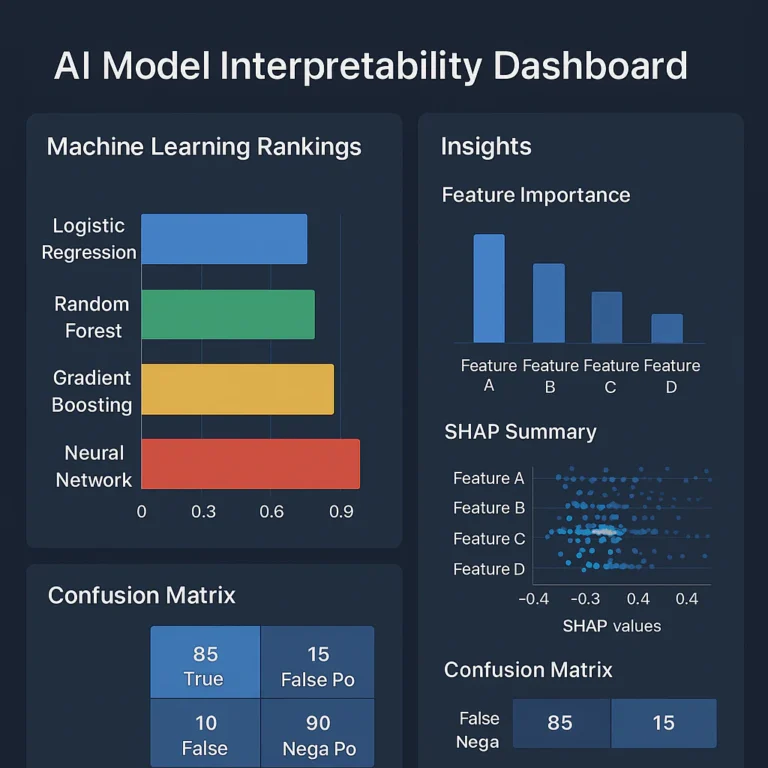
A confusion matrix separates true positives, false positives, true negatives, and false negatives. Those categories matter because an error can have different consequences in different applications.
- A false positive in a music recommendation system may be mildly annoying.
- A false negative in screening for a serious medical condition may be much more consequential.
- A false positive in fraud detection can create friction for a legitimate customer.
There is no universal “best” metric. Teams should set thresholds with stakeholders who understand the operational consequences.
Regression and ranking
For regression, mean absolute error (MAE) is relatively easy to interpret: the average absolute distance between predictions and outcomes. Root mean squared error (RMSE) penalizes larger errors more heavily, which can be useful when big misses are especially costly.
For ranking, NDCG and related metrics assess whether the most relevant results are near the top. They are useful for search and recommendations, but don’t tell the whole story about user satisfaction, fairness, or the quality of the content users eventually see.
Test Sets, Ground Truth, and Statistical Confidence
A labeled test set is only as helpful as its labels and its resemblance to the real-world cases you care about.
A sound evaluation typically includes:
- Train, validation, and test separation: Avoid letting the model learn from examples that are later used to claim success.
- Representative sampling: Include the expected range of customers, environments, languages, and edge cases.
- Leakage checks: Make sure information from the answer or future outcome has not slipped into the input.
- Uncertainty estimates: Report confidence intervals or repeated-run variability where relevant.
- Subgroup analysis: Check whether performance differs meaningfully across populations or operating conditions.
The NIST AI Risk Management Framework encourages organizations to evaluate validity, reliability, and risk in context—not merely report one aggregate score. That advice applies to traditional models, too.
✨ How Generative AI Evaluation Works
Generative AI evaluation often begins with a set of representative prompts and a rubric for judging responses. The rubric may ask whether answer is correct, relevant, complete, grounded in supplied sources, safe, and appropriately formatted.
The University of Illinois puts the central issue succinctly: “The quality of the generated content is evaluated, and feedback is used to refine the model.” In practice, quality is not a single dial. We usually need several checks, because answer can sound excellent while being wrong.
Why There May Be Many Valid Answers
A question such as “Write a friendly reminder about tomorrow’s meeting” can have hundreds of acceptable responses. Exact-match comparison would mark most of them wrong, even when they serve the user well.
For open-ended outputs, evaluation commonly uses:
- Task success: Did the response satisfy the request?
- Factuality: Are factual claims accurate?
- Groundedness: Are claims supported by the supplied source material?
- Relevance: Does the response address the actual question?
- Completeness: Does it cover the requested points?
- Clarity and coherence: Is it understandable and logically organized?
- Instruction following: Did it respect the requested format and constraints?
- Safety and appropriateness: Does it avoid harmful, discriminatory, or disallowed content?
These qualities can pull in different directions. A short answer may be clear but incomplete. A cautious answer may be safe but evasive. A detailed answer may be useful but introduce more opportunities for error.
That’s why a rubric should define what matters most for the use case and explain how reviewers should handle trade-offs.
Evaluating Text, Images, Audio, Video, and Multimodal Outputs
Different output formats need different tests. A text metric cannot fully evaluate whether an image contains the requested object, whether speech is intelligible, or whether a generated video maintains continuity across frames.
| Output type | Useful evaluation dimensions | Example checks |
|---|---|---|
| Text | Factuality, relevance, groundedness, clarity, tone | Verify claims against trusted sources; check instruction adherence |
| Code | Correctness, security, maintainability, task completion | Run unit tests, static analysis, and security scans |
| Images | Prompt alignment, composition, fidelity, artifacts, safety | Human ratings, object or attribute checks, safety classifiers |
| Audio | Intelligibility, speaker consistency, timing, pronunciation, safety | Speech recognition checks, listening tests, signal-quality measures |
| Video | Temporal consistency, scene alignment, visual quality, safety | Frame sampling, human review, event and continuity checks |
| Multimodal | Cross-modal consistency and task success | Confirm image, audio, and text outputs agree where required |
For code generation, for instance, “looks plausible” is not a quality metric. Run the code, test edge cases, scan for security problems, and have qualified reviewers inspect high-impact changes. The same principle holds for other modalities: evaluate the behavior that matters, not just the appearance of the output.
⚖️ Generative AI vs. Traditional AI: 12 Key Evaluation Differences
1. Correctness vs. Quality and Usefulness
Traditional model evaluation often starts with whether the prediction matches a label or observed value. Generative evaluation asks a broader question: does the output accomplish the task well?
An answer can be factually correct but unhelpful, or polished but false. We recommend separating objective criteria—such as correct figures or required fields—from judgment-based criteria such as clarity or tone.
2. Fixed Labels vs. Open-Ended Outputs
A classifier may choose among a fixed set of categories. A generative model may respond in thousands of valid ways, making exact-match scoring too strict for many tasks.
Use exact-match tests when the expected output is genuinely fixed, such as a JSON field or a yes/no decision. Use rubrics, semantic checks, or expert review when there are multiple acceptable answers.
3. Exact Answers vs. Semantic Similarity
Traditional metrics can compare a predicted class or number with a reference value. Text generation often needs measures of meaning, not merely word overlap.
BLEU or ROUGE can help compare generated text with reference text, but they may penalize a good paraphrase. Embedding-based measures such as BERTScore compare semantic similarity, yet they do not prove that a statement is true. A similar-sounding falsehood is still a falsehood.
4. Deterministic Results vs. Sampling Variability
Many traditional models return the same result for the same input when the model and settings are unchanged. Generative systems can produce different responses because of sampling and decoding settings, or because prompts and context vary.
To test consistency:
- Run representative prompts multiple times.
- Record model version and generation settings.
- Compare both quality and failure rates across runs.
- Test reasonable prompt variations, not only one carefully written prompt.
- Decide whether variability is acceptable for that task.
A creative-writing assistant can benefit from variation. A compliance summary usually should not invent a new interpretation every Tuesday.
5. Offline Benchmarks vs. Real-World User Testing
A benchmark gives a controlled comparison, but users bring messy wording, incomplete context, unexpected goals, and domain-specific terminology. Strong offline scores are useful evidence—not a substitute for real-world evaluation.
Use both:
- Offline evaluation for repeatable, regression-friendly testing.
- Pilot testing for usability, workflow fit, and unexpected behavior.
- Production monitoring for changing inputs, new failure modes, and actual outcomes.
6. Model Accuracy vs. End-to-End System Performance
A deployed generative AI product may include a language model, prompt templates, a retriever, business data, safety filters, tools, and a user interface. Any component can fail.
For example, answer may be well written but cite a stale policy because the retrieval index is outdated. Or the model may give a correct response that the application truncates. Evaluate the whole path from user request to user outcome, not just the base model.
7. Standard Metrics vs. Human and AI-as-Judge Evaluation
Traditional tasks often have established metrics and labeled outcomes. Generative outputs often require subjective judgments and expert knowledge, which makes human evaluation more prominent.
Automated judging can scale comparisons, but it can also inherit biases or overlook domain-specific errors. A sensible approach is to calibrate automated evaluators against human reviewers and reserve expert review for high-risk or subtle cases.
8. Data-Set Quality vs. Prompt and Context Sensitivity
Traditional evaluation focuses heavily on training and test data. Generative evaluation must also examine prompts, conversation history, retrieved documents, and tool outputs.
Test paraphrases and context changes. Does the system answer consistently when the user asks politely, tersely, or with a typo? Does it distinguish trusted source material from instructions embedded inside an untrusted document?
9. Aggregate Scores vs. Failure-Mode Analysis
One score can hide the behavior you most need to catch. A system might have high average quality while failing on a small group, a rare language, a specific document type, or a safety-critical scenario.
Break results down by:
- Task type and user intent
- Language and reading level
- User or population subgroup
- Source and document format
- Risk level and severity
- Prompt or system version
A failure taxonomy makes improvements actionable: “citation points to wrong section” is more useful than “quality down 3%.”
10. Static Testing vs. Continuous Evaluation
Traditional models need monitoring for data drift and performance changes. Generative systems add more moving parts: model provider updates, prompt edits, changing retrieval indexes, new tools, and evolving user behavior.
Treat important updates as changes that require regression testing. Maintain a stable test suite, compare versions, and monitor production signals. The NIST AI RMF is a useful starting point for lifecycle-oriented risk management.
11. Predictive Risk vs. Generative Safety and Misuse Risk
Traditional systems can create harm through biased predictions or incorrect decisions. Generative systems can also produce harmful instructions, expose sensitive information, fabricate authority, or be manipulated through adversarial prompts.
The risks overlap, but the test cases differ. A hiring model may need subgroup fairness and decision consistency checks; a chatbot may additionally need jailbreak resistance and protection against prompt injection.
12. Model Scores vs. Cost, Latency, and User Experience
A powerful model can score well and still be the wrong choice if it is too slow, too difficult to integrate, or too costly to operate at the required scale. Evaluation should include response time, reliability, accessibility, review burden, and task completion.
MIT Sloan cautions that “reclaiming 20% of an employee’s time” does not necessarily mean a 20% reduction in labor costs. Productivity measures need a clear connection to business outcomes, not just an attractive headline.
📏 Metrics for Traditional AI and Generative AI
No metric captures all model quality. Choose a small portfolio of complementary metrics, then explain what each one does—and does not—establish.
Accuracy, Precision, Recall, F1, ROC-AUC, and Calibration
| Metric | Useful for | Limitation |
|---|---|---|
| Accuracy | Balanced classification tasks | Can conceal poor performance on rare classes |
| Precision | Reducing false positives | May miss many true cases |
| Recall | Finding as many true cases as possible | May generate more false alarms |
| F1 | Balancing precision and recall | Hides the application’s error-cost trade-off |
| ROC-AUC | Ranking across classification thresholds | Can look strong with imbalanced classes |
| PR-AUC | Evaluating positive-class detection under imbalance | Depends on the positive-class prevalence |
| Calibration | Checking whether confidence scores match observed outcomes | Requires sufficient, representative outcome data |
The scikit-learn metrics documentation provides definitions and guidance. For a high-impact task, report class-specific results and error costs instead of presenting accuracy alone as a trophy.
Perplexity, BLEU, ROUGE, and BERTScore
| Metric | What it estimates | Best use | Caution |
|---|---|---|---|
| Perplexity | How well a language model predicts text tokens | Comparing language-model fit in controlled settings | Low perplexity does not guarantee useful or true answers |
| BLEU | N-gram overlap with references | Some translation or constrained-generation comparisons | Can under-credit good paraphrases |
| ROUGE | Overlap with reference summaries | Summary comparison when references are informative | Overlap is not the same as factuality |
| BERTScore | Contextual semantic similarity | Comparing paraphrased text with references | Semantic similarity does not verify claims |
The original BLEU paper and the BERTScore paper explain these metrics’ design. Use them as signals, not as a final verdict.
Faithfulness, Relevance, Coherence, and Groundedness
These are often assessed through a combination of programatic checks, reference comparison, source verification, and human judgment.
- Faithfulness: Does the response accurately reflect supplied information?
- Groundedness: Are claims supported by the permitted sources?
- Relevance: Does the answer address the request?
- Completeness: Does it cover required facts or steps?
- Coherence: Does it make sense as a whole?
- Citation correctness: Do citations support the claims they are attached to?
For RAG systems, evaluation should distinguish retrieval quality from answer quality. If the retriever misses the right document, blaming the language model is like blaming a chef for ingredients that never arrived.
Toxicity, Bias, Privacy, and Safety Metrics
Safety evaluation may combine automated classifiers, adversarial test cases, human review, and incident analysis. No single score proves a system is safe.
Check at least:
- Harmful or disallowed output rates
- Refusal behavior on genuinely unsafe requests
- False refusals on benign requests
- Sensitive-data exposure
- Group-level differences in output quality
- Robustness to jailbreaks and prompt injection
- Severity and frequency of failures
Use the NIST Generative AI Profile to help structure risk identification and response. Metrics should be tied to explicit policies and consequences.
Latency, Throughput, Token Use, and Cost Efficiency
Measure operational performance alongside quality:
- Latency: Time until the user receives a useful result.
- Throughput: Requests or tasks completed within a given interval.
- Reliability: Successful completion rate and service availability.
- Token use: Input and output volume, which affects system performance and operating cost.
- Human-review effort: Time needed to inspect, correct, or approve results.
- Task completion: Whether users complete the intended work with the system.
The best model is not always the largest model. A smaller model may be preferable for structured, low-risk tasks if it meets quality requirements with lower latency and simpler deployment.
🧪 Evaluation Methods and Testing Strategies
A robust program mixes automated testing, structured human judgment, and observation in real workflows. Each method catches different failures.
Human Evaluation and Expert Review
Human reviewers are particularly useful when quality depends on context, domain knowledge, or subtle judgment. A medical answer, for example, should not be rated only by whether it reads smoothly; a qualified reviewer should check whether the clinical content is appropriate.
Good reviewer practice includes:
- Give reviewers a clear rubric and examples.
- Hide model identities where feasible to reduce brand bias.
- Use multiple reviewers for subjective or high-stakes comparisons.
- Measure agreement and investigate disagreements.
- Provide escalation rules for uncertain or risky cases.
- Compensate reviewers fairly and protect their wellbeing when reviewing harmful material.
Human judgments are not infallible. Reviewers can disagree, overlook errors, or apply inconsistent standards. The goal is a well-designed process, not the fantasy of a perfectly neutral human oracle.
Automated Metrics and Programatic Checks
Automated checks are efficient and repeatable for objective requirements, including:
- Required fields in JSON or structured outputs
- Citation formatting and link validity
- Unit tests and code execution
- Exact values, named entities, and prohibited strings
- Output length or format limits
- Known benchmark answers
- Regression comparisons across model versions
Programatic checks should be strict where the requirement is objective and flexible where meaning matters. A schema validator can reliably check whether a field exists; it cannot tell you whether the explanation is humane.
LM-as-a-Judge: Benefits, Biases, and Validation
An LM evaluator can score or compare responses at scale. It is most useful when the rubric is explicit and the model’s judgment is checked against human ratings.
Potential problems include:
- Preference for longer or more polished answers
- Sensitivity to answer order or formatting
- Inconsistent scores across repeated runs
- Weakness on specialist or culturally specific content
- Agreement with confident, unsupported claims
To validate an LM judge:
- Create a human-rated sample set.
- Compare judge decisions with human decisions.
- Analyze disagreement by task and subgroup.
- Test answer-order and paraphrase effects.
- Revalidate when the judge model or rubric changes.
Never use an LM judge as the only safety gate for a high-risk system. It can help scale review; it cannot inherit accountability.
A/B Tests, User Studies, and Online Evaluation
A/B tests compare system variants with real users, but they need careful design. A response that increases clicks may not improve accuracy or user welfare. Define the outcome in advance and consider whether the experiment could expose users to harmful behavior.
Useful outcomes can include:
- Task completion and resolution rate
- User correction or escalation rate
- Time saved, measured carefully
- Satisfaction and trust
- Error and complaint rates
- Accessibility and subgroup performance
For more context on deploying AI into organizational workflows, see our coverage of AI Business Applications. Evaluate whether the system improves the work—not simply whether people interact with it.
Red Teaming, Adversarial Tests, and Stress Testing
Red teaming intentionally probes how a system fails. Test direct misuse and less obvious risks, including:
- Prompt injection in retrieved files or webpages
- Requests to reveal private or system instructions
- Conflicting or misleading source documents
- Ambiguous, emotional, or deliberately confusing prompts
- Unsafe requests disguised as benign work
- Long conversations that change the task or context
- Unexpected tool failures and unavailable services
Record the attack setup, observed behavior, severity, and remediation. A list of clever jailbreaks is not a complete security program; it is one input to a broader risk assessment.
🧰 Evaluating Retrieval-Augmented Generation and AI Agents
Generative applications often include more than a model. RAG systems retrieve documents before generating answer; agents can plan tasks and call tools. Both require evaluation beyond text quality.
Our AI Agents coverage explores these systems, but the testing principle is straightforward: measure each component and the end-to-end result.
RAG Retrieval, Context Relevance, and Citation Accuracy
A RAG evaluation should ask:
- Did retrieval find the right material?
- Was the retrieved context relevant and current?
- Did the model answer using that context accurately?
- Do citations actually support the claims?
- Did the system say when the available sources were insufficient?
Useful measures include recall at k, precision at k, context relevance, answer faithfulness, and citation accuracy. Keep a set of questions with trusted source documents and expected evidence. Include unanswerable questions: a system that confidently answers everything is not demonstrating competence.
Agent Planning, Tool Use, and Task Completion
Agents bring a new evaluation target: a sequence of decisions and actions. Assess whether the agent reaches the intended outcome, uses authorized tools correctly, handles failures, and seeks human approval when appropriate.
A practical agent test should record:
- Goal and constraints
- Planned steps
- Tools called and arguments passed
- Permissions used
- Intermediate observations
- Final result and verification
- Recovery behavior after a tool error
- Human approvals or escalations
MIT Sloan’s discussion of agentic AI stresses shared metrics and continuous validation. It also notes that “without shared, robust metrics, it’s difficult to prove value” or know whether a system is introducing new risks. That is a warning against measuring only the final response when the path to that response may involve consequential actions.
IBM distinguishes generative AI, which creates or transforms content, from agentic AI, which can pursue goals through planning and action. Its article does not prescribe a particular benchmark for comparing generative and traditional AI; its useful contribution is the reminder to assess autonomy, oversight, and control. See IBM’s generative AI vs. agentic AI overview.
🛡️ Safety, Fairness, Privacy, and Responsible AI Evaluation
A model can meet a quality target and still be unfit for deployment if it exposes private data, treats groups unfairly, or can be manipulated into unsafe behavior. Responsible evaluation treats these risks as core performance requirements.
Hallucinations, Misinformation, and Factuality
A hallucination is a plausible-sounding claim that is unsupported or incorrect. It may come from the model, a bad source, a retrieval failure, or a mismatch between the system and the user’s question.
Ways to assess factuality:
- Verify claims against authoritative sources.
- Separate supported claims from speculation.
- Check whether citations point to evidence that supports the exact statement.
- Test unanswerable and ambiguous questions.
- Record errors by severity, not only frequency.
- Evaluate whether the system communicates uncertainty appropriately.
IBM notes that generative AI can produce inaccurate information, sometimes called a hallucination, and recommends review when accuracy matters. That is practical guidance, not a guarantee that human review will catch every error.
Bias, Accessibility, and Performance Across User Groups
Training data and product design can encode unfairness. Measure both the quality of results and the effects of errors across relevant groups.
A good assessment may include:
- Performance by language, dialect, and reading level
- False-positive and false-negative rates by group
- Accessibility with assistive technologies
- Whether outputs rely on stereotypes or uneven assumptions
- Differences in refusal, helpfulness, and error rates
- Domain-specific review by affected communities
Avoid treating demographic categories as interchangeable or assuming that one fairness metric fits every application. Consult the NIST AI RMF and relevant legal and organizational requirements.
Jailbreaks, Prompt Injection, and Data Leakage
Prompt injection occurs when untrusted input tries to override system instructions or steer a model into unsafe behavior. The risk increases when a system reads external content or has access tools and private information.
Test safeguards such as:
- Clear separation between trusted instructions and untrusted content
- Least-privilege access for tools and data
- Secret and personal-data filtering
- Human approval for sensitive or irreversible actions
- Logging that supports investigation without unnecessarily retaining private data
- Robust handling of adversarial documents and user messages
Security checks should cover the entire application. A model refusal policy cannot compensate for an API that exposes sensitive data directly.
Governance, Documentation, and Regulatory Considerations
Document what the system does, where it is used, what data it handles, what it cannot reliably do, and who is accountable for decisions. Keep records of evaluations, changes, incidents, and approvals.
The NIST Generative AI Profile offers guidance for identifying and managing generative AI risks. For regulated or high-impact deployments, organizations should seek legal, security, privacy, and domain-specific review rather than treating a benchmark report as a compliance certificate.
🧩 Building a Reliable Generative AI Evaluation Framework
A useful evaluation framework is not a giant spreadsheet that nobody opens. It is a repeatable system that answers three questions: What does success mean? What can go wrong? How will we know when behavior changes?
Define Use Cases, Users, and Success Criteria
Start by describing the task in plain language.
- Who uses the system?
- What inputs can they provide?
- What output or action is expected?
- What decisions remain with a human?
- Which errors are tolerable, and which are not?
- What business or public-interest outcome should improve?
Define separate goals for quality, safety, usability, and operations. “Make the chatbot better” is not an evaluation target; “answer policy questions using current approved documents, cite them, and abstain when evidence is missing” is much closer.
Create Representative Test Sets and Evaluation Data
Build a test set that reflects real requests, not just clean examples written by the model team. Include routine tasks, difficult cases, edge cases, and known failure patterns.
Protect the test set from contamination and leakage. Keep some examples private or newly collected, and refresh test cases when the product or policy changes. For high-stakes tasks, use qualified reviewers to verify references and labels.
Choose Metrics, Baselines, and Human Reviewers
Compare against sensible baselines:
- A current manual process
- A simpler model or search system
- A previous model version
- A no-AI workflow where appropriate
Use metrics that correspond to the task. For generative outputs, combine automated checks with human rubric scores. For traditional prediction systems, pair predictive metrics with calibration, subgroup performance, and downstream impact.
Our AI Infrastructure coverage can help teams think through the operational side: model serving, data pipelines, monitoring, and reliability are part of a real evaluation plan.
Set Quality Thresholds and Release Gates
Before testing, define minimum acceptable performance and what happens if a test fails. For example:
- No release if a critical safety test regresses.
- Require human approval for sensitive actions.
- Block outputs that fail schema validation.
- Escalate when source evidence is weak.
- Roll back if live quality or reliability drops below an agreed threshold.
Thresholds should reflect the severity and likelihood of failure, not an arbitrary “90% sounds good.” A 90% pass rate may be unacceptable if the remaining failures involve serious harm.
Monitor Production Behavior and Model Drift
Production monitoring should capture enough information to find problems while protecting privacy. Track model and prompt versions, retrieval quality, errors, latency, escalation, user corrections, and incidents.
A feedback loop needs owners and actions:
- Collect permitted feedback and operational signals.
- Review them for recurring failure types.
- Verify whether the signal represents a real issue.
- Update prompts, retrieval, policies, or models as appropriate.
- Run regression tests before deployment.
- Monitor the change after release.
We also cover workflow integration in AI Automation Workflows. Automation is helpful only when the evaluation process follows the system into production.
🧭 A Practical Evaluation Workflow: From Prototype to Production
Here’s a step-by-step workflow we recommend for teams building or adopting generative AI.
Step 1: Write a task contract
Specify the user, task, permitted inputs, expected output, prohibited behavior, and human-review requirements. Keep it short enough that product, engineering, legal, and domain teams can agree on it.
Step 2: Map the system
List every component: model, prompts, retrieval, tools, filters, interface, data sources, and monitoring. If the system has an agent, map its permissions and possible actions.
Step 3: Define failure modes
Write down what could go wrong: wrong answer, missing caveat, stale source, private-data disclosure, unsafe tool call, biased response, timeout, or confusing refusal. Rank failures by likelihood and impact.
Step 4: Build a test set and rubric
Use realistic examples and clear scoring criteria. Include normal requests, edge cases, adversarial inputs, and questions the system should decline or answer cautiously.
Step 5: Establish baselines
Compare the system with an existing process, a simpler solution, and previous model versions. A fancy model is not useful if it performs no better than a reliable search workflow.
Step 6: Run component and end-to-end tests
Test retrieval, output quality, safety filters, tools, interface, latency, and workflow outcomes separately—and then test the full user journey.
Step 7: Review failures with the right people
Use domain experts for specialized correctness, security reviewers for abuse paths, and representative users for usability. Document disagreements and update the rubric when it is ambiguous.
Step 8: Pilot with guardrails
Limit access, use human approval for risky actions, and provide an easy way to report problems. A small pilot is not a free pass; it is a controlled way to learn.
Step 9: Set release gates and rollback plans
Define who approves deployment, which tests must pass, and how to revert if behavior worsens. Record versions so you can reproduce a result.
Step 10: Monitor and keep evaluating
Review live performance and update test cases as users, data, policies, and models change. A system that passed last quarter’s test has not automatically passed this quarter’s test.
🏭 Evaluation Examples Across Industries and Use Cases
The evaluation method should follow the consequences of failure. The same model behavior may be acceptable in a brainstorming assistant and unacceptable in a medical triage workflow.
Healthcare, Finance, and Legal Services
| Use case | What to evaluate | Practical safeguards |
|---|---|---|
| Clinical information assistant | Factuality, source support, uncertainty, omission of safety-critical details | Qualified clinical review; clear escalation; current sources |
| Financial document assistant | Accuracy, calculation correctness, privacy, compliance with approved material | Reproducible calculations; access controls; audit logs |
| Legal research and drafting | Citation validity, jurisdictional relevance, completeness, confidentiality | Verify authorities; lawyer review; protect client data |
For these settings, “sounds professional” is a particularly dangerous proxy for quality. Evaluate claims, sources, and consequences—and ensure a qualified professional retains appropriate oversight.
Education, Customer Support, and Software Development
In education, a traditional model might identify students who could benefit from intervention; evaluate predictive validity, fairness, and false alarms. A generative system might draft lesson materials or feedback; assess accuracy, accessibility, age appropriateness, usefulness, and whether educators can verify the content.
For customer support, assess whether answers resolve the request, use current account and policy data, avoid exposing personal information, and escalate when the issue exceeds the system’s authority.
For software development, test generated code by running it, checking security and maintainability, and reviewing licensing and dependency concerns. IBM uses a similar distinction: a generative system can write code, while an agentic system may plan implementation, run tests, identify errors, and revise work for human review.
Search, Content Creation, and Creative Media
Search and summarization need careful source attribution and coverage checks. Content generation needs brand, factual, originality, and audience-appropriateness review. Image and video systems need tests for prompt adherence, visible defects, representation, and safety.
Creative applications may value novelty and variation, so deterministic output is not always the goal. Still, safety and factual constraints remain relevant when generated content is presented as documentary, educational, or news material.
🚫 Common Evaluation Mistakes—and How to Avoid Them
| Mistake | Why it fails | Better approach |
|---|---|---|
| Using accuracy as the only score | Ignores quality, calibration, safety, and consequences | Use a task-specific metric set |
| Testing only polished prompts | Misses ordinary user behavior and adversarial inputs | Include realistic, messy, and edge-case requests |
| Treating a benchmark as proof of readiness | Benchmarks may not match real users or workflows | Pair benchmarks with pilots and monitoring |
| Leting an LM judge itself | The evaluator may share the model’s blind spots | Calibrate against independent human ratings |
| Checking fluency instead of truth | Fluent language can make errors more persuasive | Verify facts and evidence separately |
| Evaluating only the base model | Ignores retrieval, tools, UI, and workflow failures | Test the end-to-end system |
| Ignoring subgroup results | Aggregate scores can conceal uneven harm | Report relevant breakdowns and investigate gaps |
| Calling user feedback “learning” | Feedback may never reach a model or product change | Assign owners, review signals, and retest updates |
| Measuring activity instead of outcomes | More use does not necessarily mean better results | Track task completion, quality, effort, and risk |
| Skipping version tracking | Makes regressions hard to reproduce | Log model, prompt, data, and system versions |
One common surprise in deployment: a system can look impressive in a demo and struggle with the dull, everyday work users actually need. That’s why we favor representative test cases over theatrical ones. The glitter is fun; the edge cases pay the bills.
✅ Quick Tips for Better AI Model Evaluation
- ✅ Start with the task, not the model. Name the intended outcome and the cost of failure.
- ✅ Use different scorecards for different jobs. A classifier, summarizer, RAG assistant, and agent do not share one universal metric.
- ✅ Keep a human-reviewed “gold set.” Use it to calibrate automated metrics and LM judges.
- ✅ Test repeated runs and prompt variations. Measure variability, not just the best response you saw.
- ✅ Check sources and citations claim by claim. A citation-shaped link is not evidence.
- ✅ Measure quality, safety, and operations together. Track completion, latency, escalation, and review effort.
- ✅ Test abstention. The system should sometimes say it lacks enough evidence.
- ✅ Re-run evaluations after changes. Model, prompt, retrieval index, tool, and policy updates can all change behavior.
- ❌ Don’t ship based one aggregate score. Break results down by task, subgroup, and severity.
- ❌ Don’t confuse productivity claims with business results. MIT Sloan’s warning about reclaimed employee time is a useful reminder: time saved does not automatically equal cost saved.
A compact dashboard might track task success, factuality, groundedness, safety incidents, subgroup performance, latency, escalation, and user correction rates. Keep the dashboard small enough to act on—and detailed enough to catch the failures that matter.
❓ Frequently Asked Questions

Can traditional AI metrics evaluate generative AI?
Yes, some can—but only for the parts of the task they measure. Accuracy, precision, recall, and calibration may apply when a generative application produces a structured classification or a clearly verifiable value. They do not, by themselves, assess whether an open-ended answer is useful, grounded, complete, or safe.
For generated text, metrics such as BLEU, ROUGE, and BERTScore can provide comparison signals. They should be paired with factual verification, rubric-based review, and testing against real use cases.
What is the best metric for evaluating a large language model?
There is no single best metric for every LM. Choose measures based on the intended application:
- For RAG answers: groundedness, citation accuracy, retrieval quality, and answer relevance.
- For code: test pass rate, security checks, and task completion.
- For summarization: coverage, factual consistency, and readability.
- For customer support: resolution rate, correctness, escalation quality, and privacy.
- For high-risk advice: expert-reviewed factuality, safe handling, and uncertainty communication.
A leaderboard score can help compare models on a defined benchmark, but it cannot decide whether one model is suitable for your workflow.
How do you measure hallucinations in generative AI?
Create test questions with trusted source material and compare each factual claim in the answer against that evidence. Track unsupported claims, incorrect claims, missing citations, and whether the system appropriately abstains when evidence is absent.
For RAG systems, separate failures into retrieval problems, unsupported generation, and source-quality problems. This distinction helps teams fix the actual cause rather than patching the wrong component.
Is human evaluation more reliable than automated evaluation?
Neither is universally more reliable. Automated evaluation is repeatable and efficient for objective checks; humans are better suited to nuanced, contextual, and domain-specific judgment. Humans can still disagree or miss errors, while automated metrics can reward superficial patterns.
A strong program uses both: automation for scale, human review for interpretation and high-risk decisions, and calibration to understand where the two disagree.
How often should generative AI systems be evaluated?
Evaluate during development, before deployment, after meaningful changes, and continuously in production. Re-run regression tests when the model, prompt, retrieval index, data source, policy, or tool access changes. Monitor production behavior for drift, incidents, and emerging failure patterns.
The more consequential the use, the more frequent and rigorous the checks should be. A low-risk creative assistant and a system that influences a medical or financial decision should not share the same release gate.
How do you evaluate the quality of generative AI outputs beyond accuracy?
Use a rubric that separates factuality, relevance, completeness, groundedness, clarity, instruction following, safety, and usefulness. Score these dimensions independently where possible, because one overall rating can hide important trade-offs.
For subjective qualities, use trained reviewers and clear examples. For objective constraints, use programatic tests. For source-based answers, verify that citations support the exact claims made. Then test outputs with representative users to see whether quality holds up in the actual workflow.
What metrics best measure the business impact of generative AI compared with traditional AI?
Start with the outcome the business wants to improve, then measure the full process—not just model activity. Useful indicators may include task completion, error reduction, customer resolution, review effort, turnaround time, adoption, and the cost of failures.
For traditional prediction systems, connect predictive performance to downstream decisions and outcomes. For generative systems, include the time required to verify and edit outputs, the rate of escalation, and the value of completed work. As MIT Sloan cautions, time reclaimed does not automatically translate into equivalent labor-cost savings.
How can companies assess generative AI for safety, bias, and factual accuracy?
Use a layered assessment:
- Define prohibited behavior and high-impact failure modes.
- Test factual claims against trusted sources.
- Include adversarial prompts, unanswerable questions, and prompt-injection attempts.
- Compare quality and error rates across relevant languages and user groups.
- Use qualified human reviewers for high-impact decisions.
- Restrict tool and data access to what the system needs.
- Document incidents, mitigations, and model or prompt changes.
- Monitor the deployed system and rerun tests after updates.
Guidance from the NIST Generative AI Profile can help organizations organize this work. Passing a safety test is evidence about a test set and configuration—not proof that all future behavior is safe.
Why do generative AI evaluation methods require human feedback more often than traditional AI testing?
Generative systems can produce many acceptable answers, and the quality of answer often depends on context, tone, relevance, and nuance. Those qualities are harder to capture with one fixed label or numerical comparison. Human feedback helps define whether an output is genuinely useful and appropriate.
Traditional AI also needs human input—for example, to label data, set error costs, and review high-impact decisions. The difference is that generative AI’s open-ended outputs make human judgment especially valuable for evaluating qualities that automated metrics cannot reliably settle.