Support our educational content for free when you purchase through links on our site. Learn more
12 Challenges in Evaluating Generative AI Models 🤖

What challenges exist in assessing the performance of generative AI models? The biggest are that outputs can be open-ended, inconsistent, subjective, and difficult to verify—so no single benchmark or score can tell you whether a model is truly reliable. Our recommendation: combine task-specific metrics, human review, safety testing, and real-world monitoring.
We’ve seen a model ace a clean benchmark question, then stumble when a customer asked the same thing in different words. That gap between a tidy test and a messy real interaction is exactly why evaluation needs to look beyond polished answers and average scores.
The challenge isn’t just deciding whether answer sounds good. It’s determining whether it is accurate, fair, safe, useful, and reliable for the people and setting that matter—and spotting the failures a headline score can hide.
Key Takeaways
- There is no universal measure of generative AI performance. Define success around the model’s specific task, users, and risk level.
- Benchmarks are useful evidence, not deployment guarantees. Test realistic prompts, edge cases, and your own use case.
- Fluent answers can still be wrong. Measure factuality, groundedness, safety, and instruction-following separately.
- Use several evaluation methods. Combine automated metrics, trained human reviewers, red teaming, and live monitoring.
- Look beyond averages. Check variability, severe failures, and performance across relevant languages and user groups.
- Retest after meaningful changes. Model updates, prompt edits, new data, and tool integrations can all shift behavior.
Table of Contents
- ⚡ Quick Tips and Facts: Evaluating Generative AI
- 🧭 How Generative AI Evaluation Evolved
- Why Traditional Software Testing Falls Short
- What Makes Generative AI Models Different
- 🎯 What Does “Performance” Mean for a Generative AI Model?
- Quality, Accuracy, and Helpfulness
- Safety, Fairness, Privacy, and Transparency
- Latency, Reliability, and Cost
- 🚧 12 Major Challenges in Assessing Generative AI Performance
- 1. Open-Ended Outputs Resist Simple Scoring
- 2. Multiple Answers Can Be Correct
- 3. Quality Judgments Are Often Subjective
- 4. Benchmarks Can Be Misleading or Contaminated
- 5. Model Outputs Are Nondeterministic
- 6. Small Prompt Changes Can Shift Results
- 7. Training Data and Model Behavior Are Hard to Inspect
- 8. Bias and Unequal Performance Hide in Aggregate Scores
- 9. Safety Failures Are Rare, Contextual, and High-Impact
- 10. Real-World Use Changes Over Time
- 11. Human and AI Judges Have Their Own Limitations
- 12. There Is No Single Standard for “Good” Performance
- 📏 Metrics and Methods for Generative AI Evaluation
- Automated Metrics: Exact Match, BLEU, ROUGE, and Perplexity
- Human Evaluation and Expert Review
- LLM-as-a-Judge: Benefits and Risks
- Red Teaming, Adversarial Testing, and Safety Evaluation
- Online Evaluation: A/B Tests and User Feedback
- 🧰 Building a Reliable Generative AI Evaluation Framework
- Define the Use Case, Users, and Risk Level
- Create Representative Test Data and Evaluation Rubrics
- Combine Metrics, Human Review, and Failure Analysis
- Measure Performance Across Groups, Languages, and Edge Cases
- Track Version Changes, Drift, and Regression
- 🏢 Evaluating Different Generative AI Applications
- Large Language Models and AI Chatbots
- Retrieval-Augmented Generation and AI Search
- Code Generation and AI Agents
- Image, Audio, and Video Generation
- High-Stakes Uses in Healthcare, Finance, and Education
- ⚖️ Responsible AI, Governance, and Evaluation Standards
- Documenting Limitations and Communicating Uncertainty
- Privacy, Data Protection, and Consent
- Audits, Accountability, and Regulatory Expectations
- 🔮 The Future of Generative AI Model Evaluation
- More Realistic Benchmarks and Continuous Testing
- Evaluation for Multimodal Models and Autonomous Agents
- ❓ Frequently Asked Questions
- Why is generative AI difficult to evaluate?
- Are benchmarks enough to compare AI models?
- Can an AI model evaluate another AI model reliably?
- How often should generative AI systems be tested?
- ✅ Conclusion
- 🔗 Recommended Links
- 📚 Reference Links
Table of Contents
- ⚡ Quick Tips and Facts: Evaluating Generative AI
- 🧭 How Generative AI Evaluation Evolved
- Why Traditional Software Testing Falls Short
- What Makes Generative AI Models Different
- 🎯 What Does “Performance” Mean for a Generative AI Model?
- Quality, Accuracy, and Helpfulness
- Safety, Fairness, Privacy, and Transparency
- Latency, Reliability, and Cost
- 🚧 12 Major Challenges in Assessing Generative AI Performance
- 1. Open-Ended Outputs Resist Simple Scoring
- 2. Multiple Answers Can Be Correct
- 3. Quality Judgments Are Often Subjective
- 4. Benchmarks Can Be Misleading or Contaminated
- 5. Model Outputs Are Nondeterministic
- 6. Small Prompt Changes Can Shift Results
- 7. Training Data and Model Behavior Are Hard to Inspect
- 8. Bias and Unequal Performance Hide in Aggregate Scores
- 9. Safety Failures Are Rare, Contextual, and High-Impact
- 10. Real-World Use Changes Over Time
- 11. Human and AI Judges Have Their Own Limitations
- 12. There Is No Single Standard for “Good” Performance
- 📏 Metrics and Methods for Generative AI Evaluation
- Automated Metrics: Exact Match, BLEU, ROUGE, and Perplexity
- Human Evaluation and Expert Review
- LLM-as-a-Judge: Benefits and Risks
- Red Teaming, Adversarial Testing, and Safety Evaluation
- Online Evaluation: A/B Tests and User Feedback
- 🧰 Building a Reliable Generative AI Evaluation Framework
- Define the Use Case, Users, and Risk Level
- Create Representative Test Data and Evaluation Rubrics
- Combine Metrics, Human Review, and Failure Analysis
- Measure Performance Across Groups, Languages, and Edge Cases
- Track Version Changes, Drift, and Regression
- 🏢 Evaluating Different Generative AI Applications
- Large Language Models and AI Chatbots
- Retrieval-Augmented Generation and AI Search
- Code Generation and AI Agents
- Image, Audio, and Video Generation
- High-Stakes Uses in Healthcare, Finance, and Education
- ⚖️ Responsible AI, Governance, and Evaluation Standards
- Documenting Limitations and Communicating Uncertainty
- Privacy, Data Protection, and Consent
- Audits, Accountability, and Regulatory Expectations
- 🔮 The Future of Generative AI Model Evaluation
- More Realistic Benchmarks and Continuous Testing
- Evaluation for Multimodal Models and Autonomous Agents
- ❓ Frequently Asked Questions
- Why is generative AI difficult to evaluate?
- Are benchmarks enough to compare AI models?
- Can an AI model evaluate another AI model reliably?
- How often should generative AI systems be tested?
- ✅ Conclusion
- 🔗 Recommended Links
- 📚 Reference Links
⚡ Quick Tips and Facts: Evaluating Generative AI
For a practical starting point, see our guide to generative AI model evaluation. The short version: don’t ask one score to answer five different questions. A model can be fluent yet inaccurate, helpful yet unsafe, or impressive in a demo and brittle in production.
Quick evaluation checklist
- ✅ Start with the task. Define what users need the system to do, what counts as success, and which failures would be unacceptable.
- ✅ Test representative examples. Include ordinary requests, ambiguous inputs, edge cases, adversarial attempts, and examples from the people and settings where the system will actually be used.
- ✅ Use more than one evaluation method. Combine automated metrics, human review, targeted safety tests, and real-world monitoring.
- ✅ Compare like with like. Hold prompts, datasets, model settings, and scoring procedures steady when comparing models or versions.
- ✅ Inspect failures, not just averages. A strong mean score can conceal severe errors for a particular language, user group, or rare scenario.
- ❌ Don’t treat a leaderboard as a deployment decision. Public benchmarks are useful evidence, not a substitute for testing your own use case.
- ❌ Don’t assume polished language means truth. Generative models can express incorrect claims with confidence.
- ❌ Don’t let an AI judge be the only judge. Model-based scoring can speed up review, but it can also share biases with the system being evaluated.
| Evaluation question | What to measure | A useful first check |
|---|---|---|
| Does it do the job? | Task success, completeness, instruction-following | Test realistic user requests against a task rubric |
| Is it trustworthy? | Factuality, grounding, calibration, consistency | Check claims against authoritative sources |
| Is it safe and fair? | Harmful outputs, disparate performance, privacy risks | Test risk scenarios and disaggregated results |
| Is it usable? | Clarity, relevance, user satisfaction, accessibility | Ask representative users to assess outputs |
| Is it practical to operate? | Latency, availability, cost, energy use | Profile the full system under expected load |
The research landscape is just as clear about what not to trust in isolation. A broad review of generative AI evaluation warns that “automatic evaluations on popular benchmark datasets cannot be our only measure of model success” (paper on arXiv). That does not make benchmarks useless. It means they are one instrument in the toolbox, not the whole workshop. 🧰
🧭 How Generative AI Evaluation Evolved
Why Traditional Software Testing Falls Short
Traditional software usually follows explicitly written rules. Given the same input and system state, a calculator should return the same answer; a database query either finds a record or does not. Generative AI systems instead produce outputs from learned patterns, and those outputs may vary even when the prompt appears unchanged.
That difference changes the testing question. For conventional software, we often ask, “Did the program follow the specification?” For a generative model, we also need to ask:
- Is the output factually correct?
- Does it meet the user’s intent?
- Is it safe and appropriate in this context?
- Does it respect constraints such as format, privacy, or source requirements?
- How often does it fail, and how severe are those failures?
A model can pass a collection of example tests and still fail when the wording changes, a user asks a follow-up, or the system encounters unfamiliar information. Testing therefore needs to consider both the model and the surrounding application: prompts, retrieval systems, tools, filters, interfaces, and human review.
What Makes Generative AI Models Different
Generative AI produces content rather than simply selecting from a fixed set of predefined responses. That makes evaluation more like judging a performance than checking a light switch: several outputs may be acceptable, but some are subtly wrong, misleading, biased, or unsafe.
The 2024 review of evaluation challenges discusses difficulties involving quality measurement, uncertainty, fairness, robustness, constraints, and computational cost. The NIST AI Risk Management Framework likewise emphasizes that AI risks should be managed across a system’s lifecycle, rather than inferred from a single lab score.
Here’s the important distinction: a model’s benchmark score is not the same thing as a product’s real-world performance. A deployed assistant may include retrieval, custom instructions, safety checks, and access tools. Each component can improve performance, introduce new failure modes, or both.
Video context: The Udacity video “Some Challenges for Generative Models” offers a short introduction to why generative systems are difficult to assess. It’s especially helpful for the basic intuition: generation involves trade-offs that a simple pass/fail test can miss.
🎯 What Does “Performance” Mean for a Generative AI Model?
There is no universal score for “good AI.” A useful evaluation starts by turning that vague label into measurable objectives that reflect the task, users, and consequences of mistakes.
Quality, Accuracy, and Helpfulness
These dimensions overlap, but they are not interchangeable:
- Accuracy: Are factual claims and calculations correct?
- Groundedness: Are claims supported by the sources the system is supposed to use?
- Relevance: Does the answer address the question?
- Completeness: Does it include the essential information without important omissions?
- Instruction-following: Does it obey requested format, scope, and constraints?
- Clarity: Can the intended user understand and use the result?
- Creativity or diversity: Does the output offer useful variation when the task calls for it?
For a customer-support assistant, a concise response that solves the customer’s problem may beat an eloquent essay. For a creative-writing tool, factual precision may matter less than originality and style. The right metric depends on the job.
Safety, Fairness, Privacy, and Transparency
Performance includes avoiding harms, not only producing good outputs. A credible evaluation plan should consider whether the system:
- Generates discriminatory or stereotyping content.
- Reveals private or confidential information.
- Provides dangerous instructions or unsupported high-stakes advice.
- Handles different dialects, languages, and user groups equitably.
- Makes limitations clear enough for users to make informed decisions.
- Allows outputs to be traced to reliable sources when the use case requires it.
The NIST AI RMF provides a useful governance lens, while the OECD AI Principles frame trustworthy AI around human rights, transparency, robustness, and accountability. These principles do not produce a magic fairness number. They help teams ask the right questions—and document the trade-offs.
Latency, Reliability, and Cost
A model can be brilliant but unsuitable if it responds too slowly, fails under peak demand, or requires resources the organization cannot sustain. Evaluate the whole system, not just the model’s answer quality.
| Operational measure | What it tells you | Why it matters |
|---|---|---|
| Latency | Time to first response and full completion | Slow systems frustrate users and can disrupt workflows |
| Availability | Whether the system is reachable when needed | Unreliable service can make a strong model unusable |
| Error rate | Failed requests, tool errors, malformed outputs | Failures may occur outside the model itself |
| Cost per successful task | Resources consumed relative to useful outcomes | The cheapest response is not necessarily the cheapest solution |
| Energy and resource use | Compute and, where measurable, environmental footprint | High-volume use can multiply operational and environmental costs |
A practical comparison looks at the performance–complexity trade-off: how much quality, safety, and usefulness you gain for added operational burden. The arXiv review recommends considering performance alongside computational complexity rather than optimizing one alone (source).
🚧 12 Major Challenges in Assessing Generative AI Performance
1. Open-Ended Outputs Resist Simple Scoring
Many tasks do not have one exact answer. A summary can be excellent without sharing the reference summary’s wording. A single “match or mismatch” score can punish a valid response simply because it uses different phrasing.
Metrics such as BLEU and ROUGE can help compare text overlap, especially in established tasks, but they may not capture meaning, factuality, or user value. A fluent answer can share many words with a reference and still get the substance wrong. Conversely, a strong paraphrase can score poorly.
What helps: use a task-specific rubric that scores qualities separately—such as factual accuracy, completeness, and relevance—instead of collapsing them into one similarity score.
2. Multiple Answers Can Be Correct
A broad question might reasonably invite a short answer, a detailed explanation, or examples tailored to a particular audience. Reference-answer datasets often struggle to represent that range.
This becomes especially tricky for creative writing, brainstorming, education, and advice. The evaluator must distinguish acceptable variation from genuine error. A model that gives the same safe, generic answer every time may score consistently but serve users poorly.
What helps: define acceptable answer criteria and test sets of outputs, not just one expected phrase.
3. Quality Judgments Are Often Subjective
People disagree about what counts as useful, clear, respectful, persuasive, or creative. A domain expert may favor precision; a user may prefer plain language. In a culturally sensitive setting, a response that seems neutral to one reviewer may feel dismissive to another.
The supplied TNO summary captures this in a memorable line: “Five experts can have five different opinions.” That is not an argument against human review. It is a reason to make review more structured.
What helps: give raters clear rubrics, train them with examples, measure agreement, and escalate disagreements for adjudication. For sensitive applications, include reviewers with relevant lived and professional experience.
4. Benchmarks Can Be Misleading or Contaminated
Benchmarks are curated tests, not miniature copies of every future use case. Their questions may not reflect your users, language, domain, or operating conditions. A model may also have encountered test material during training, making performance look stronger than its ability to generalize.
Benchmarks can become saturated, too: if leading systems approach perfect scores, the test may no longer distinguish meaningful differences. The review on arXiv warns that leaderboard results can conceal weak generalization, bias, and failures under distribution shifts (source).
What helps: check dataset provenance, use private holdout examples, report what the benchmark actually measures, and validate results on your own deployment-relevant data.
5. Model Outputs Are Nondeterministic
The same model can respond differently to the same prompt due to sampling settings, system updates, infrastructure, or other factors. Even when a system is configured for more repeatable output, randomness is only one source of variation.
One run is therefore a shaky basis for a model comparison. A lucky response can hide instability; an unlucky one can exaggerate it.
What helps: repeat tests, record model versions and generation settings, and report both average performance and variability. For consequential tasks, measure the frequency and severity of failures, not just the best-looking answer.
6. Small Prompt Changes Can Shift Results
A slight change in wording, ordering, examples, or context can affect a model’s output. This makes it difficult to tell whether a change in score reflects a stronger model or a more favorable prompt.
Prompt sensitivity also matters to users: they do not always phrase requests like benchmark authors.
What helps: test paraphrases, spelling variations, indirect requests, long contexts, follow-ups, and realistic user inputs. Keep prompts identical when comparing systems, then separately evaluate how robust they are to prompt variation.
7. Training Data and Model Behavior Are Hard to Inspect
Large models contain many interacting learned patterns, and developers may not be able to provide a complete account of why a particular output occurred. Some providers also disclose limited information about training data, model updates, or internal behavior.
This creates practical challenges: difficult-to-trace errors, uncertain data provenance, and limited ability to explain the result to users. Evaluation can reveal patterns in behavior, but it does not automatically explain the underlying mechanism.
What helps: request documentation, record model and system versions, use traceable sources where possible, and distinguish observed behavior from claims about internal reasoning. Explanations should themselves be tested for faithfulness rather than accepted because they sound plausible.
8. Bias and Unequal Performance Hide in Aggregate Scores
A model’s overall accuracy can look healthy while performance differs across language varieties, demographic groups, regions, or accessibility needs. Aggregate metrics can flatten those differences into a comforting average.
Fairness is also context-dependent. A measure that is appropriate for one decision may be inadequate for another, and fairness definitions can conflict. The arXiv review cautions that “Many aspects of fairness cannot be captured by quantitative metrics” (source).
What helps: disaggregate results, define the affected groups and harms, involve domain and community expertise, and combine statistical tests with qualitative review. Treat a fairness score as evidence about a specific question—not proof that a system is fair.
9. Safety Failures Are Rare, Contextual, and High-Impact
A system may behave safely in thousands of routine prompts yet fail on a rare request with serious consequences. Average scores are poorly suited to describing low-frequency, high-severity risks.
Safety is also context-sensitive. A playful fiction assistant and a medical decision-support tool should not face the same acceptance threshold. The TNO summary makes this point bluntly: “Context is everything.”
What helps: create risk-specific scenarios, use red-team testing, track severity as well as frequency, and set clear stop conditions. For systems connected to external tools, test what actions they can take and whether those actions are bounded.
10. Real-World Use Changes Over Time
Users adapt. Products change. Documents become outdated. New prompt patterns appear. The distribution of requests may shift after launch, while the model or its surrounding services may be updated without changing the user-facing name.
A test passed before deployment is therefore a snapshot, not a permanent guarantee.
What helps: monitor production outcomes and user reports, run regression suites before updates, and retest when data, prompts, integrations, or policies change. This is where AI infrastructure practices and continuous evaluation meet: good monitoring is part of model quality, not an optional afterthought.
11. Human and AI Judges Have Their Own Limitations
Human reviewers bring expertise and judgment but can disagree, tire, or apply inconsistent standards. They also cost time, especially when tasks require specialist knowledge.
LLM judges can review large batches quickly, but may favor certain styles, miss subtle factual errors, or share biases with the evaluated model. If the same model family writes and grades the answer, the evaluator may reward familiar habits rather than genuine quality.
What helps: validate AI-judge scores against human judgments on a representative sample, blind reviewers to model identity where possible, and use expert adjudication for high-risk disagreements.
12. There Is No Single Standard for “Good” Performance
The right evaluation depends on purpose. A brainstorming tool can be judged partly on variety; a support assistant on resolution; an image generator on visual fidelity and prompt adherence; a code assistant on executable correctness and security.
That is why a single league table cannot tell you which model to deploy. A lower benchmark score may still be acceptable for a narrow use, while a high score may fail to address your most important risk.
What helps: publish a model card or system evaluation report that states what was tested, what was not, the intended use, known limitations, and the acceptance criteria. The result you need is not “the best model”; it is the best-supported choice for your context.
📏 Metrics and Methods for Generative AI Evaluation
No method is perfect. Good evaluations combine complementary approaches and make their limitations explicit.
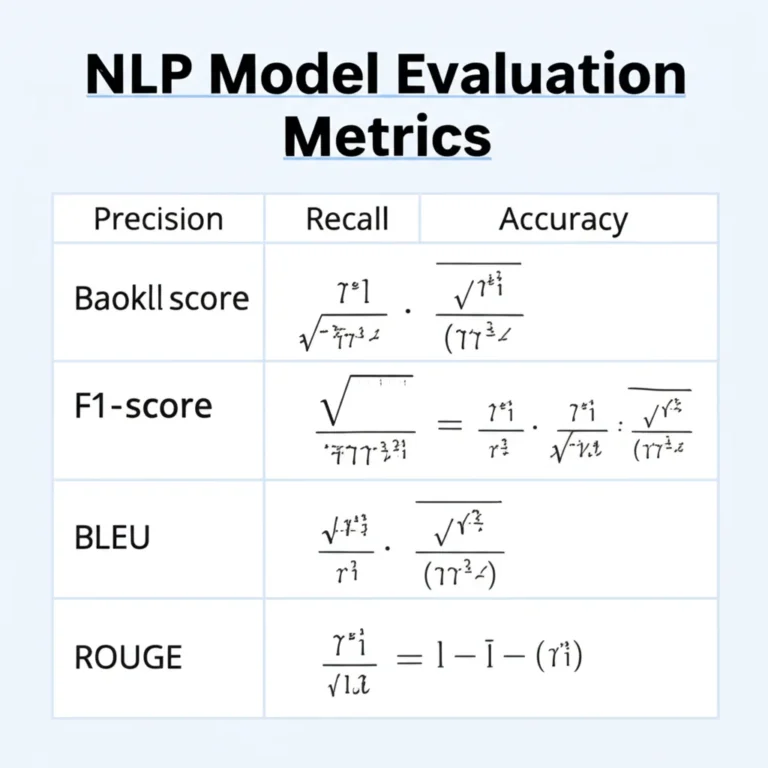
Automated Metrics: Exact Match, BLEU, ROUGE, and Perplexity
| Metric or method | Often useful for | Common limitation |
|---|---|---|
| Exact match | Structured answers and tightly specified tasks | Treats valid wording differences as errors |
| BLEU | Machine translation comparisons | Word overlap may not reflect meaning or usefulness |
| ROUGE | Summarization comparisons | Can reward overlap without checking factual correctness |
| Perplexity | Modeling how well a model predicts observed text | Does not necessarily predict human-perceived output quality |
| Task-specific checks | Required fields, code tests, format rules, policy constraints | Only checks what has been explicitly encoded |
| Embedding similarity | Approximate semantic similarity | Can miss factual contradictions and important distinctions |
These metrics are best treated as signals, not verdicts. The arXiv review notes that BLEU and ROUGE can provide weak signals for human judgments in some generative settings, while likelihood-based measures may not track sample quality well (review).
For image generation, metrics such as Fréchet Inception Distance (FID) compare generated and reference distributions, but they depend on the representation and sample set used. A metric tuned to one image domain may miss distinctions that matter in another. In short: if a metric’s assumptions do not match your task, its decimal places won’t rescue it.
Human Evaluation and Expert Review
Human review is valuable when quality depends on context, nuance, or specialist judgment. It can assess whether answer is helpful, respectful, grounded, or practically usable—things that are difficult to express in a simple automated check.
A disciplined process looks like this:
- Write the rubric. Define each criterion and what counts as weak, acceptable, and strong.
- Train reviewers. Walk through borderline examples and explain how to handle uncertainty.
- Blind model identity. Reduce the chance that brand familiarity affects ratings.
- Use multiple reviewers. Measure agreement and flag disputed cases.
- Adjudicate important disagreements. Have an expert review cases that affect safety or deployment decisions.
- Record evidence. Keep the output, prompt, scoring rationale, and system version together.
Human ratings can be expensive and imperfect, but they remain essential when the cost of an incorrect automated judgment is high. That is particularly true in public services, medicine, finance, and legal workflows.
LM-as-a-Judge: Benefits and Risks
Using a language model to score another model can make evaluation faster and more scalable. A judge can apply a rubric to thousands of outputs and explain its ratings, which is useful for triage and routine regression tests.
But model-based evaluation has a catch: the judge is another system that must be evaluated. It may prefer longer answers, favor a certain tone, miss unsupported claims, or judge outputs differently when they appear first or last. The arXiv review also highlights the risk of circularity: model-based evaluators can reinforce their own biases and potentially narrow output diversity.
Use an LM judge responsibly:
- Compare its scores with human ratings on a carefully sampled set.
- Provide a specific rubric and evidence requirements.
- Test for position, verbosity, and wording bias.
- Ask the judge to identify supporting evidence, then verify that evidence.
- Keep human review for high-stakes decisions and disputed cases.
Red Teaming, Adversarial Testing, and Safety Evaluation
Red teaming probes how a system can fail rather than checking only how well it handles normal requests. It can reveal attempts to extract sensitive data, bypass safeguards, manipulate tool use, or exploit ambiguous instructions.
A useful test plan includes:
- Direct requests for restricted content.
- Indirect, multi-turn, or role-played attempts to bypass constraints.
- Prompt injection within retrieved documents or user-provided text.
- Conflicting instructions and policy edge cases.
- Unsafe tool actions or excessive permissions.
- Multilingual and culturally varied prompts.
Red teaming is not a guarantee that all harmful behavior has been found. It is a focused search for failures, which should feed into safeguards and regression tests. Teams deploying tools or autonomous workflows should also review AI agents and AI automation workflows for the distinct risks that arise when outputs can trigger actions.
Online Evaluation: A/B Tests and User Feedback
Offline tests cannot fully reproduce real use. A/B tests and user feedback can show whether a system actually improves task completion, satisfaction, or workflow efficiency.
However, live testing requires guardrails. Do not expose users to a potentially harmful variant simply to see what happens. Define a safe rollout, select metrics before launch, protect personal data, and monitor negative outcomes as carefully as positive ones.
Useful live indicators include:
- Task completion or successful resolution.
- User corrections, retries, and abandonment.
- Escalations to a human.
- Complaint and incident rates.
- Response latency and service errors.
- Differences in outcomes across user groups.
User feedback is informative but not a random sample: people who respond may differ from those who stay silent. Pair it with system logs and targeted research, while respecting privacy.
🧰 Building a Reliable Generative AI Evaluation Framework
Define the Use Case, Users, and Risk Level
Start by writing a plain-language description of the task. “Improve customer experience” is too broad; “answer order-status questions using approved account data and escalate disputed charges” is testable.
Then establish:
- Intended users: Who will use the system, and what knowledge or accessibility needs do they have?
- Allowed tasks: What may it answer or do?
- Prohibited behavior: What must it refuse, avoid, or escalate?
- Impact of failure: Could an error cause financial loss, privacy exposure, safety harm, or unfair treatment?
- Human role: Who reviews, approves, or corrects the system’s output?
Set evaluation intensity to match risk. A low-risk writing assistant does not need the same controls as a system advising on treatment or changing financial records.
Create Representative Test Data and Evaluation Rubrics
Build a test set from realistic scenarios, not only clean examples written by the development team. Include common requests, unusual phrasing, incomplete information, relevant edge cases, and known failure modes.
Protect the test set from leakage into tuning wherever practical. If developers repeatedly adjust a system against the same examples, it may learn to perform for the test without improving more broadly.
A good rubric separates criteria rather than hiding them inside one score:
| Criterion | Example evaluation question |
|---|---|
| Accuracy | Are factual claims correct and verifiable? |
| Grounding | Are claims supported by the approved sources? |
| Relevance | Does the response address the actual request? |
| Completeness | Does it include the information needed to act? |
| Safety | Does it avoid prohibited or harmful guidance? |
| Fairness | Are results consistent across relevant user groups? |
| Usability | Is the response clear and appropriately concise? |
| Constraint adherence | Does it follow required formats, policies, and limits? |
Combine Metrics, Human Review, and Failure Analysis
A robust pipeline uses different methods for different questions:
- Automated checks catch format errors, missing fields, policy violations, or failed code tests.
- Similarity and task metrics provide repeatable comparisons on suitable tasks.
- Human review judges nuance, usefulness, and context-sensitive quality.
- AI judges help scale routine assessment after validation.
- Failure analysis identifies why errors occurred and how consequential they were.
- Operational monitoring tests performance under actual usage conditions.
The goal is not to collect every possible metric. It is to use a small, defensible set that maps to the use case and is reliable enough to guide decisions.
Measure Performance Across Groups, Languages, and Edge Cases
Averages can conceal unequal outcomes. Choose the groups, language varieties, accessibility needs, and scenarios that matter for your users and risk profile. Report sample sizes and uncertainty; tiny groups should not be hidden, but their estimates also should not be presented as more conclusive than the data supports.
Test edge cases deliberately:
- Ambiguous or contradictory user requests.
- Out-of-date or missing source information.
- Long conversations and context limits.
- Noisy text, typos, and non-standard phrasing.
- Requests involving multiple constraints.
- Uncommon but consequential situations.
For multilingual use, do not assume that success in English transfers to other languages. Translate and culturally adapt tests rather than merely translating the scoring rubric.
Track Version Changes, Drift, and Regression
Every meaningful system change deserves a repeatable check. That includes model upgrades, prompt edits, retrieval changes, tool permissions, safety-policy revisions, and changes to data sources.
Maintain a versioned record of:
- Model and provider version.
- System prompts and generation settings.
- Evaluation dataset and rubric version.
- Test results, failure examples, and known limitations.
- Reviewer decisions and remediation actions.
- Release and rollback criteria.
Use regression tests for known failures, but refresh the evaluation set periodically. Otherwise, the suite can become a museum of yesterday’s problems while new ones stroll right past.
🏢 Evaluating Different Generative AI Applications
Large Language Models and AI Chatbots
For chatbots, evaluate more than a single answer. Conversation quality depends on follow-up handling, memory, clarification, refusal behavior, and consistency across turns.
Test whether the model:
- Answers the intended question rather than a superficially similar one.
- Admits when it lacks enough information.
- Maintains relevant context without inventing details.
- Corrects mistakes when challenged with evidence.
- Escalates to a human when the task exceeds its limits.
A chatbot can appear helpful in isolated examples and still frustrate users through repeated clarification loops or confident misinformation. Include multi-turn scenarios and user-reported outcomes.
Retrieval-Augmented Generation and AI Search
Retrieval-augmented generation (RAG) adds retrieved documents to a model’s context. This can improve access to current or specialized information, but it creates two separate evaluation problems:
- Did retrieval find the right evidence?
- Did generation represent that evidence accurately?
Measure retrieval recall and relevance, citation correctness, answer groundedness, coverage, and appropriate abstention when sources do not support answer. Test outdated documents, conflicting sources, access controls, and prompt injection embedded in retrieved content.
RAG is not an automatic cure for hallucination. It can improve the evidence available to a model, but the model may still misread, omit, or overstate it. Teams building enterprise search can also explore our AI business applications coverage.
Code Generation and AI Agents
Code generation should be tested with executable outcomes, not just plausible-looking snippets. Useful checks include unit tests, integration tests, static analysis, security scanning, and review by qualified developers.
For agents that can call tools or modify systems, add action-level safeguards:
- Restrict permissions to the minimum necessary.
- Test whether the agent follows approval gates.
- Verify that destructive actions require explicit authorization.
- Log tool calls and data access.
- Test recovery, rollback, and interruption behavior.
- Evaluate the agent across complete workflows, not only individual steps.
The supplied TNO summary describes a coding assistant deleting a developer’s database, which was restored. The lesson is not that every coding assistant will delete data; it is that tool access changes the severity of failure. A response-only model and an agent with production permissions need very different evaluations.
Image, Audio, and Video Generation
Generative media evaluation must consider both perceptual quality and task compliance. For images, check composition, object relationships, text rendering, prompt adherence, visual artifacts, and representation. For audio, assess intelligibility, pronunciation, timing, speaker characteristics, and consent-related risks. For video, include temporal consistency, motion, audio-visual alignment, and scene continuity.
Metrics such as FID or embedding similarity can help compare samples, but their limitations matter. The generative AI evaluation review notes that distribution metrics depend on feature representations and can be sensitive to domain mismatch. Human inspection remains valuable, particularly for specialist imagery and subtle artifacts.
Evaluate the model on prompts representative of your actual domain. A score on general images says little about whether a system can generate accurate technical diagrams or accessible instructional videos.
High-Stakes Uses in Healthcare, Finance, and Education
In high-stakes contexts, the question is not merely “Does it usually sound right?” It is “Can the system cause serious harm, and what controls prevent that?”
- Healthcare: Test factual accuracy, source quality, uncertainty communication, escalation, and clinician oversight.
- Finance: Assess numerical correctness, disclosure, fairness, privacy, and compliance with applicable requirements.
- Education: Check accuracy, age appropriateness, accessibility, learning value, and whether the system encourages appropriate student understanding rather than simply completing assessed work.
Acceptance thresholds should reflect the consequences of error. The WHO guidance on ethics and governance of AI for health is a useful sector-specific reference. For other regulated or consequential applications, involve legal, compliance, domain, and affected-user perspectives early—not after a surprising test result.
⚖️ Responsible AI, Governance, and Evaluation Standards
Documenting Limitations and Communicating Uncertainty
An evaluation report should make clear:
- What the system is intended to do.
- Which users and data were included.
- What metrics and reviewers were used.
- How often the system failed and how severe failures were.
- Which groups or scenarios were not adequately tested.
- What limitations users should know.
- What human oversight and escalation are available.
Do not confuse “the model says it is uncertain” with calibrated uncertainty. A system can sound confident when wrong, or hedge when correct. Test whether uncertainty statements track actual reliability and whether users understand them.
Privacy, Data Protection, and Consent
Evaluation data can itself create risk. Prompts may contain personal information, sensitive business records, or confidential material. Before collecting or reviewing data, decide what can be stored, who can access it, how long it is retained, and whether it can be used for provider training or other purposes.
Apply data minimization, access controls, retention limits, and appropriate de-identification. Review relevant obligations with privacy and security specialists; the European Data Protection Board provides guidance on data protection issues, while requirements depend on jurisdiction and use.
Audits, Accountability, and Regulatory Expectations
Governance means assigning responsibility for testing, approval, monitoring, incident response, and updates. It should be possible to answer: Who owns this model’s risks, and what evidence supports its release?
Useful starting points include the NIST AI RMF and the OECD AI Principles. Organizations operating in or serving the European Union should consult the European Commission’s AI Act resources, seek current legal advice, and assess obligations for their specific system and role. Regulations evolve; a benchmark score is not a compliance certificate.
🔮 The Future of Generative AI Model Evaluation
More Realistic Benchmarks and Continuous Testing
The next generation of evaluation should be less like a one-time exam and more like a maintained quality program. That means private and refreshed test sets, realistic user tasks, clearer reporting, and comparisons that include cost, risk, and operational performance.
A useful benchmark should make its scope transparent:
- What does it measure?
- Which users, domains, and languages does it represent?
- What are its known blind spots?
- How is contamination risk handled?
- Are results reproducible across model versions?
As benchmarks improve, they still will not replace context-specific testing. The aim is better evidence, not one universal leaderboard.
Evaluation for Multimodal Models and Autonomous Agents
Models that combine text, images, audio, video, and tools introduce more ways to fail. An agent might interpret an image incorrectly, take a wrong action, or propagate an early mistake through a long workflow. Evaluation must cover the sequence of perception, reasoning, tool use, and outcome, rather than giving credit for a plausible final explanation alone.
Research gaps remain around uncertainty, fairness in generated outputs, causal and counterfactual evaluation, faithful explanations, constraint adherence, and robust testing under distribution shifts (review on arXiv). For organizations exploring the operational side, our coverage of AI news, AI agents, and AI infrastructure tracks the systems and practices shaping deployment.
The practical question remains the same, even as the technology grows more capable: what evidence would convince you this system is safe and useful for this particular job?
❓ Frequently Asked Questions
How can businesses measure the real-world performance of generative AI models?
Businesses should measure the outcomes that matter to users and operations, not just model scores. Define success for the use case—for example, correctly resolving a support request—and track task completion, factuality, user corrections, escalation, latency, safety incidents, and performance across relevant groups.
Use offline tests before deployment, then monitor live outcomes with privacy protections and clear safeguards. Compare model versions using consistent datasets, prompts, and rubrics, and inspect failures rather than relying on an average. For risky applications, begin with human review or a limited rollout and expand only when the evidence supports it.
What makes evaluating generative AI outputs difficult across different tasks and industries?
Generative AI produces open-ended outputs, so different answers may all be acceptable. Quality also means different things across applications: creativity matters for writing, while factual correctness and traceable sources matter more for clinical information or financial guidance.
Industry context changes the consequences of failure, the required expertise, the acceptable level of uncertainty, and the relevant rules. This is why a general benchmark can provide background but cannot establish readiness for a specific deployment. Teams need task-specific criteria and representative users, data, and failure scenarios.
How can companies assess the accuracy, reliability, and bias of generative AI models?
For accuracy, verify claims against trusted sources and use task-specific ground truth where it exists. For reliability, repeat tests across prompts and runs, measure consistency, and evaluate performance on distribution shifts and edge cases. For bias, disaggregate results across relevant groups and languages, investigate harmful patterns, and involve people with appropriate domain and community expertise.
No single metric proves a model unbiased or reliable. Combine quantitative measurements with qualitative review, document limitations, and retest after meaningful changes. In high-impact settings, provide human oversight and clear escalation paths.
Which evaluation metrics help organizations compare generative AI models and gain a competitive edge?
Useful metrics depend on the job. Teams may combine exact match or executable tests for structured tasks, factuality and groundedness checks for knowledge work, human ratings for nuanced quality, safety and fairness assessments, and operational measures such as latency and cost per successful task.
To compare models fairly, use the same prompts, datasets, settings, and scoring criteria, and report uncertainty and failure severity alongside average scores. A competitive edge comes from choosing the system that delivers reliable outcomes at an acceptable risk and operating burden—not simply the model with the highest public benchmark score.
How often should generative AI systems be tested?
Test before release and whenever a meaningful component changes: the model, prompt, retrieval corpus, tools, safety rules, or user workflow. Keep a regression suite for known failures, monitor production continuously for emerging issues, and refresh evaluation data as user behavior and information needs change.
The cadence should reflect risk. A low-impact writing assistant may need lighter controls than a system that influences healthcare, financial decisions, or external actions. For high-risk systems, testing should be continuous and tied to explicit release and rollback criteria.