Support our educational content for free when you purchase through links on our site. Learn more
How Generative AI Evaluation Improves Decisions 🧠

How can generative AI model evaluation improve business decision-making? By testing AI against real business tasks, measurable outcomes, and known risks, organizations can make better-informed choices about which systems to use, where human review is needed, and whether the investment is paying off.
A polished AI answer can feel convincing while missing the detail that changes a decision. In a Harvard Business School field experiment, AI-assisted screeners were 9 percentage points more likely to reject an innovation idea than screeners in a human-only control group—an eye-opening reminder that AI can influence judgment as well as inform it.
That’s why evaluation should go beyond benchmark scores. We’ll look at how to compare models, measure accuracy and risk, connect results to business outcomes, and keep people meaningfully involved in high-impact decisions.
Key Takeaways
- Evaluate business tasks, not just models. Use representative workflows, clear scoring criteria, and a credible baseline.
- Measure more than accuracy. Assess factuality, consistency, safety, bias, latency, cost, and user outcomes.
- Treat one AI answer as weak evidence. Repeat tests and use human review for subjective or consequential decisions.
- Connect evaluation to business value. Track whether AI improves quality, customer experience, productivity, or decision outcomes.
- Keep evaluating after launch. Model updates, changing data, and shifting workflows can change performance and risk.
Table of Contents
- ⚡️ Quick Tips and Facts: How AI Evaluation Improves Business Decisions
- 🧭 Background: Generative AI Evaluation and Evidence-Based Decision-Making
- What generative AI model evaluation actually measures
- Why traditional software testing is not enough
- 💼 How Generative AI Evaluation Improves Business Decision-Making
- Reduce uncertainty before investing in AI
- Compare models, vendors, and use cases objectively
- Connect model performance to business outcomes
- 📊 The Business Benefits of Evaluating Generative AI Models
- Improve accuracy, productivity, and customer experience
- Manage risk, compliance, and reputation
- Make AI investments measurable and accountable
- 🔍 What to Measure: Key Generative AI Evaluation Metrics
- Accuracy, relevance, and task completion
- Hallucinations, factuality, and groundedness
- Safety, bias, privacy, and policy compliance
- Latency, scalability, and cost efficiency
- User satisfaction and business impact
- 🧪 Generative AI Evaluation Methods and Testing Approaches
- Automated benchmarks and task-specific tests
- Human review and expert judgment
- LLM-as-a-judge: strengths, limits, and safeguards
- A/B testing, pilots, and real-world experiments
- 🛠️ A Practical Framework for Evaluating Generative AI at Work
- 1. Define the decision and business objective
- 2. Identify stakeholders, users, and acceptable risk
- 3. Build representative test data and evaluation criteria
- 4. Test candidate models against a baseline
- 5. Validate results with people and production-like workflows
- 6. Monitor performance and reassess decisions over time
- ✅ Model Validation, Verification, and Responsible AI Governance
- Human oversight and escalation paths
- Data quality, privacy, and security controls
- Auditability, documentation, and regulatory readiness
- 🏢 Generative AI Evaluation by Business Function
- Customer service and contact centers
- Marketing, sales, and content operations
- Finance, legal, and compliance
- Human resources and internal knowledge management
- Software development and data analysis
- ⚖️ Choosing Between Generative AI Models and Vendors
- Compare closed, open-weight, and fine-tuned models
- Evaluate retrieval-augmented generation and agent workflows
- Assess vendor claims, portability, and lock-in
- 📈 Turning Evaluation Results into Better Business Decisions
- Build a decision scorecard and set go/no-go thresholds
- Calculate ROI, total cost, and opportunity cost
- Use evaluation findings to prioritize AI projects
- 🚧 Common Generative AI Evaluation Mistakes to Avoid
- Relying on generic benchmarks instead of business tasks
- Ignoring edge cases, bias, and failure costs
- Treating a one-time test as ongoing assurance
- 🔮 The Future of AI Evaluation and Decision Intelligence
- 🏁 Conclusion
- 🔗 Recommended Links
- ❓ FAQ
- How does generative AI model evaluation improve business decision-making?
- Which metrics matter most when evaluating a generative AI model?
- How often should businesses evaluate AI models?
- Can AI evaluation prove a model is unbiased or safe?
- Who should be responsible for generative AI evaluation?
- 📚 Reference Links
⚡️ Quick Tips and Facts: How AI Evaluation Improves Business Decisions
Generative AI model evaluation improves business decision-making by turning “this answer looks impressive” into evidence about accuracy, reliability, risk, cost, and business value. Our researchers and ML engineers at ChatBench.org™ recommend evaluating models against real workflows and real decision criteria—not just a glossy benchmark or a memorable demo.
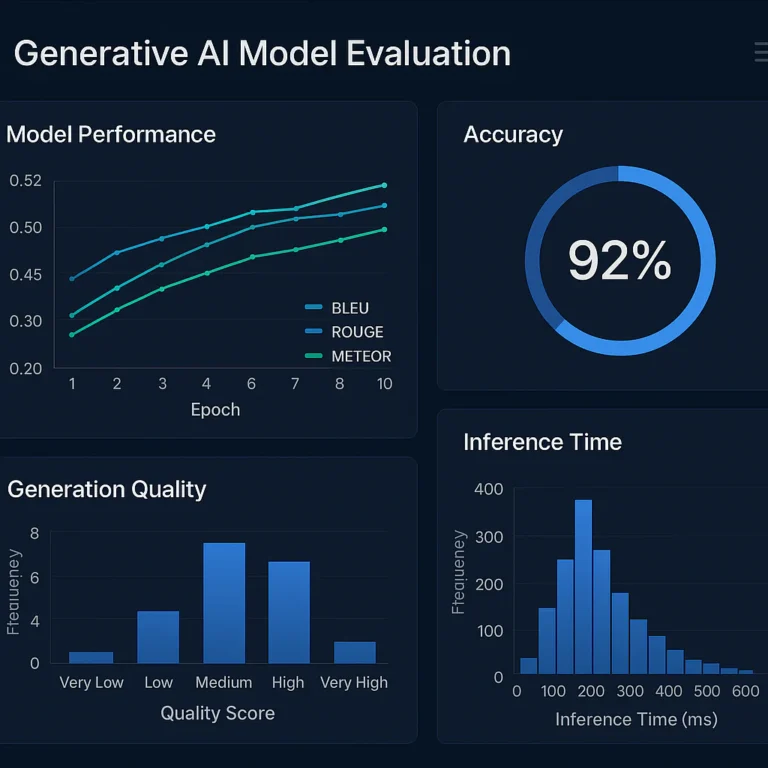
For a practical overview of evaluation methods and measures, start with our guide to generative AI model evaluation. The core lesson: test AI as part of a decision system, not as a standalone chatbot.
| Quick fact | What it means for a business |
|---|---|
| A fluent answer can still be wrong | Measure factuality and task success, not writing quality alone. |
| One AI judgment can be unstable | Repeat evaluations, reverse option order, and compare models and prompts. |
| Human oversight matters most for subjective decisions | Use AI to structure analysis, not to rubber-stamp judgments about potential, taste, or strategic fit. |
| Average performance can hide dangerous failures | Track failure types, severity, and performance across user groups and edge cases. |
| Evaluation should continue after launch | Monitor changing data, user behavior, model versions, and business outcomes. |
Five evaluation habits that make decisions better
- Start with the decision. Ask what choice the model will inform, who owns that choice, and what a wrong answer would cost.
- Use business-specific test cases. A general benchmark may not reflect your contracts, customers, products, or internal policies.
- Compare with a baseline. Test against current human performance, existing software, and alternative models.
- Aggregate evidence. Repeat tests across prompts, model versions, evaluators, and option order. A single score is a snapshot, not a verdict.
- Keep a human accountable. Especially for high-impact or subjective decisions, require a qualified person to review evidence and own the outcome.
The National Institute of Standards and Technology’s AI Risk Management Framework recommends managing AI risk across the system lifecycle. That aligns with our engineering practice: test before deployment, monitor after deployment, and revisit decisions when the system or its context changes.
The question to keep asking: Is the AI making the business decision better—or merely making the existing workflow faster? We’ll return to that distinction when we connect evaluation to operating models and business outcomes.
🧭 Background: Generative AI Evaluation and Evidence-Based Decision-Making

Generative AI can summarize research, compare proposals, draft recommendations, and support decisions across business functions. But it does not produce a stable “truth score” by itself. Its output depends on the model, prompt, data, context, evaluation criteria, and sometimes the order in which options appear.
That variability is why we treat model evaluation as decision evidence. It helps an organization understand where AI is useful, where it is unreliable, and where humans must remain firmly in the loop. For more on practical enterprise use cases, see AI Business Applications.
What generative AI model evaluation actually measures
Generative AI evaluation is the structured testing of a model, application, or AI-assisted workflow against defined expectations. A useful evaluation can measure:
- Task quality: Did the model answer the question or complete the work?
- Factual grounding: Are its claims supported by reliable evidence?
- Consistency: Does it reach similar conclusions when the input is equivalent?
- Safety and policy compliance: Does it handle sensitive requests appropriately?
- Operational performance: Is it fast and reliable enough for the workflow?
- Business outcomes: Does it improve time, quality, customer experience, or decision effectiveness?
Evaluation may cover a foundation model, such as OpenAI’s models, an AI product, such as Microsoft Copilot, or a complete system that includes retrieval, tools, people, and business processes.
A distinction we emphasize with teams is model performance versus decision quality. A model may score well on answer relevance but still fail to improve the decision it supports. A well-written summary is not valuable if it omits the exception that changes the recommendation.
Why traditional software testing is not enough
Traditional software often returns predictable outputs for the same input. Generative models are probabilistic: small changes in wording, context, model version, or generation settings can change the answer.
| Traditional software test | Generative AI evaluation |
|---|---|
| Often checks exact outputs or deterministic rules | Usually checks quality against a rubric or expected properties |
| Failures can be isolated to specific code paths | Failures may emerge from data, prompts, context, or model behavior |
| A passing test may remain valid across repeated runs | Results may vary between runs, even with similar inputs |
| Software version changes are tracked | Model updates, prompts, retrieval indexes, and tools may all change |
| Functionality is often the main target | Must also assess factuality, bias, safety, and decision impact |
This does not mean software testing is obsolete. It means AI systems need software testing plus behavioral evaluation. NIST’s AI RMF Playbook offers guidance for identifying and managing risks across AI design, development, deployment, and use.
💼 How Generative AI Evaluation Improves Business Decision-Making
Evaluation helps leaders decide what to deploy, where to deploy it, how much human oversight to retain, and whether the investment is working. It replaces guesswork with a structured comparison between alternatives.
Reduce uncertainty before investing in AI
Before committing to a model or workflow, teams can test it on representative business tasks. That helps distinguish a convincing demo from a useful product.
For example, a customer-support team could test an AI assistant on anonymized historical tickets and assess:
- Whether it identifies the correct issue.
- Whether it retrieves the right policy.
- Whether it drafts an accurate, appropriate response.
- Whether it knows when to escalate.
- Whether agents can review and correct it efficiently.
The evaluation may reveal that the model works well for order-status questions but performs poorly on refunds involving unusual circumstances. That is actionable: limit the first deployment to suitable cases, improve the retrieval system, or require additional review for exceptions.
The NIST AI RMF frames risk management as an ongoing activity rather than a one-time prelaunch hurdle. We agree: a controlled pilot can reduce uncertainty, but production evidence is needed before expanding scope.
Compare models, vendors, and use cases objectively
Vendor demonstrations are useful for generating hypotheses. They are not neutral comparisons. Models may be tuned to different tasks, and vendors may showcase their strongest examples. Use the same test set, scoring criteria, and business constraints when comparing options.
| Comparison question | Evidence to collect |
|---|---|
| Which model handles our task best? | Task-specific results from the same test cases |
| Which one is more reliable? | Repeated trials and consistency checks |
| Which is safer for this workflow? | Policy tests, red-team cases, and human review |
| Which fits our operating needs? | Latency, integration effort, access controls, and monitoring |
| Which produces greater value? | Outcome measures compared with a baseline |
A practical comparison should include more than a model leaderboard. Consider the full system: a strong model can underperform when paired with poor retrieval, unclear prompts, or missing escalation rules. For organizations exploring orchestration and autonomous workflows, our AI Agents coverage provides useful context.
Connect model performance to business outcomes
A model score matters only if it informs a decision. Connect evaluation results to outcomes such as reduced handling time, fewer errors, improved conversion, faster research, or better service resolution.
The business measurement should reflect the actual job:
- For a drafting assistant, measure editing time and correction rates.
- For a search assistant, measure answer accuracy and successful information retrieval.
- For a screening tool, measure consistency, false rejections, and human agreement.
- For a forecasting or planning workflow, compare recommendations with a defined baseline and track downstream results.
This is also where organizational design matters. In the featured video, Aaron Mitchell of ZS argues that businesses should focus on transforming decisions and workflows, not simply adding AI tools to old processes. His “decision system” view—sensing, modeling, deciding, acting, and learning—helps explain why a capable model can still deliver little value if the surrounding workflow does not change.
📊 The Business Benefits of Evaluating Generative AI Models
Evaluation is not paperwork attached to an AI project. Done well, it is how a business discovers where AI helps, where it introduces risk, and what needs to change before wider adoption.
Improve accuracy, productivity, and customer experience
A well-designed evaluation identifies which tasks AI can handle reliably and which need human review. This can support:
- Faster information retrieval and first-draft creation.
- More consistent answers to routine questions.
- Better routing of complex cases to experienced staff.
- Reduced rework caused by incomplete or unsupported outputs.
- More time for employees to focus on nuanced customer needs.
The benefit is not automatic. Productivity gains can disappear if employees spend the saved time checking poor outputs, correcting errors, or navigating a cumbersome workflow. Measure net productivity, not just generation speed.
For example, a support assistant that drafts responses in seconds may still slow the team if agents have to verify every sentence. Evaluation should compare end-to-end handling time, answer quality, and escalation—not just time to first draft.
Manage risk, compliance, and reputation
Generative AI can produce fabricated claims, expose sensitive information, or apply criteria inconsistently. Testing for these behaviors helps the organization set guardrails before a customer, employee, or regulator discovers a failure the hard way.
A sensible risk evaluation includes:
- High-impact and edge-case scenarios.
- Attempts to elicit prohibited or confidential information.
- Checks for unsupported claims and missing citations.
- Analysis of performance differences across relevant groups.
- Human escalation rules for uncertain or consequential cases.
- Documentation of known limitations and approved uses.
The NIST Generative AI Profile expands on risks that are especially relevant to generative systems. For privacy, security, and data protection, governance should also involve legal, security, compliance, and domain experts—not only the model team.
Make AI investments measurable and accountable
An evaluation plan makes ownership clearer. Teams can agree in advance on:
- The business problem and intended user.
- The current workflow baseline.
- The success metrics and failure thresholds.
- Who approves deployment and exceptions.
- What evidence triggers a rollback or retraining.
- Who monitors performance after launch.
This creates a more honest investment conversation. If a pilot improves drafting speed but does not improve resolution quality, the result is still valuable. It tells leaders what the tool does—and does not—justify.
🔍 What to Measure: Key Generative AI Evaluation Metrics
There is no universal “best AI score.” Choose metrics based on the task, risk, and decision being supported. A low-risk brainstorming assistant and a system that helps triage medical records need very different evaluation thresholds.
| Metric family | Example measures | Business question |
|---|---|---|
| Task success | Completion rate, rubric score, exact-match accuracy | Did it do the required work? |
| Factuality | Claim accuracy, citation support, groundedness | Can users rely on its content? |
| Consistency | Agreement across runs, prompt variations, option order | Does its judgment hold up? |
| Safety | Policy violations, harmful output rate, escalation accuracy | Does it fail safely? |
| Fairness | Performance and error gaps across groups | Are outcomes uneven or discriminatory? |
| Operations | Latency, availability, throughput, failure rate | Can it support the workflow? |
| Economics | Cost per successful task, review effort, total cost | Is the result worth the resources? |
| Business impact | Resolution, conversion, quality, time saved | Did the organization improve? |
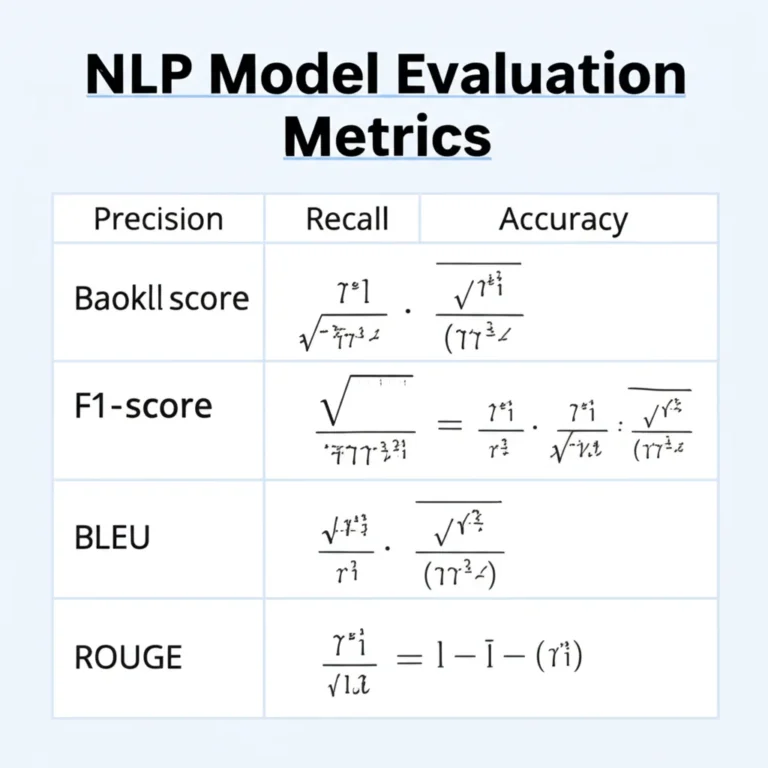
The HELM benchmark from Stanford’s Center for Research on Foundation Models illustrates why model assessment can span multiple scenarios and metrics. Broad benchmarks are useful for orientation; they do not substitute for testing your own tasks.
Accuracy, relevance, and task completion
Define what a correct answer means before scoring one. “Relevant” is not the same as correct, complete, policy-compliant, or useful.
For a contract summary, a rubric might assess whether the model:
- Correctly identifies parties and obligations.
- Preserves exceptions and key dates.
- Distinguishes quoted language from interpretation.
- Cites the source clause for each material claim.
- Flags uncertainty rather than filling gaps with guesses.
Use exact-match scoring where answer has a clear right result. Use expert rubrics for open-ended outputs, and report the rubric and sample size so decision-makers can interpret the score.
Hallucinations, factuality, and groundedness
A hallucination is an unsupported or fabricated statement presented as though it were true. In business workflows, the impact depends on the claim. An invented product feature in a brainstorming session is different from a fabricated regulatory obligation.
Measure:
- Claim accuracy: Are individual factual statements correct?
- Groundedness: Are claims supported by supplied documents or retrieved evidence?
- Citation quality: Do citations point to relevant, authoritative sources?
- Abstention quality: Does the model admit uncertainty when evidence is insufficient?
Retrieval-augmented generation, or RAG, can provide access to approved documents, but retrieval alone does not guarantee faithful answers. Test whether the system retrieves the right passages and whether its response accurately represents them.
Safety, bias, privacy, and policy compliance
Test what the system does with sensitive requests, personal data, and ambiguous instructions. Also check whether performance varies across customer groups, languages, regions, or other relevant categories.
A practical scorecard can include:
- Rates of policy violations and unsafe completions.
- False refusals on legitimate requests.
- Incorrect disclosure of sensitive information.
- Disparate error rates where a relevant, lawful comparison is possible.
- Correct escalation for high-stakes or out-of-scope cases.
A test cannot prove that a model is unbiased or completely safe. It can reveal measurable failure patterns and inform mitigations. The NIST AI RMF and its generative AI profile provide risk-management guidance, but organizations still need context-specific assessments.
Latency, scalability, and cost efficiency
Operational measures can decide whether a technically strong model is practical. Track:
- Response-time percentiles, not only the average.
- Availability and error rates during peak demand.
- Throughput under realistic workloads.
- Cost per successful, accepted task, rather than cost per generated response.
- Human review and correction effort.
- Infrastructure and integration requirements.
For example, a model that generates a response quickly but needs extensive human editing may have a higher effective cost than a slower, more dependable system. The relevant comparison is total workflow cost and quality, not model inference in isolation. Our AI Infrastructure category covers the systems and deployment choices that shape these trade-offs.
User satisfaction and business impact
Ask users whether AI makes the work easier, but do not treat satisfaction as proof of accuracy. A confident answer can be pleasant and wrong; a cautious answer can be less flashy and more dependable.
Pair user feedback with outcome measures such as:
- Resolution and repeat-contact rates.
- Editing, correction, or escalation frequency.
- Decision turnaround time.
- Adoption and abandonment rates.
- Customer satisfaction, retention, or task completion.
- Quality outcomes assessed by independent reviewers.
🧪 Generative AI Evaluation Methods and Testing Approaches
Different methods answer different questions. Automated tests can scale, expert reviews can catch nuance, and real-world experiments can reveal workflow effects. Most businesses need a combination, not a winner-takes-all method.
Automated benchmarks and task-specific tests
Automated evaluations can test large sets of prompts consistently and quickly. They are useful for regression tests, model comparisons, and narrow tasks with clearly defined expectations.
Strengths:
- Repeatable and efficient at scale.
- Helpful for detecting changes between model versions.
- Can cover many routine cases and known failure patterns.
Limitations:
- A benchmark can reward test-taking behavior rather than business usefulness.
- A test set may not reflect current customers or edge cases.
- Automated scoring may miss nuance, context, or subtle factual errors.
Use broad benchmarks as a starting point and your own carefully maintained test set for decisions. Keep some holdout cases private to reduce the risk that systems become optimized only for familiar tests.
Human review and expert judgment
Human reviewers are essential when quality involves domain knowledge, context, or consequences that are difficult to score automatically. Reviewers should use clear rubrics, receive relevant training, and assess outputs without being nudged toward a preferred answer.
For subjective criteria—such as the promise of a business idea—reviewers should be especially alert to persuasive explanations. In a field experiment described by Harvard Business School’s Digital, Data, and Design Institute, AI-assisted screeners were 9 percentage points more likely to fail a solution than screeners in a human-only control group. The authors found that explanations could make AI recommendations more persuasive, particularly for subjective criteria.
The implication is not “never show explanations.” It is: a rationale can influence a reviewer even when it is not reliable evidence. Ask reviewers to inspect the underlying submission and explain their own judgment, rather than simply accepting the model’s story.
LLM-as-a-judge: strengths, limits, and safeguards
An LM-as-a-judge uses one language model to score or compare outputs from another system. It can help scale evaluations, especially when a rubric is explicit and human review is too slow for every example.
Use it cautiously:
- Validate judge scores against expert-rated examples.
- Check whether it favors particular styles or longer answers.
- Test sensitivity to order, phrasing, and model identity.
- Use multiple judges or human adjudication for consequential decisions.
- Keep evaluation criteria separate from the output being judged.
- Avoid treating the judge as an independent authority if it shares the same blind spots as the model under test.
LLM judges are best treated as triage and measurement aids, not final arbiters of quality.
A/B testing, pilots, and real-world experiments
A pilot can show how AI behaves in the actual workflow. A controlled experiment can help determine whether the AI caused an observed change rather than merely coinciding with it.
A careful rollout might:
- Select a well-defined workflow with a manageable risk profile.
- Establish baseline performance before introducing AI.
- Compare AI-assisted work with the existing process.
- Use consistent eligibility rules and outcome definitions.
- Review both average outcomes and failures.
- Expand only when the evidence supports expansion.
Avoid measuring only speed or adoption. A workflow may become faster while producing more corrections, poorer decisions, or uneven customer outcomes. Check quality and risk alongside efficiency.
🛠️ A Practical Framework for Evaluating Generative AI at Work
Here is a six-step framework our team uses to keep evaluations tied to decisions rather than detached from them.
1. Define the decision and business objective
Write down what decision the AI will inform and what outcome the organization wants to improve.
Example: “Help support agents draft accurate answers to routine account questions” is more testable than “deploy an AI assistant.”
Specify:
- The decision or task.
- The intended users.
- The current process.
- The desired outcome.
- The possible harms if the system is wrong.
2. Identify stakeholders, users, and acceptable risk
Include the people who build, use, govern, and experience the system. A workflow may affect frontline staff, customers, compliance teams, and product owners in different ways.
Agree on:
- Who can use the model.
- Which cases are out of scope.
- When human approval is required.
- What constitutes a severe failure.
- Who can pause or roll back deployment.
3. Build representative test data and evaluation criteria
Create test cases that reflect the real range of inputs, not only clean examples. Include typical requests, difficult cases, ambiguous instructions, and known failure risks.
Protect data appropriately: use approved data, remove or control sensitive information, and document the source and limitations of the test set. Write scoring rubrics before testing to reduce the temptation to redefine success after seeing the results.
4. Test candidate models against a baseline
Compare candidates using the same inputs, evaluation rules, and operating conditions. Include the existing process as a baseline, whether that is a human workflow, a rules-based tool, or another model.
Record:
- Task and quality scores.
- Error categories and severity.
- Performance variation across repeated runs.
- Latency and failure rates.
- Human correction effort.
- Total workflow costs and constraints.
A model should not win simply because it produces more polished prose. The winning system is the one that best fits the task and risk profile.
5. Validate results with people and production-like workflows
Have qualified reviewers examine outputs in realistic context. Test the user interface, retrieval sources, permissions, escalation path, and handoffs—not just the model response in a notebook.
This step often exposes failures that a standalone model test misses. For example, the model may answer accurately when given the right document but fail because the production search system retrieved an outdated policy.
6. Monitor performance and reassess decisions over time
After launch, monitor usage, errors, user corrections, quality, and changing business conditions. Re-evaluate when the model, prompt, data source, tool access, policy, or workflow changes.
Set thresholds in advance:
- What performance drop triggers investigation?
- Which failure requires rollback?
- How often will reviewers audit samples?
- Who receives incident reports?
- When must the model be reapproved?
Treat deployment as a managed cycle, not a ribbon-cuting moment. The NIST AI RMF similarly emphasizes lifecycle risk management.
✅ Model Validation, Verification, and Responsible AI Governance
Responsible evaluation asks not only “Does this model work?” but also “For whom, under what conditions, with what oversight, and with what consequences?”
Human oversight and escalation paths
Human oversight needs to be meaningful. A person should have sufficient context, time, authority, and expertise to challenge the system. A reviewer who must approve hundreds of outputs in a minute is not an effective safeguard.
For high-impact decisions:
- Make the model’s role explicit: advise, prioritize, draft, or decide.
- Provide access to source evidence when possible.
- Give users a way to disagree and record why.
- Route uncertain or out-of-scope cases to qualified staff.
- Audit whether people actually catch errors.
The Harvard field experiment on innovation screening found that explanations could make AI judgments more influential. Its recommendation is relevant beyond screening: AI can support human decisions, but people need training to question and integrate its output rather than accept it uncritically. See the study summary at Harvard’s D^3 Institute.
Data quality, privacy, and security controls
An evaluation is only as useful as its data. Poorly labeled examples, outdated policies, and missing edge cases can create false confidence.
Check:
- Whether test data reflects the intended population and workflow.
- Whether sensitive information is necessary and appropriately protected.
- Whether retrieved documents are current and access-controlled.
- Whether prompts or logs retain confidential information.
- Whether the application is exposed to prompt injection or data exfiltration risks.
The OWASP Top 10 for LM Applications covers security risks such as prompt injection, sensitive information disclosure, and improper output handling. Security review should include the whole application, not merely the underlying model.
Auditability, documentation, and regulatory readiness
Keep records that allow a later reviewer to understand what was tested and why a deployment decision was made.
Useful documentation includes:
- Intended use and prohibited use.
- Model, prompt, and system versions.
- Test data sources and limitations.
- Metrics, rubrics, and acceptance thresholds.
- Results, known weaknesses, and mitigations.
- Human review procedures and incident handling.
The OECD AI Principles and the EU AI Act provide broader governance context. Applicable duties depend on jurisdiction, use case, and organizational role, so legal review should be part of implementation planning.
🏢 Generative AI Evaluation by Business Function
The same foundation model can perform differently across workflows. Evaluate the task in context, with its users, data, and consequences.
| Business function | Example AI use | Evaluation emphasis |
|---|---|---|
| Customer service | Answer drafting and routing | Accuracy, escalation, resolution, customer experience |
| Marketing and sales | Research, personalization, content drafts | Factual claims, brand fit, conversion, privacy |
| Finance and legal | Document review and summaries | Completeness, traceability, confidentiality, expert review |
| Human resources | Internal policy support and drafting | Fairness, privacy, correct policy interpretation |
| Software and analytics | Code assistance and data queries | Correctness, security, test coverage, reproducibility |
Customer service and contact centers
Evaluate both the answer and the journey around it. A useful assistant should retrieve current policies, recognize when a case is unusual, and transfer the customer to a person with the right context.
Track first-contact resolution, repeat contacts, agent edits, escalation quality, and customer satisfaction. A polished answer that sends a customer down the wrong path is not a success.
Marketing, sales, and content operations
AI can help with research, drafting, segmentation, and sales enablement. Evaluation should check factual claims, audience fit, brand standards, privacy, and whether the work improves the intended campaign outcome.
For sales research, for example, verify that company facts are current and sourced. For generated content, assess not only readability but also compliance and factual integrity. See more workflow examples in AI Automation Workflows.
Finance, legal, and compliance
These workflows often have low tolerance for unsupported claims or missing details. Require traceable evidence, use expert review, and define which tasks are suitable for assistance versus automated action.
AI may help organize documents or draft summaries, but evaluation should test whether it preserves exceptions, distinguishes facts from interpretation, and flags uncertainty. A confident summary is not a substitute for review by an authorized professional.
Human resources and internal knowledge management
For internal assistants, test whether answers reflect current policies, respect access permissions, and handle sensitive employment topics appropriately. Review performance across different user groups and question styles.
Measure successful self-service and time saved, but also track incorrect policy guidance, privacy incidents, and escalation behavior. The best system may be one that declines to answer certain questions and routes them to HR.
Software development and data analysis
Code and analytics assistants need tests for correctness, security, maintainability, and reproducibility. Measure whether generated code passes tests and follows approved practices—not merely whether it compiles.
For natural-language data analysis, test whether the system chooses the correct dataset, applies filters properly, explains assumptions, and avoids exposing restricted data. Keep human review for consequential decisions drawn from generated analysis.
⚖️ Choosing Between Generative AI Models and Vendors
A model choice is a system choice. Assess the model together with its access controls, data handling, integration, monitoring, support, and portability.
Compare closed, open-weight, and fine-tuned models
| Option | Potential strengths | Trade-offs to evaluate |
|---|---|---|
| Hosted proprietary model | Managed access, frequent updates, mature tooling | Vendor dependency, data handling, limited control over updates |
| Open-weight model | More deployment flexibility and customization | Infrastructure, security, maintenance, and evaluation burden |
| Fine-tuned model | Better adaptation to a specific task or style | Training data quality, maintenance, and risk of overfitting |
| Smaller task-specific model | Potentialy efficient for narrow workflows | May lack breadth or robustness on unfamiliar inputs |
Examples include OpenAI, Anthropic Claude, Google Gemini, Meta Llama, and Mistral AI. Brand reputation is not a substitute for task-specific tests. A strong general model may be unnecessary for a narrow classification task; a specialized option may fail when the workflow broadens.
Evaluate retrieval-augmented generation and agent workflows
RAG systems combine a language model with retrieval from a document collection. Agent workflows can add tools and take actions. Each component adds a new evaluation surface.
For RAG, test:
- Retrieval precision and coverage.
- Source freshness and access control.
- Whether generated claims are supported by retrieved passages.
- Behavior when relevant evidence is missing or conflicting.
For agents, also test tool selection, permissions, action confirmation, recovery from tool errors, and safe termination. An agent that can act on business systems should face stricter evaluation than a system that only drafts text. Explore the surrounding technology in our AI Agents coverage.
Assess vendor claims, portability, and lock-in
Ask vendors for evidence relevant to your use case, not just headline benchmark scores. Clarify how model updates are communicated, how customer data is handled, what logs are available, and whether you can export prompts, evaluations, and workflow data.
Before adoption, test:
- Service and data-processing terms.
- Versioning and change-management practices.
- Evaluation and monitoring capabilities.
- Integration with existing identity and security controls.
- Ability to switch models or providers.
- Support for audit and incident investigation.
📈 Turning Evaluation Results into Better Business Decisions
Evaluation results become useful when they change a choice. A scorecard can show which option meets the business need, what risks remain, and what should happen next.
Build a decision scorecard and set go/no-go thresholds
Use a compact scorecard with criteria weighted by business importance. Do not let a strong average score hide a failure that is unacceptable for the use case.
| Criterion | Example decision rule |
|---|---|
| Task quality | Meets a minimum threshold on representative cases |
| Critical errors | No unresolved high-severity failure pattern |
| Human review | Review effort is practical and effective |
| Security and privacy | Required controls are verified |
| Operational fit | Latency and availability support the workflow |
| Business value | Outcomes improve versus a credible baseline |
Set thresholds before reviewing results. Otherwise, teams may unconsciously move the goalposts to favor a preferred model.
Calculate ROI, total cost, and opportunity cost
A useful ROI assessment compares the value created with the full cost of deploying and operating the workflow.
Consider:
- Time saved after accounting for review and correction.
- Changes in quality, error rates, and customer outcomes.
- Integration, governance, training, and monitoring effort.
- Infrastructure and model usage.
- Opportunity cost of choosing one project over another.
A simple decision lens is:
Net value = measurable benefit − total workflow cost − expected failure cost
This is not a universal accounting formula, but it forces leaders to include the costs that demos often leave offstage. For related operating considerations, see AI Infrastructure.
Use evaluation findings to prioritize AI projects
Prioritize use cases where the task is valuable, data is available, outcomes can be measured, and risk can be managed. A promising candidate often has:
- A repeated workflow with clear pain points.
- Reliable source material or feedback.
- A measurable baseline.
- Human expertise available for review.
- A safe path to start small and expand gradually.
The broader point is that model evaluation should inform portfolio decisions, not only model selection. It can reveal which projects deserve further investment, which need redesign, and which should not be automated.
🚧 Common Generative AI Evaluation Mistakes to Avoid
Relying on generic benchmarks instead of business tasks
Why it fails: A benchmark may test general knowledge while your business needs reliable policy interpretation or document extraction.
Better approach: Use public benchmarks for broad comparison, then validate with representative, domain-specific cases and business outcomes.
Ignoring edge cases, bias, and failure costs
Why it fails: Average scores can look healthy while a small number of severe errors affect customers, employees, or compliance.
Better approach: Categorize errors by severity, examine relevant group differences, and create explicit escalation rules.
Treating a one-time test as ongoing assurance
Why it fails: Models, prompts, retrieval sources, users, and business policies change. Yesterday’s pass does not guarantee today’s performance.
Better approach: Monitor in production, rerun regression tests after changes, and keep ownership for incident response and reassessment.
🔮 The Future of AI Evaluation and Decision Intelligence
Evaluation is moving beyond “Which model has the highest score?” toward Which combination of people, models, evidence, and workflows produces better decisions?
That shift matters because a language model can be persuasive without being consistent. In research summarized by the Harvard Business School Digital, Data, and Design Institute, individual generative AI evaluations of strategic options were inconsistent and biased. The reported consistency varied widely across models and prompting setups, while aggregating evaluations across models, roles, prompts, and repeated comparisons improved alignment with human expert rankings.
Those findings do not mean that crowds of models are automatically right. They show why one answer from one model is weak evidence, particularly for complex strategic decisions. Aggregation can reduce the influence of an individual judgment, but human expertise and business context still matter.
A complementary field experiment on innovation screening found that AI recommendations could make screeners more likely to reject ideas, especially when explanations made subjective judgments more persuasive. Together, the studies point to a balanced approach:
- Use AI for structured analysis and consistent pre-screening where appropriate.
- Aggregate evidence when comparing uncertain strategic options.
- Preserve human scrutiny for subjective, high-impact choices.
- Train decision-makers to challenge AI-generated rationales.
- Evaluate the whole decision workflow, including incentives and accountability.
This is where the video’s “decision system” idea becomes practical. If AI changes how an organization senses, models, decides, acts, and learns, evaluation must assess the entire flywheel—not just whether a model can produce a convincing answer. That is the difference between deploying another tool and improving how the business makes decisions.